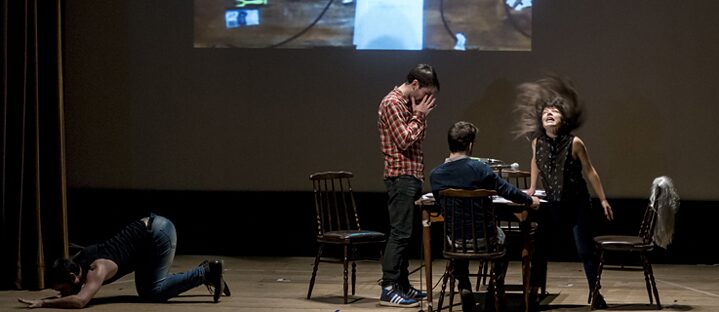
Terezia Mora: Day in Day Out
Abel Nema isn’t an easy man to pin down. This impassive and enigmatic character at the centre of Mora’s narrative inspires equal parts of admiration and annoyance in those he encounters. His elusive nature makes him a constant subject of conjecture and suspicion among his acquaintances, as they project and ascribe all sorts of motives onto this seemingly empty vessel whose silence speaks volumes. Apart from a few snippets about his past, the reader’s impression of Abel is largely formed through the eyes and opinions of others.
Born and raised in the Balkans, Abel is thirteen when his “alien orphan” father unexpectedly abandons him and his mother, never to be heard from again. Five years later and still smarting from the unrequited love of his best friend Ilia, Abel goes in search of his estranged father and meets instead with an accident, which increases his appetite and aptitude for languages but deadens some of his sensory perceptions, particularly those of smell and taste.
With the threat of national service looming and his recent heartbreak, Abel leaves the Balkans to pursue his love of language in central Europe. Although the incredibly introverted nineteen-year-old never goes in search of company, a string of troubled souls inevitably seeks him out, including the unofficial landlord of Abel’s student digs, Konstantin, the attention-seeking and aging groupie Kinga and her band of musicians, and the downtrodden and troubled teen Danko. The linguist finds some sense of normalcy when he meets teacher and single mother Mercedes, who continues her streak of being unlucky in love when she enters into a “fictive marriage” with Abel, and ends up falling for him until she discovers his sexual secret.
Abel’s aptitude for language seems to come at the expense of his ability to engage with others. His aloof and anti-social air leaves others to question why he has such a passion for languages when he barely speaks. With a surname that means mute, Abel is the only character who never ‘voices’ an opinion. This boy from the Balkans is an alien who seems to have nothing of note to define him; no discernable accent, no romantic attachments, no interests (other than languages), and after the post-war break up of the Balkans no country to call home. “He speaks like a person who comes from nowhere”, remarks his referee Professor Tibor. Abel’s aimlessness is exemplified in his lack of geographical direction, another side effect from the accident, whereby the only way he can orient himself is to follow others. Always watching from the sidelines, rather than actively participating, he has even earned the nickname of ‘the spy’ at the sex club he frequents, where he drinks to excess but never gets drunk.
It is not until Abel ingests a hallucinogenic substance that for the first time in 13 years we see shades of his humanity. Given the suspicion that his silence and secretiveness arouses in others it’s not surprising that part of his drug-induced hallucination is played out in a courtroom, where his points of difference, namely his homosexuality and anti-social tendencies are put on trial.
The appearance of these revelations at the three-quarter mark may seem too little too late for readers who have been kept at arms length from the inner workings of the central character for 400 pages of the 418-page book. In a novel that is about social expectation and projection, Mora defies the usual convention of privileging the reader with a lot of extra information, proving that there is a thin line between the characters’ expectations of Abel and our own. Similarly, the Hungarian author also plays with reader expectations in her use of multiple narrators, replete with abrupt shifts between first and third person, which, together with a fractured chronology force the reader to work hard to keep apace with the constant shift in time and voice.
As a fellow translator, Mora would have presented Michael Henry Heim with an unenviable task, one that for the most part he has handled with aplomb. For her part, Mora has created a complex, highly accomplished and multifaceted novel that is at times a little too clever and chaotic for its own good and will undoubtedly alienate less patient readers, but proves a rewarding for those who can look beyond its artifice.
The Book
Mora, Terezia: Day In Day Out / transl. by Michael Henry Heim . - New York : Harper, Perennial, 2007. - 432 S.
ISBN 978-0060832643
Original title: Alle Tage (German)