50 Years Goethe-Institut London 1962-2012

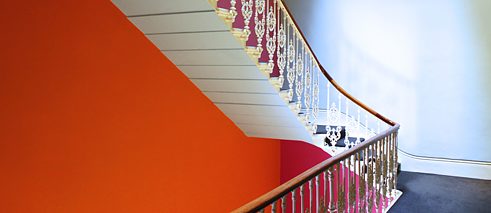
This year the Goethe-Institut in London celebrates both its 50th anniversary and the re-opening of its newly restored building. To mark the occasion a work has been commissioned from German artist Gloria Zein, winner of the 2011 Cass Prize for Sculpture. Zein’s intervention I Can’t Stop The Dancing Chicken explores both the inside and outside of the institute and includes a series of film screenings in May and June.


History

Plans for a German cultural institute in London formally began in 1955, and temporary premises were established the following year in a wing of the German Embassy at 21-23 Belgrave Square. A proposal to acquire 51 Princes Gate as the future seat of the German cultural institute was submitted to the Foreign Ministry and in 1958 the site was officially named the German Cultural Institute London, before being handed over to the Goethe-Institut in 1962.

1970s

Renoviertes Auditorium des Goethe-Instituts, 1978
Newly refurbished auditorium
of the Goethe-Institut London, 1978
In 1972, the German Foreign Ministry purchased the adjacent building at 50 Princes Gate with the aim of joining the two buildings in a future development. In the interim, gallery owner and curator Sigi Krauss was invited to develop and implement an exhibition programme, which soon became known as Gallery House. Krauss insisted that the gallery never close, never charge admission, and never censor artists. The inaugural show included works by Stuart Brisley, Gustav Metzger, and Marc Chaimowicz, who were soon followed by Jörg Immendorff, Sigmar Polke, Ulrike Rosenbach and Jeffrey Shaw.

In 1975 the house at 50 Princes Gate was rebuilt and connected up to number 51, providing the institute with its own exhibition space and auditorium and enabling it to broaden its cultural and educational programmes.

1980s

In the 1980s, the focus of the institute’s cultural programme was on promoting new German films and contemporary German drama, as well as working with British schools on theatre for children and young people from Germany, and programming conferences on topical socio-political themes. In 1981-82, the programme of guest performances was expanded to include the Tanzforum Cologne, the Stuttgart Ballet and Pina Bausch’s Wuppertaler Tanztheater. There was also a successful annual programme of 10-15 art and documentary exhibitions in this period, increasing the emphasis on visual arts.

During this period the Goethe-Institut library, with its focus on literature, arts, philosophy and contemporary history, enjoyed great popularity and lent up to 16,000 books a year. Language learning at the Goethe-Institut consisted of up to 40 courses per year attended by 700-800 participants.

1990s to present day

Renovierter Kinosaal, Goethe-Institut London, 2000; Copyright: Goethe-Institut
Refurbished cinema,
Goethe-Institut London, 2000
The 1990s saw the first plans to modernise the building, visibly altering the external appearance of the Institute and opening it up to the general public.

In recent years, in house exhibitions have concentrated principally on presenting photography by young German artists and other underrepresented areas of German culture.