Navjot Altaf
A Cognitive Process (2020-2021)
Photo prints on Plexiglass, 23.6 x 16.6 inches / 60cm x 42cm.
These have evolved from Altaf’s interest in exploring the concept of ecological democracy in relation to representative democracies that we have been experiencing and are domineering and unjust. They not only exclude other life forms or organisms on the planet but marginalize certain sections of human society as well. During the pandemic, I became curious as to how our lives and lives of animals and plants etc. depend on democratic principles of communication - how the loss of diversity and extinction of various species is also happening to the human microbiota, which affects our health and well-being - as microbiotas are present in every living being.
A critical reflection on the human struggle of achievements is not isolated from a simultaneous breakdown of the environment, conflicts and the contradictions between the warning signs by environmental scientists alongside peoples’ lived experiences and actions of people in power, including the politics behind it. It is how the procedures of urbanization have come with a blend of environmental disturbances and alternations and how all alternations or modifications have not been beneficial.
Water Flows 2021 -Video [ on the left monitor ]
Single projection video, 75 minutes, colour, sound, loop
Water flows, a work in process is about the citizens’ collective attempt to use their rights to save, restore and develop open spaces for public use through democratic procedures, with the objective to integrate people and nature. A close relationship between people and nature when seen historically has always existed. The concern is to work towards sustainability and a sustainable ecology in Mumbai, where 30 percent of the city comprises of natural areas closely associated with land mass, “if these are integrated, it opens new ways of looking at the idea of open spaces, not what is reserved in development plans but the idea of natural areas forming an idea of open spaces and people beginning to relate to them in order to understand the value of them… and participate in decision making”. [P.K Das]
Body City Flows 2015 -Video [ on the right monitor ]
Single projection video, 18 minutes, Colour, sound, loop
Body City Flows attempts to address how the flow of river water is impacted by the abuse and appropriation of natural resources in Mumbai, which has 4 river basins. Altaf sees a link in flow of rivers their tributaries and the human body's vascular system – its veins and arteries.
To create a better perception of flow of life both in terms of the human body and natural environment- apart from the material researched and shot on 4 rivers [ Mithi, Poiser, Oshiwara and Dahisar], footage of blood flow and blockages in the human body obtained from medical practitioners and the hospitals- the video also includes animation on blood flow specially done for this work and a conversation with Dr. Modak (founder of Ekonnect Knowledge Foundation) on Mumbai’s present day water situation.
The body’s veins, a tree’s roots and river’s delta visually convey a sense of the timelessness of similar shapes. The rivers are like the blood in the veins or the roots under trees, because they support life and provide sustenance. And because of their organic connection with the earth and water, civilizations have thrived off the river system. In the metaphorical sense rivers have been compared with the soul, like implying the endless quest for roots or routes of knowing and perceiving nature. Here I intend to bring things full circle by connecting bodily blood flow to the present system of water supply and the state of flow of the four rivers in Mumbai .
Location: Gallery MMB, Goethe-Institut / Max Mueller Bhavan Mumbai
 © Navjot Altaf
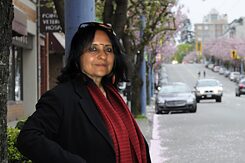
Navjot Altaf (b.1949) is a transcultural artist, whose inventive multi-media work reflects political and aesthetic concerns that have been informed by dialogical ways of working. Her practice is located in the metaphor of flow – across materiality and theory, across place and people, and in finding a transdisciplinary perspective where inquiry and self-inquiry intersect. Her ideological positions move from Marxism in the 1970s, to feminism in the 1980s-1990s, and eco-feminism from early 2000 onwards, critically examining the intersectionality between natural systems, community growth, and development.
© Navjot Altaf
Navjot Altaf (b.1949) is a transcultural artist, whose inventive multi-media work reflects political and aesthetic concerns that have been informed by dialogical ways of working. Her practice is located in the metaphor of flow – across materiality and theory, across place and people, and in finding a transdisciplinary perspective where inquiry and self-inquiry intersect. Her ideological positions move from Marxism in the 1970s, to feminism in the 1980s-1990s, and eco-feminism from early 2000 onwards, critically examining the intersectionality between natural systems, community growth, and development.
With a sustained engagement with indigenous cultures, local knowledge systems, ecology and social justice, her intellectual trajectory, like her creative process, has been shaped by life experiences and theoretical readings. It has been marked by complexities, conflicts, and imaginative turns. From a formalist training in Western modernism, her quest has been to find a conceptual and artistic language through forms of “critical emplacement” or experiential belonging in various locales. This has prompted her to work in Bombay and Bastar, to engage with an Adivasi life-world, Adivasi artists, as well as artists and researchers from other parts of India and beyond.
Her extensive dialogues with Adivasi communities and artists led to the co-founding of the Dialogue Interactive Artists’ Association (DIAA, 2000) in Kondegaon, Bastar, which focuses on enabling an inclusive and experimental platform for equal aesthetic rights, while probing systems of knowledge production. Her engagement through research and practice has been to understand the relationship between deep ecology, sustainability, and spirituality with an emphasis on environmental philosophy. In retrospect, she has envisioned inquiry as an ongoing process in dialogue with diverse modes of creative thought.
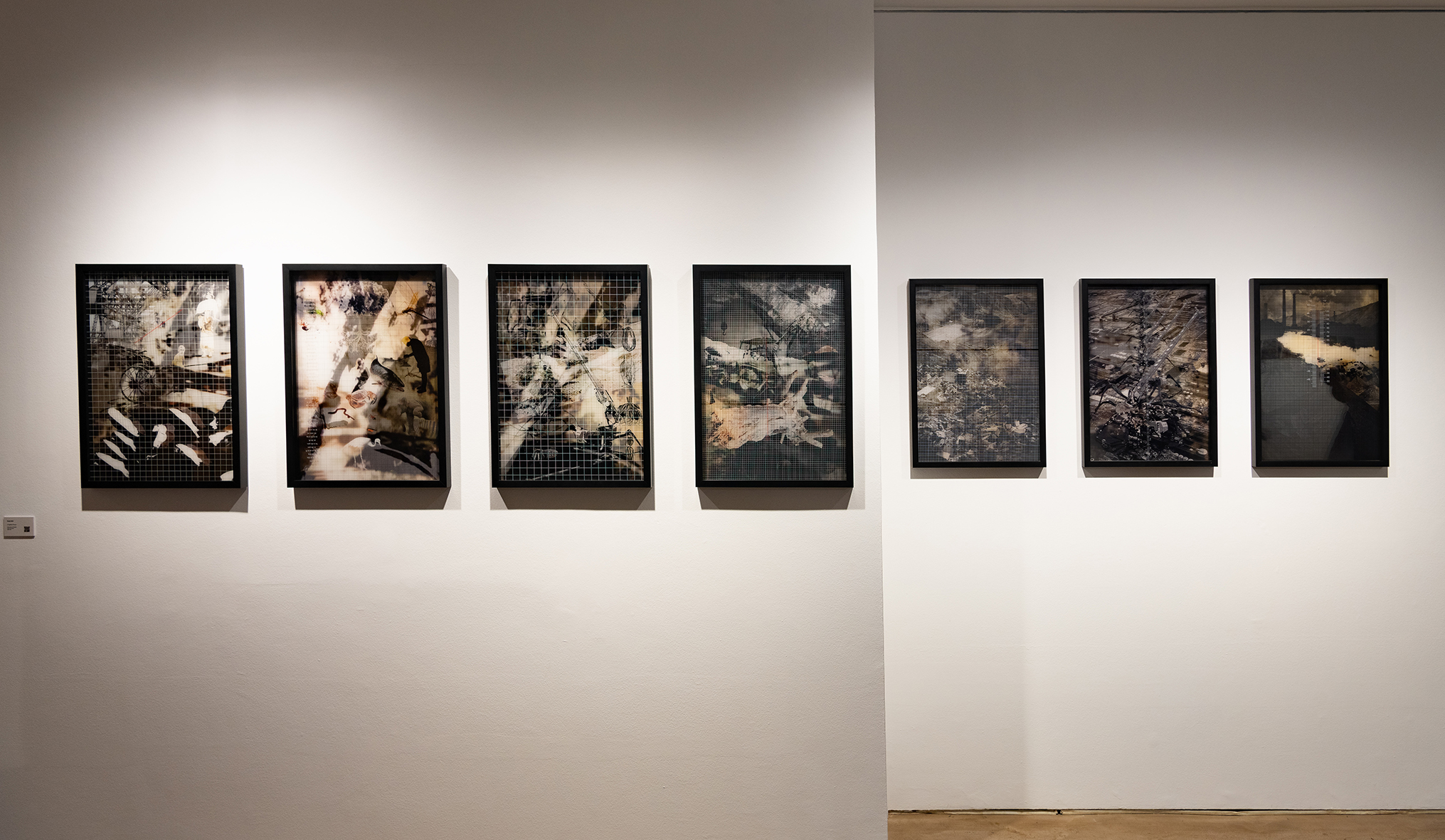
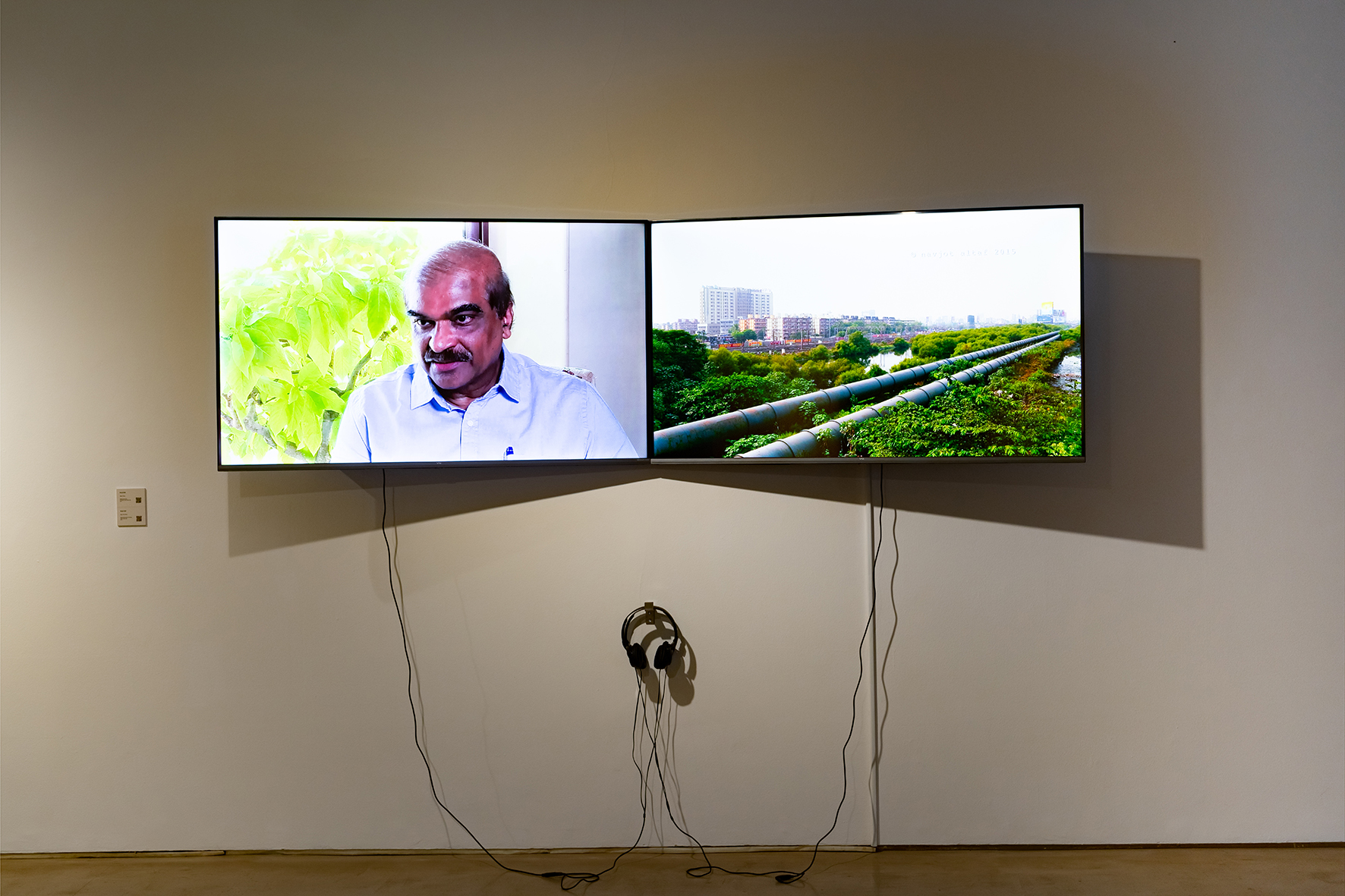
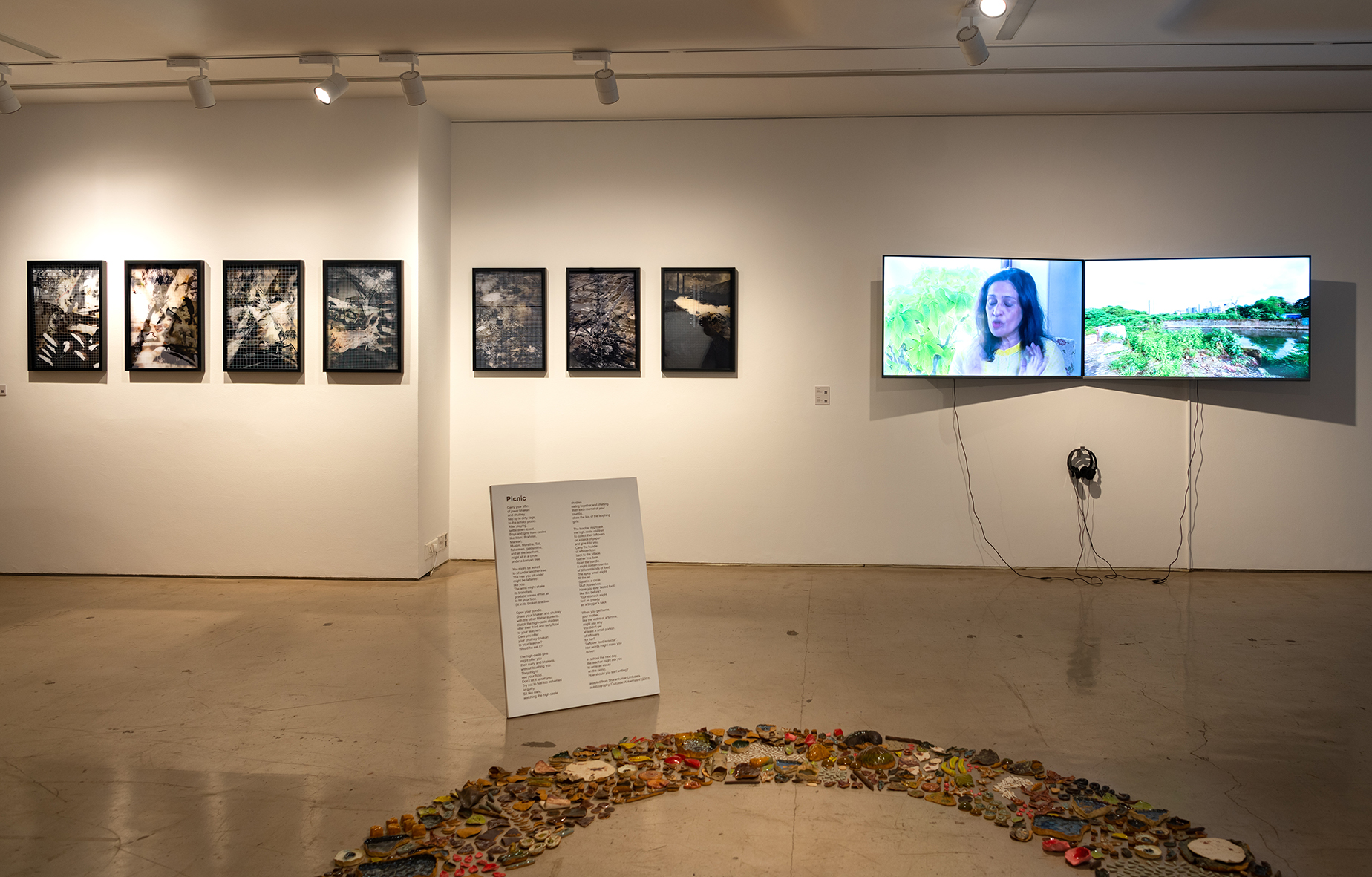
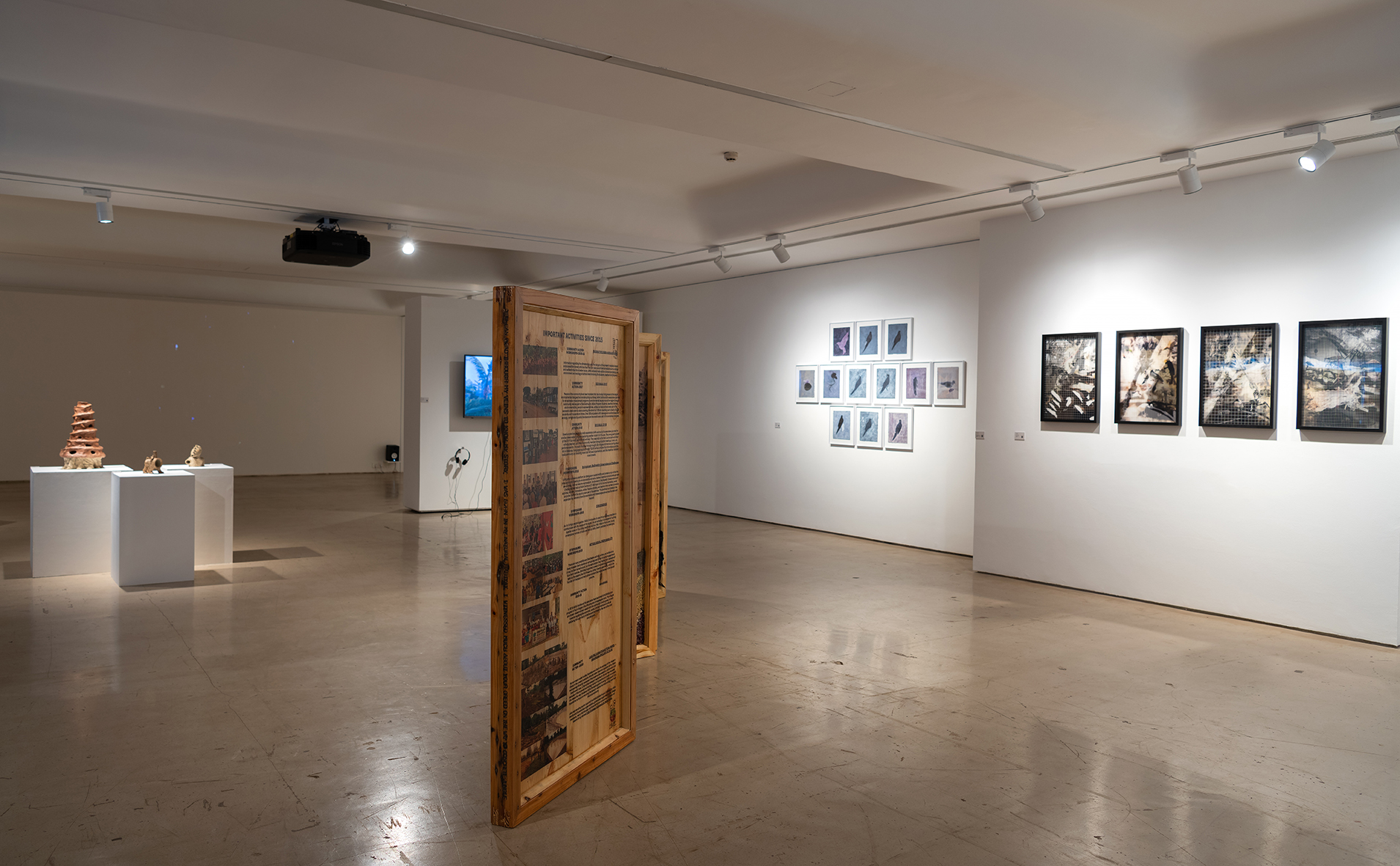
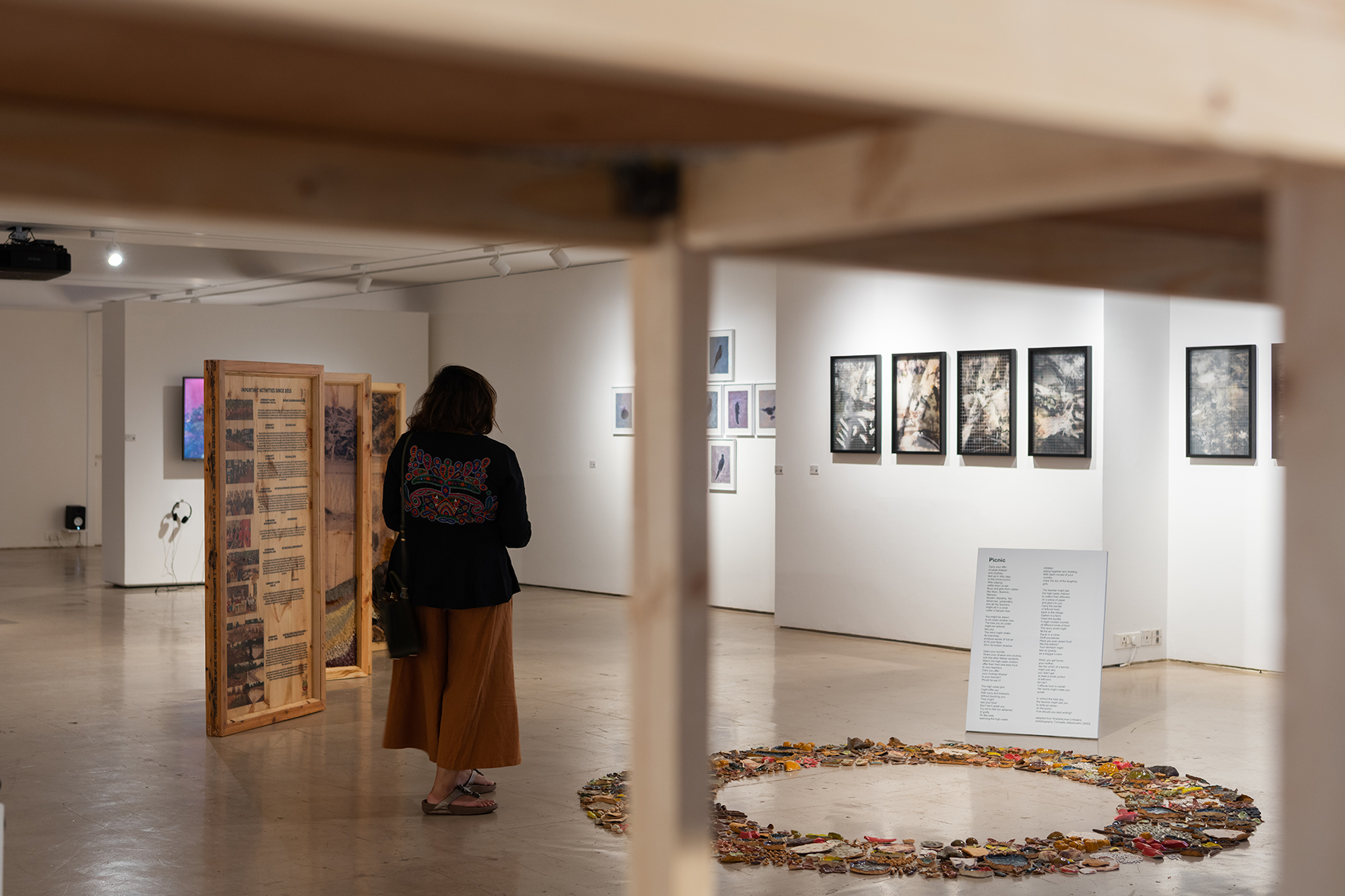
Photo prints on Plexiglass, 23.6 x 16.6 inches / 60cm x 42cm.
These have evolved from Altaf’s interest in exploring the concept of ecological democracy in relation to representative democracies that we have been experiencing and are domineering and unjust. They not only exclude other life forms or organisms on the planet but marginalize certain sections of human society as well. During the pandemic, I became curious as to how our lives and lives of animals and plants etc. depend on democratic principles of communication - how the loss of diversity and extinction of various species is also happening to the human microbiota, which affects our health and well-being - as microbiotas are present in every living being.
A critical reflection on the human struggle of achievements is not isolated from a simultaneous breakdown of the environment, conflicts and the contradictions between the warning signs by environmental scientists alongside peoples’ lived experiences and actions of people in power, including the politics behind it. It is how the procedures of urbanization have come with a blend of environmental disturbances and alternations and how all alternations or modifications have not been beneficial.
Water Flows 2021 -Video [ on the left monitor ]
Single projection video, 75 minutes, colour, sound, loop
Water flows, a work in process is about the citizens’ collective attempt to use their rights to save, restore and develop open spaces for public use through democratic procedures, with the objective to integrate people and nature. A close relationship between people and nature when seen historically has always existed. The concern is to work towards sustainability and a sustainable ecology in Mumbai, where 30 percent of the city comprises of natural areas closely associated with land mass, “if these are integrated, it opens new ways of looking at the idea of open spaces, not what is reserved in development plans but the idea of natural areas forming an idea of open spaces and people beginning to relate to them in order to understand the value of them… and participate in decision making”. [P.K Das]
Body City Flows 2015 -Video [ on the right monitor ]
Single projection video, 18 minutes, Colour, sound, loop
Body City Flows attempts to address how the flow of river water is impacted by the abuse and appropriation of natural resources in Mumbai, which has 4 river basins. Altaf sees a link in flow of rivers their tributaries and the human body's vascular system – its veins and arteries.
To create a better perception of flow of life both in terms of the human body and natural environment- apart from the material researched and shot on 4 rivers [ Mithi, Poiser, Oshiwara and Dahisar], footage of blood flow and blockages in the human body obtained from medical practitioners and the hospitals- the video also includes animation on blood flow specially done for this work and a conversation with Dr. Modak (founder of Ekonnect Knowledge Foundation) on Mumbai’s present day water situation.
The body’s veins, a tree’s roots and river’s delta visually convey a sense of the timelessness of similar shapes. The rivers are like the blood in the veins or the roots under trees, because they support life and provide sustenance. And because of their organic connection with the earth and water, civilizations have thrived off the river system. In the metaphorical sense rivers have been compared with the soul, like implying the endless quest for roots or routes of knowing and perceiving nature. Here I intend to bring things full circle by connecting bodily blood flow to the present system of water supply and the state of flow of the four rivers in Mumbai .
Location: Gallery MMB, Goethe-Institut / Max Mueller Bhavan Mumbai
About the artist
© Navjot Altaf
Navjot Altaf (b.1949) is a transcultural artist, whose inventive multi-media work reflects political and aesthetic concerns that have been informed by dialogical ways of working. Her practice is located in the metaphor of flow – across materiality and theory, across place and people, and in finding a transdisciplinary perspective where inquiry and self-inquiry intersect. Her ideological positions move from Marxism in the 1970s, to feminism in the 1980s-1990s, and eco-feminism from early 2000 onwards, critically examining the intersectionality between natural systems, community growth, and development. With a sustained engagement with indigenous cultures, local knowledge systems, ecology and social justice, her intellectual trajectory, like her creative process, has been shaped by life experiences and theoretical readings. It has been marked by complexities, conflicts, and imaginative turns. From a formalist training in Western modernism, her quest has been to find a conceptual and artistic language through forms of “critical emplacement” or experiential belonging in various locales. This has prompted her to work in Bombay and Bastar, to engage with an Adivasi life-world, Adivasi artists, as well as artists and researchers from other parts of India and beyond.
Her extensive dialogues with Adivasi communities and artists led to the co-founding of the Dialogue Interactive Artists’ Association (DIAA, 2000) in Kondegaon, Bastar, which focuses on enabling an inclusive and experimental platform for equal aesthetic rights, while probing systems of knowledge production. Her engagement through research and practice has been to understand the relationship between deep ecology, sustainability, and spirituality with an emphasis on environmental philosophy. In retrospect, she has envisioned inquiry as an ongoing process in dialogue with diverse modes of creative thought.