

About the project
DATAS: The Data and the Sovereign is a collaborative cultural programme that brings together a network of partners from across Europe to critically examine how computation, automation, and digital infrastructures are eroding both personal and state sovereignties. In an age where big data corporations and algorithmic systems increasingly shape global political and social dynamics, DATAS uses the lens of art to challenge the normalization of surveillance, data extraction, and digital control. Through interdisciplinary artistic exchange and collective inquiry, the programme creates space for questioning, resistance, and reimagining of these complex realities.
The programme consists of several interlinked outcomes: a transnational residency involving eight artists from seven countries, expert mentorship throughout the creative process, a major group exhibition at Galerie Rudolfinum (June 2026), and a final publication that will document the research, artistic practices, and thematic explorations developed over the course of the project. More than a residency, DATAS is a platform for dialogue between artists, theorists, technologists, and the public — cultivating cultural awareness and critical engagement in the age of surveillance capitalism.




Curatorial Concept: The Data and the Sovereign (DATAS)
Computation and automation are reshaping global political dynamics, challenging established sovereignties and necessitating a fundamental shift in our understanding of politics. The rise of algorithmic influence on our decisions based on rapidly evolving AI technologies prompts questions about preserving personal and national sovereignties in a post-surveillance information society, and the role of art in reflecting this shift.Establishing technological sovereignty becomes essential for preserving democracy, countering the trend of individuals being treated as mere users and commodities by the extractivist tech industry, while autocratic tendencies disguised as protection of the sovereign state are one the rise.
It is a topical question whether, and how, we define our personal and national sovereignties in the era of surveillance capitalism and technofeudalism. And it implies others, such as: How shall we delegate decision-making to partly or entirely automated, statistically-driven software capable of machine learning, while keeping an acceptable degree of self-determination intact? How can digital disobedience—such as data camouflage or misdirection—be mobilized as a viable strategy of resistance in an age of ubiquitous surveillance? What forms of sovereignty are possible when borders, governance, and identities are increasingly encoded in and administered by computational infrastructures? How do algorithmic systems reconfigure the emotional terrain of public discourse, and what agency remains when affect is weaponized through synthetic voices and inauthentic actors? How do we confront the spectral remnants—corrupted data, partial archives, invisible subjects—left behind by surveillance regimes that target marginalized communities under the guise of security? How do we confront the spectral remnants—corrupted data, partial archives, invisible subjects—left behind by surveillance regimes that target marginalized communities under the guise of security? What does bodily and technological sovereignty mean in a future where care, control, and automation are indistinguishably entangled? How might fictional geographies, error zones, and haunted datasets function as counter-territories—imagined or real—against the extractive logic of digital empires?
We believe artistic projects can foster awareness and drive shifts in the relationship between technology and power. We invite artists to engage with information technologies as integral to society rather than as mere tools.
The Data and the Sovereign was conceived as an assembly of people, artworks, artifacts, and texts that enable experiments of rewriting the manifold systems of sovereignty.
Just as beast and sovereign [1] are above the law, so too are today’s rapidly advancing information technologies. The new opportunities for statistical analysis afforded by big data, network externality, self-produced online traces, user profiling, micro-targeting, and real-time supercomputing leave the average citizen with little hope of directly and imminently grasping the ‘social reality’.
At this point, it seems clear that the establishment of technological sovereignty is the very basis for maintaining democracy as we know or imagine it. People who use information technology are increasingly defined as users, and ultimately, as the product itself, contributing monetizable data and even labour to the profit of tech companies. Though not a new idea, the option of making self-determined choices that impact and shape both individual technologies, and the social and economic processes in which they are embedded, is still more wish than reality.
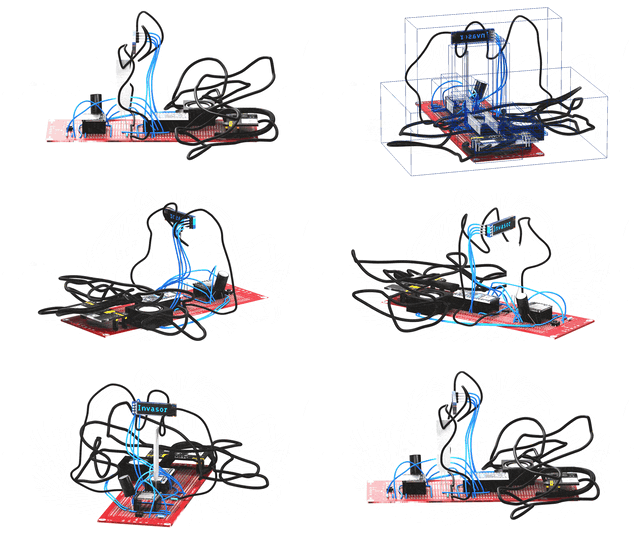
Artistic projects produced and presented as part of DATAS aim to raise awareness and foster a much-needed shift in how we understand the entangled relationship between technology and power. They engage critically with the entangled dynamics of technology and power, offering speculative and research-driven responses to our algorithmically mediated reality. These works propose future-oriented political imaginaries that confront pressing global challenges—from the ecological crisis and AI governance to disinformation and the erosion of sovereignty. Through diverse media forms including film, interactive installation, and web-based interventions, they adopt strategies such as reimagining decision-making from fictional futures, repurposing technological infrastructures, and reclaiming data agency. Some construct immersive environments or digital counter-geographies that resist surveillance and centralized control; others expose the emotional architectures of propaganda, or critique the mythologies of self-sustaining techno-utopias. Collectively, these projects function as world-building exercises—speculative, resistant, and materially grounded—imagining ethical alternatives to dominant sociotechnical systems.
Openness, commoning and common sense-making is part of the curatorial method of DATAS, ensured by an open call for artists and constant exchange between the partners, invited experts, and the curator of the project.
The residency programme encourages applicants to explore sovereignty in relation to contemporary information technologies and to envision how these concepts can be expanded. Rather than seeking a single answer, artists are welcome to shed light on diverse perspectives and solutions. During the residencies, participants will develop artworks that engage with the project’s core questions. Existing projects may also be further developed within this framework.
The outcomes will be presented at the hosting institutions and may be included in a final exhibition at Galerie Rudolfinum in Prague. The residencies provide artists working in the field of contemporary art from the Central and Eastern European, and Southern Caucasian region with the opportunity to live and work in Ljubljana, Tallinn or Prague for a period of two to three months, or to accomplish their residency online.
DATAS aims at catalysing artistic exploration with engaging experts. The resident artists will have the opportunity to collaborate with theoreticians, artists, and scientists who play a multifaceted role. Their input shall not be limited to mere technical guidance but extends to sparking dialogues, igniting debates, and thought-provoking discussions. They become catalysts for the development of artworks that contribute to the broader discourse on art, technology, and societal transformation. They are not just advisors; they are collaborators who help shape the artistic journey and amplify the impact of our residency project.
DATAS goes against the process of knowledge disintegrating into information with the presentation of artworks, accessible discourses, and a publication that gathers various approaches to the subject. In DATAS curatorial work and artistic production catalysed by the support of experts, inevitably omits sheer representation of reality and turns to the constructivist approach of building new worlds. These worlds are models and emulations of life-worlds, as well as prefigurations, or prototypes of possible future ones.
DATAS is an assembly convened to amplify marginalized voices from Central and Eastern Europe, and Southern Caucasus that reflect the relationship between the self, technology, and power.
Artistic Director

Currently, she serves as curator for ARE YOU FOR REAL, a hybrid platform for transnational dialogue on digital world-making, exploring the influence of science and computation, organized by IFA – Institut für Auslandsbeziehungen.
As of 2023, she has taken on a lecturer role in curation and media practice at University College London’s Department of Culture, Communication & Media, and she contributes to the research project *Paik Replayed* at ECAL Lausanne as both curator and researcher.