
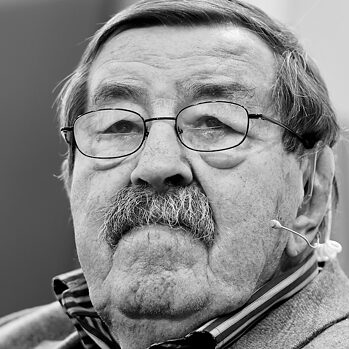
 Photo (Detail): © dpa
Günter Grass
(born 16.10.1927 in Gdansk; died 13.04.2015 in Lübeck), author, graphic designer
Günter Grass studied graphic design and sculpture in Düsseldorf and Berlin. His first publications as an author after 1956 were short prose works, poems and theatre plays. His literary breakthrough came in 1959 with the novel "Die Blechtrommel" (The Tin Drum). It was the first part of the Danzig Trilogy, which was completed by the books "Katz und Maus" (Cat and Mouse; 1961) and "Hundejahre" (Dog Years; 1963). In these and later works, Grass looks at the background and consequences of National Socialism, as well as asking questions about remembering, forgetting and guilt. He was involved with the SPD for many years and expressed his political views on a number of matters openly. Günter Grass received many awards for his extensive work, including the Georg Büchner Prize in 1965 and the Nobel Prize for Literature in 1999. His role as moral authority was highly controversial when it was later disclosed that he had been a member of the Waffen SS. Günter Grass is considered an important author in German post-war literature.