
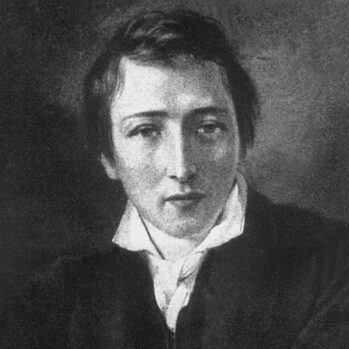
 Foto (Ausschnitt): dpa - Bildarchiv
Heinrich Heine
(born 13.12.1797 in Düsseldorf; died 17.02.1856 in Paris), author, journalist
Heinrich Heine began an apprenticeship as a merchant in 1816, under his uncle Salomon Heine in Hamburg. His first poems were published in 1817 in the magazine "Hamburgs Wächter" (i.e. Hamburg's Watchmen). From 1819 to 1825 he studied law in Bonn, Göttingen and Berlin. In 1824 the "Dreiunddreißig Gedichte" (Thirty-three Poems) collection was published, which contained "Die Loreley", still Heinrich Heine's most popular poem. The travel journal "Die Harzreise" (The Harz Journey) was published in 1826 and made him known to a wide readership, In 1827 the publisher Hoffmann und Campe published an anthology of all the poems Heinrich Heine had written up to that point under the title "Das Buch der Lieder" (Book of Songs). Suffering increasing hostility because of his Jewish origins and political views, Heine migrated to Paris in 1831, where he worked as correspondent for the Augsburger Allgemeine Zeitung newspaper. In 1835 the works of Heine were banned in Germany because of a Bundestag resolution against "Junges Deutschland". One of his late publications was published in 1844 under the title "Deutschland – ein Wintermärchen" (Germany – A Winter's Tale). Heine became increasingly bedridden due to an incurable disease, even though he continued his writing activities. After his death he was buried at the Montmartre Cemetary in Paris. As one of Germany's most important poets Heinrich Heine had a lasting influence on the German language. Coming from the Romanticism tradition, he was considered to be a conqueror of this literary genre. His extremely diverse and artistic work, which encompasses poetry, prose, polemics and journalistic texts, includes such diverse material as the revolutionary ideas of the Vormärz and elements of the Enlightenment and Realism.
Universität Trier, Heinrich Heine Portal