
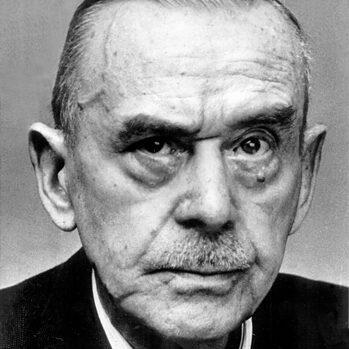
 Photo (Detail): © dpa - Bildarchiv
Thomas Mann
(born 06.06.1875 in Lübeck; died 12.08.1955 in Zurich), writer.
Thomas Mann's first novella Gefallen appeared in 1894 in the magazine Die Gesellschaft. Because it was a success, Mann gave up his job at a Munich insurance company and worked as a freelance writer from then on. His first novel, Die Buddenbrooks, was published as early as 1901 and met with an extremely positive response, culminating in the award of the Nobel Prize in 1929. His novellas such as Tonio Kröger, Death in Venice and Mario und der Zauberer were also widely praised. The novel Der Zauberberg, published in 1924, continued the tradition of the European Bildungsroman, among other things with the means of critical irony. Thomas Mann made himself heard with his statements on current political, social and cultural issues. While he was still sceptical of Western democracy in his 1918 Betrachtungen eines Unpolitischen, he later became a defender of the Weimar Republic, for example in his speech Von deutscher Republik, delivered in 1922. During the Nazi regime, he emigrated to Switzerland in 1933 and to the USA in 1938, where he became a citizen in 1944. From 1940 to 1945, his monthly radio speeches German Listeners were broadcast to Germany via the BBC. He lived in Switzerland again from 1952. The numerous honours bestowed on Thomas Mann, one of the most important and prolific storytellers of the 20th century, include many honorary doctorates from universities, but also honorary citizenship of his native city of Lübeck, which he was able to revisit shortly before his death.