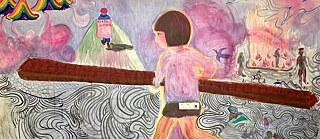
Lost at Home
Conversations with Returnee Cultural Practitioners

Alleinsein: Einsamkeit & Freiheit © Everyday Practice


The “Lost at Home” project explores a specific “diasporic” experience: the current situation facing cultural practitioners who have chosen to return to China after living abroad. Here, “diaspora” signifies not only geographical migration but also a persistent cultural and psychological state—reflected in how, upon returning to their homeland, they must confront institutional differences, negotiate multiple identities, and construct a “middle ground” between the local and their past diasporic experiences, responding to the sense of foreignness in the here and now.

This interview series is part of the Goethe-Institut’s East and Central Asia regional project “Solitude: Loneliness & Freedom,” conceived by Jenny Jiaying CHEN and co-curated with CHEN Yun, which sets out to offer alternative narratives of “diaspora.” The interviewees span multiple generations and come from various Chinese cities. They went to live overseas for academic, family, or institutional reasons or through the whims of fortune and returned by choice or impelled by necessity or a sense of belonging. They all share a deep connection with Shanghai. These interviews ask, What drives these creators to make their choices within an increasingly constrained cultural environment? How do they navigate institutional differences and personal shifts after returning? This not only traces their paths from diverse backgrounds to the current intersections of art, culture, and thought but also reveals the practical strategies they continue to explore in today’s China in a rapidly changing world—strategies that are neither passive submission nor complete escape but rather efforts to “re-embed” cultural freedom. As CHEN Yun suggests, these dialogues do not offer simple answers but open up space to reflect on “roots” and how the next generation of cultural workers might emerge with new perspectives and methods.
 

Interviewer

Interviews

  • Interview with Ara Yun Qiu

    Seeking a creative life with a sense of diaspora

    Moving between Beijing, New York, Shanghai, Berlin, and Haikou, curator Ara Yun Qiu’s trajectory has slowly woven a personal diasporic landscape. During our interview, she leads us through her journey in an extremely subtle way and responds to the question preoccupying many women art practitioners today: How can we work, live, and love?

    Ara Yun Qiu © Ara Yun Qiu © Ara Yun Qiu

  • Interview with yy?

    Feeling the granularity of pain

    Taking conflicts with “family” as a starting point, yy? reflects on childhood memories, gender suppression, and relational structures and the gradual building of her sense of political consciousness during her years abroad. In the face of structural disempowerment and cultural displacement, she responds to reality with honesty and self-sufficiency, rendering the emotional contours visible through art.

    Eyesore © yy? © yy?

  • Interview with Alice Chen

    "Retreat is a rigorous and determined artistic method"

    From Yiwu to Beijing, and then to a peripatetic life as part of a diplomat’s family, her trajectory flows like a side stream through the history of contemporary Chinese art: atypical yet profoundly contemporary. Her practice demonstrates a subtle form of persistence, beginning with personal experience and ultimately unfolding into a gentle sense of the collective.

    AC_03 Image courtesy of PARC. Image courtesy of PARC.

  • Interview with Lilin

    Holding the Knife, Venting the Fire

    The trajectory of artist Lilin, from Dalian to Shanghai, reveals an alternative narrative of diaspora—one defined not by cross-border migration but by deliberate movement and self-reinvention within China’s urban landscape. Her story raises a universal question: When former modes of life and work become untenable, how does one seek out new tools and spaces—and, in the process, rediscover where one belongs?

    LL_05 © Lilin © Lilin

  • Interview with Liang Jie

    Seeking a creative life with a sense of diaspora

    From the alleys of Shanghai to universities in Australia, from a Go “child prodigy” to an economics scholar, Liang Jie’s trajectory reflects the intellectual journey of a Shanghai-born intellectual of the 1980s generation. Amid increasingly specialized academic systems and increasingly superficial public discourse, Liang strives to maintain a delicate balance—neither abandoning scholarly rigor nor losing touch with the real world.

    Liang Jie © Liang Jie © Liang Jie

  • Interview with Yang Yang

    Where there are no walls, put windows. Where there is wilderness, light fires.

    Yang Yang’s journey from Xi’an to New York and eventually to Shanghai, her shift from music to documentary filmmaking, and her Jilu Commune project epitomize the transnational and transdisciplinary mobility of contemporary culture. Her personal trajectory mirrors the development and choices of China’s post-’90s generation against the backdrop of rampant globalization and the hardscrabble realities of independent cultural production within modern social structures.

    YY_07 © Yang Yang © Yang Yang

Folgen Sie uns