Vitjitua Ndjiharine – An Artist on the Move
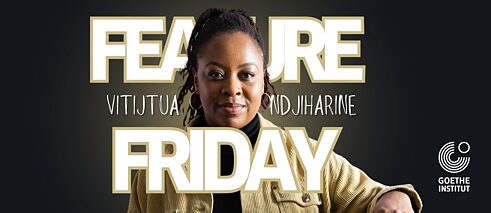
As an artist, Namibian Vitjitua Ndjiharine has so far lived and worked on three continents. Change has been her constant companion from an early age, which has had an impact on both her technique and her thematic work. She is now an internationally renowned representative of Namibian art and her work always reflects her Ovaherero roots. In the third part of our ‘Feature Friday’ series, we accompanied Vitjitua on her latest art project.
After school, she initially returned to the United States, where she had to answer the question for herself whether art could also be a career for her. ‘You might as well do what you feel drawn to do and what you feel called to do,’ she says, looking back on her decision. But not without a plan. ‘I thought to myself, at least at the very least I can study art, learn some art techniques, and then combine that with something digital like programming or web design.’ But things turned out differently, thanks in part to her fascination for Namibian history.

From university to first residency
Towards the end of her studies in New York, someone sent her a call for proposals for a project in Hamburg, Germany. Namibian historians and artists were sought to work on a project dealing with a colonial photo archive in the Markk Museum. It was the perfect opportunity at the perfect time for Vitjitua: ‘Shortly before seeing that call, I had already been working on this collage series. I was kind of juxtaposing various images with colonial images of Namibia that I could find online.’ She submitted the collage, which resulted in a one-year residency in Germany. Another move. And a project that continues to shape her artistic focus to this day. ‘I didn't realise that going into an archive and crossing out racist words that describe somebody in a photograph is decolonizing,’ says Vitjitua. To this day, she therefore classifies her work under the themes of decolonisation and postcolonialism. ‘I would say my work is really about memory, memory, culture and remembrance,’ she adds. In doing so, she primarily deals with the culture and tradition of the Herero.Further residencies in Germany and Switzerland followed. ‘This decolonial work is something that has sprung up in the last couple of years. It's also sort of influenced by the politics that are happening within Germany and all of these different conversations that are coming to the forefront,’ Vitjitua continues. However, she does not see herself as thematically constrained by this international attention and refers to a project by the Goethe-Institut. Under the title "German Colonial Heritage in Africa: Artistic and Cultural Perspectives,‘ a comprehensive study was published in 2018 on artistic productions dealing with Germany's colonial past in Africa. ’We've been doing this way before and probably will continue to do it, and it can always be reframed in so many different ways," Vitjitua concludes.

Vitjitua Ndjiharine and her Spanish colleague Rocío Asensi at a joint exhibition opening in Windhoek | © Adam Smaruj / StoryWorks
Ovaherero traditions and radically positive visions for the future
However, this does not mean that she does not want to explore other artistic avenues beyond this topic. ‘As an artist, I always want to have opportunities and to challenge myself and to try new techniques and new ways of working.’ So in 2025 she became part of the EUNIC project ‘Solarpunk: A Story of Sand and Energy’. Instead of looking at historical events, this project aimed to create a radically positive vision of the future for Namibia. Together with Spanish artist Rocío Asensi, she drew on indigenous cosmologies and everyday behaviours to articulate her ‘future present’. ‘It was a challenge,’ she admits. However, she mastered it and once again presented her country and her art on the international stage. Watch the video to find out more:‘We have to take the Namibian art scene seriously. There is a lot of talent and we have a lot stories to tell. We just need to invest in the scene,’ says Vitjitua. And what does her future look like? For now, Vitjitua has moved back to Namibia. She is working diligently on new ideas and concepts. For example, she wants to incorporate her original idea of programming into her art. And so one thing is certain: Vitjitua Ndjiharine will continue to be an important Namibian representative on the international art scene.