Roger Berkowitz
Learning to Think Again
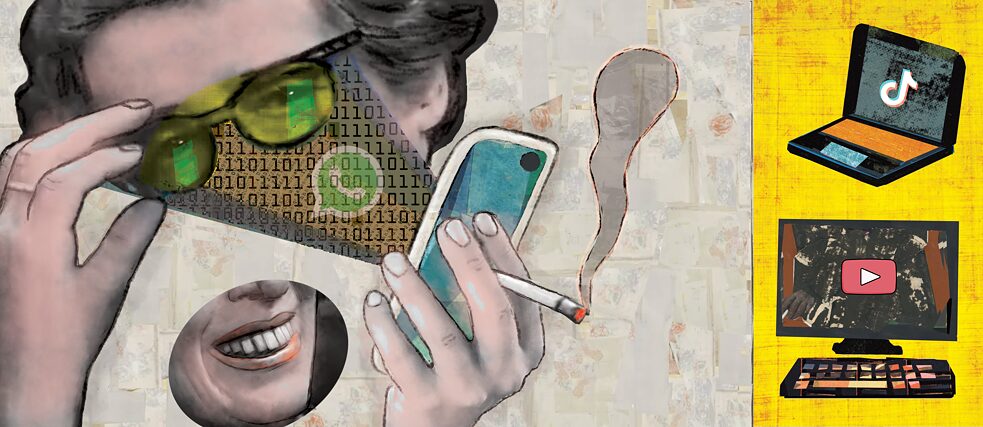
Hannah Arendt warned that real thinking demands courage and solitude. In an age of algorithms, outrage, and fear of speaking out, Roger Berkowitz shows why her voice is more urgent than ever and considers whether Arendt would succeed as an influencer today.
By Lena Kronenbürger
You’ve been running the Hannah Arendt Center for almost 20 years. After all this time, what is it that still pulls you toward her?
It’s the way she seeks to speak in her own voice. She had a confidence - some mistakenly called it arrogance. Especially for a woman at the time, it was seen as arrogant to say what you believed and not worry whether it fit with what others thought. She had the courage to be provocative, to trust herself. That’s meaningful for me.
When I’m interested in a problem - tyranny, artificial intelligence, education - reading Hannah Arendt gives you an account of past thinkers, but also her opinion, and it’s always surprising. It’s a prod to my own thinking. It makes me a better thinker.
She was known as a fearless thinker - sharp, ironic, and confident. Why do you think real thinking takes courage?
In today’s world - at least in the circles I move in, the world of left intellectualism and academia - people are terrified of saying what they think. Before anyone speaks, there’s always this internal check: “Am I saying the right thing? Will people get upset?”. People don’t call it totalitarianism, they don’t call it terror. And yet I think it is. It’s a kind of social totalitarianism, a climate of fear in which people hesitate before speaking their minds. Arendt is about as good an antidote to that as one can find. I’ve taken it as a personal challenge to speak my mind. And it’s hard! I don’t always succeed, I may not always be right. But at least I try to live up to her example - the courage to say what you believe.
Hannah Arendt called her writings “exercises in thinking.” What did she mean by that?
Arendt makes distinctions. Thinking, for her, is not the same as reasoning. Reasoning seeks truth - facts, proofs, answers. Thinking is about meaning. It doesn’t provide clear answers; it produces depth.
She used a couple of metaphors to explain this. One is what she called the “two-in-one.” Each of us, when we think, has a conversation with ourselves: “Should I do this or not? Should I drop the nuclear bomb or not?”. We challenge ourselves: “Will I be able to live with myself if I do this?”. That inner dialogue is, for Arendt, the fundamental act of thinking. And to do that, you need what she calls solitude - which is different from loneliness.
Hannah Arendt insisted that thinking takes time and solitude. In an age of constant notifications and instant reactions, are we still capable of that kind of thinking?
I remember Sherry Turkle, sociologist at MIT (Massachusetts Institute of Technology), speaking at one of our Arendt Center conferences. She studies teenagers and how they use social media. Something happens, and immediately they text their friends: “What do you think?”. Opinions get formed together, instantly. There’s no moment of sitting quietly, even for ten minutes, and asking: “What do I think?”. It becomes a group formation of opinion. And of course, there are many groups - but they rarely talk to each other.
Hannah Arendt explained in her 1964 interview with Günter Gaus that writing was, for her, part of the process of understanding. In today’s culture, where reflection gives way to performance measured in likes and followers, would you call her the ultimate anti-influencer?
She wanted to be heard and taken seriously. She wrote in The New Yorker, in Aufbau – not dusty academic journals no one reads. What she didn’t do was change what she wrote to get more followers. She defines understanding as facing up to reality without premeditation – without pre-ideas – and resisting it no matter what it might be. Arendt was an anti-ideological thinker in the extreme, someone who insisted on facing the full complexity of human life and reality.
In today’s polarized debates, we often stop listening once we’ve made up our minds. How would Arendt push us to go further?
She draws on Kant and calls this the erweiterte Denkungsart, the enlarged way of thinking. If I want to think about a problem – the climate crisis, the war in Ukraine, the conflict in Gaza – I start with my own perspective. But then I need to imagine as many other perspectives as possible: What would an Israeli say? A Palestinian? A Russian, a German, a Chinese? Of course, it would take you 5000 years to ask everyone on the planet what they think, so it becomes an act of imagination.
And the point is not to agree with them, but to stretch your own perspective?
Exactly, the point is not to adopt someone else’s view, but to widen your own perspective so that your judgment – even if it disagrees with most opinions – is informed by them. The goal is to understand why something is meaningful for the other person. This is not empathy; you’re not trying to feel what they feel. It’s about thinking what they think.
From there, Arendt links thinking to politics – the effort to form judgments others might share. Politics, for her, is not about unity but about finding what we can still agree on amid disagreement.
What happens to that in today’s digital world?
Social media creates silos. You see what you want to see – the things you agree with – and also the worst things you disagree with, the ones that make you angry. Algorithms know anger keeps you engaged. What you don’t see are thoughtful comments that oppose your view. So you get pro-Palestinian feeds and pro-Israel feeds that don’t really see each other. From Arendt’s point of view, that’s dangerous. If you never imagine the other person’s point of view, you can’t think.
You’ve said the problem goes deeper – that it’s not only about silos, but about the modern world itself often feeling incomprehensible. What do you mean?
Increasingly we live in a world that is impossible to understand. Some of it seems simple – you say at the table, “I need new shoes,” and the next day you get shoe ads. It’s shocking. But often it’s opaque: you don’t know why you’re getting what you’re getting. That’s what Arendt calls world alienation. We confront processes – technological, bureaucratic – that most of us don’t understand. I fly in a plane and I don’t really know why it flies. With climate change, I hear different claims and have little personal ability to judge. With artificial intelligence it’s worse – imagine it tells you, “You should bomb Iran.” You have no idea why it’s saying that.
When people feel the world is out of control, two things happen. First, we turn inward: I know what I believe; I don’t care about the rest. Second, we look for belonging in movements – environmental, political, even totalitarian – that promise meaning. That combination is politically dangerous.
If that’s the danger, how do we carve out spaces for real thinking and judgment – especially when our feeds push the other way?
What’s missing are institutions where people come together not knowing what truth or justice is and are actually interested in listening. That’s politics: finding meaning in disagreement and plurality, learning to live together and even enjoy being with people you disagree with. People forget: it’s fun to disagree! It’s fun to argue! We need to reawaken that joy.
One hopeful model is citizens’ assemblies: by lot, you bring together 25 to 100 people – plumbers, street cleaners, lawyers, professors, all viewpoints – who meet for months, bring in experts, hear testimony, and deliberate. The outcomes may vary, but the process itself teaches people to build common ground and take responsibility.
When you watch that 1964 interview with Günter Gaus – grainy black and white, Arendt smoking, pausing, answering with this mix of boldness and humor – it feels worlds away from today’s media. And yet it’s been seen over a million times. She never chased popularity, but here she is, viral. What do you think people are still hearing in her?
Arendt has become beloved around the world, and her name carries weight. She’s also misquoted - fake quotes by Arendt fly around online, truly viral, and I get emails almost every day asking where she said something she never did. These misquotes speak to the hunger for her words. But when you listen to her real voice - daring but thoughtful, provocative, and deeply human – you realize why people still turn to her for insight today; she helps us think. What people hear in Arendt, I think, is that politics is not only about policy, it is about the shared joy of speaking, acting, thinking, and judging together.