Practical tip: Distance teaching using conferencing tools
Effective teaching activities using conferencing tools

Using conferencing tools as a synchronous online element in blended or online learning is now an integral part of the portfolios of Goethe-Instituts and other language schools. These tools can be a sustainable approach to group learning – provided they are used in certain ways, as presented in the following practical tips.
By Stefan Häring and Christiane Bolte-Costabiei
Group learning
Learners to be committed to actively participating in order for distance learning to be effective. To ensure that learners don’t regard conferencing tools as merely a flexible option that can be used ad lib whenever they feel like it and have time, it’s important for teachers to create a setting in which they can learn actively from and with one another. To this end, we need to kindle a sense of group cohesion and, from the very outset, boost motivation and concentration by establishing camera-based activities in which learners talk to one another, find common ground even while noting differences and particularities, and learn to regard themselves as a group. “Getting-to-know-you” activities can be used to get learners to talk about themselves and their everyday lives. Ideally, learners should be free to choose the content and form of these activities so they’ll feel they’re relevant and meaningful to themselves. Most of the time, these activities can be conducted in groups of various sizes. In an activity called Zeigen Sie uns … (essentially: “Show and tell”), for example, after a brief plenary round with the whole class, you can have learners talk about objects they feel like showing the others in “breakout sessions”.
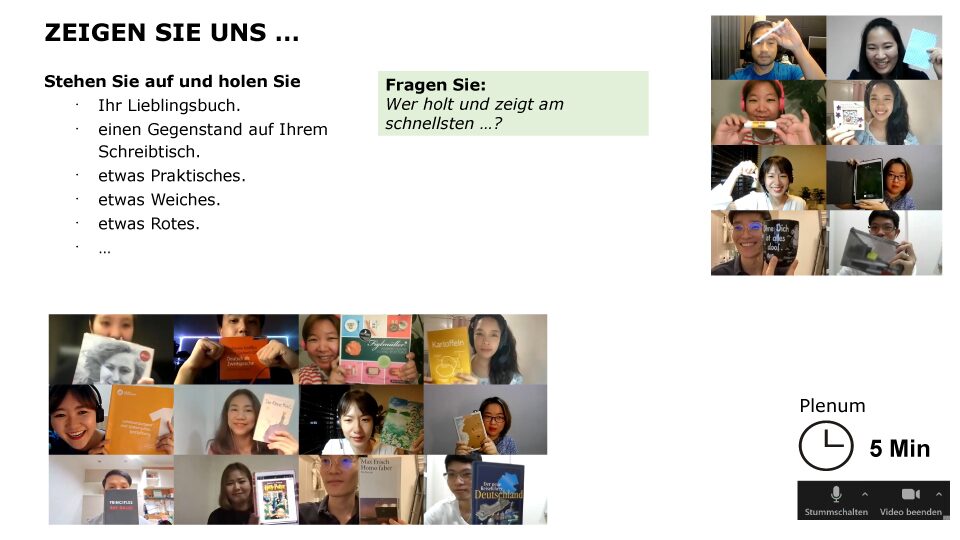 Zeigen Sie uns… (“Show and tell”): a “getting-to-know-you” activity
| © Goethe-Institut Thailand
Zeigen Sie uns… (“Show and tell”): a “getting-to-know-you” activity
| © Goethe-Institut Thailand
Introductory classes: creating a positive learning atmosphere
Wo sind Sie im Moment? (“Where are you right now?”) is an activity that gets learners involved via the chat function and can be used repeatedly in a language course. The questions shown in the example below serve to provide orientation and a sense of learners’ surroundings and their state of mind at the beginning of the class. It’s a good idea to follow them up with one or two questions that call for reflection. Wo sind Sie im Moment? (“Where are you right now?”): Another “getting-to-know-you” activity
| © Goethe-Institut Thailand
Wo ist bei Ihnen ...? is an activity that also heightens learners’ awareness of both their immediate surroundings and their state of mind. It involves getting up and moving around, which relaxes the atmosphere at the beginning of class. The learners consciously look at one another, read each other's names and get socially orientated. After the teacher gives an example by way of introduction, the learners are to ask one another the questions themselves.
Wo sind Sie im Moment? (“Where are you right now?”): Another “getting-to-know-you” activity
| © Goethe-Institut Thailand
Wo ist bei Ihnen ...? is an activity that also heightens learners’ awareness of both their immediate surroundings and their state of mind. It involves getting up and moving around, which relaxes the atmosphere at the beginning of class. The learners consciously look at one another, read each other's names and get socially orientated. After the teacher gives an example by way of introduction, the learners are to ask one another the questions themselves.
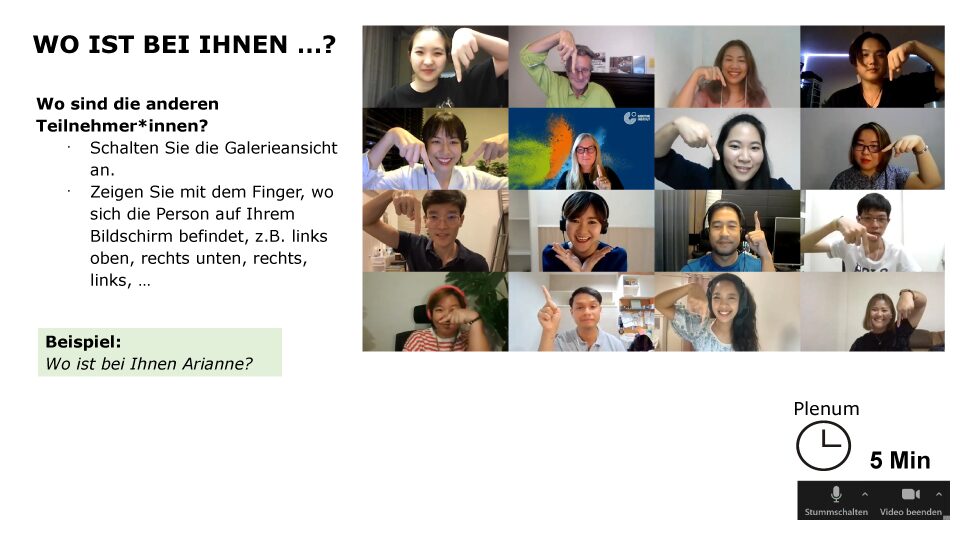 Wo ist bei Ihnen …? (“Who’s where on your screen?”): Another “getting-to-know-you” activity
| © Goethe-Institut Thailand
Wo ist bei Ihnen …? (“Who’s where on your screen?”): Another “getting-to-know-you” activity
| © Goethe-Institut Thailand
Combining in-person and distance learning methods
When using conferencing tools, the teacher and learners are in different physical locations connected up by audio and video conferencing, which yields some new opportunities for effective teaching. In addition to online conferencing supplemented by Web 2.0 tools, the teacher’s and learners’ individual personal spaces can be incorporated to produce creative learning methods that not only appeal to all their sensory channels, but also train skills at the interface between in-person and distance learning. This works particularly well with the standard topics covered in A-level teaching. Distance learning can be combined with the participants’ respective personal spaces to apply teaching methods such as personalization and learner activation, which are essential for teaching with conferencing tools in particular.
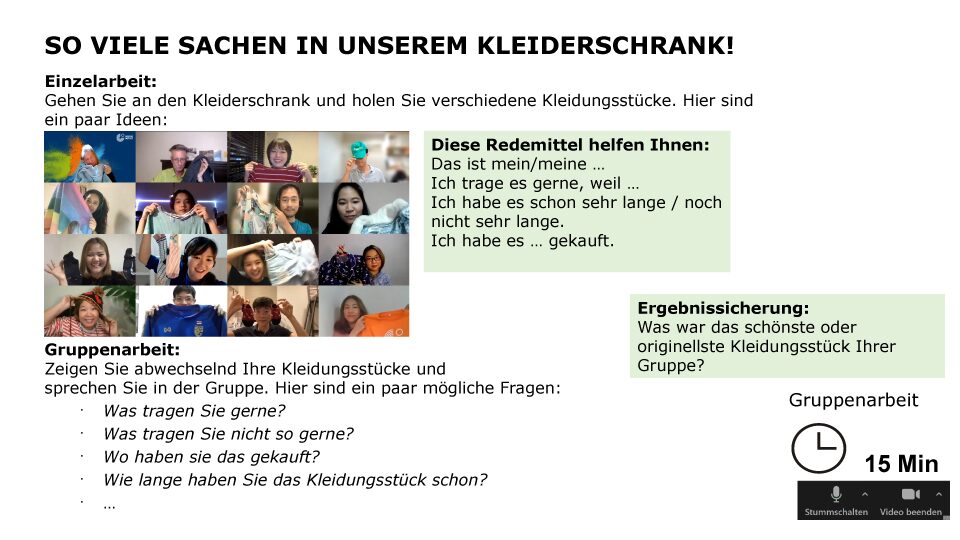 Talking about clothes
| © Goethe-Institut Thailand
So viele Sachen in unserem Kleiderschrank (“So many clothes in our wardrobe”), for instance, is an activity in which learners show one another selected items of clothing from their wardrobe and talk about them in groups.
Talking about clothes
| © Goethe-Institut Thailand
So viele Sachen in unserem Kleiderschrank (“So many clothes in our wardrobe”), for instance, is an activity in which learners show one another selected items of clothing from their wardrobe and talk about them in groups.
Exercise and assignment: personalized and action-oriented practice
The following example on the topic of “food and drinks” shows how exercises and assignments can be personalized in classes using conferencing tools and also rendered more action-oriented as a result.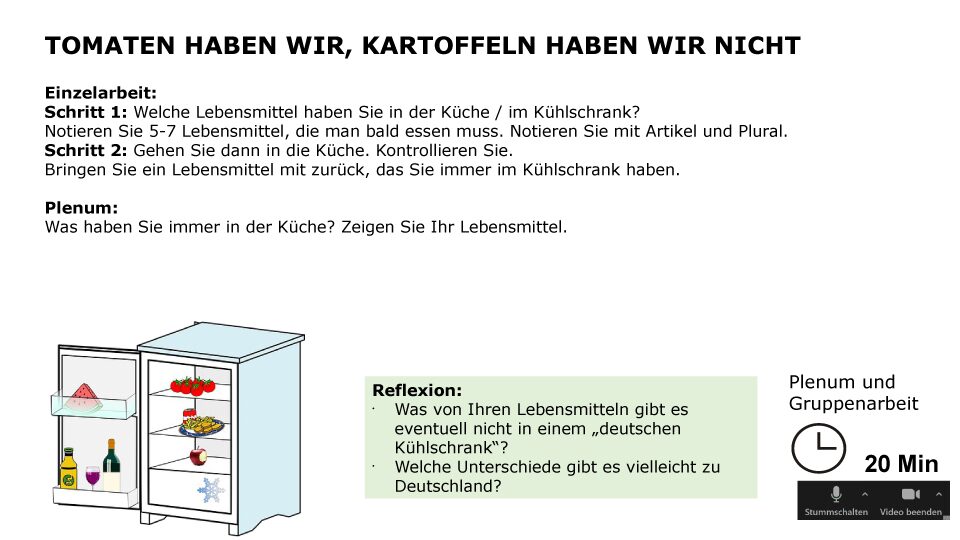 Name this food
| © Goethe-Institut Thailand
First, each learner writes down between five and seven foods in their kitchen that ought to be eaten soon. Then they each go to their kitchen to see whether they have that food at home. Each brings an item of food to serve as an example, holds it up to the camera for the others to see and tells them what it’s called. Then the teacher divides the class into breakout sessions and each breakout group draws up a menu comprising a starter, main course and dessert using the foods available and then briefly presents it to the whole class. In a final voting process designed by the teacher ahead of time using conferencing or survey tools, the learners vote on which menu they like the most and would most like to be invited to consume.
Name this food
| © Goethe-Institut Thailand
First, each learner writes down between five and seven foods in their kitchen that ought to be eaten soon. Then they each go to their kitchen to see whether they have that food at home. Each brings an item of food to serve as an example, holds it up to the camera for the others to see and tells them what it’s called. Then the teacher divides the class into breakout sessions and each breakout group draws up a menu comprising a starter, main course and dessert using the foods available and then briefly presents it to the whole class. In a final voting process designed by the teacher ahead of time using conferencing or survey tools, the learners vote on which menu they like the most and would most like to be invited to consume.
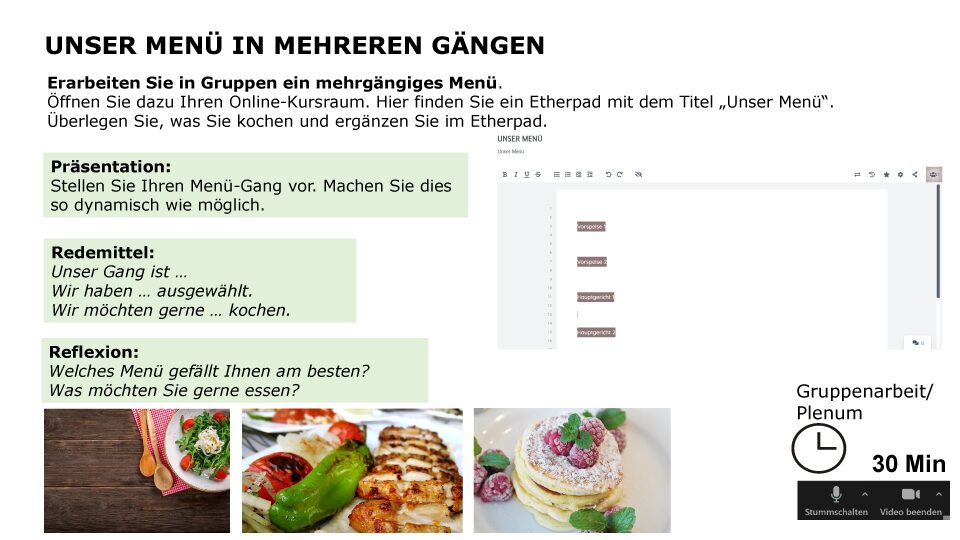 Drawing up a meal
| © Goethe-Institut Thailand
Drawing up a meal
| © Goethe-Institut Thailand
Exercises and assignments: success-oriented conferencing
Success orientation is particularly important in classes using conferencing tools, in which teachers have more limited means of providing direct support than in in-person classes. One way of applying this principle in the above example is to give learners short sample dialogues to work on as well as selected vocabulary and “chunks” for weaker and stronger learners alike to draw on.
Interactive practice and action
Many of the standard methods employed in in-person teaching can be transferred to distance teaching using conferencing tools. For example, learners can dictate texts to one another in breakout sessions, which they can then display at home a few metres away from the computer, or they can work with partners to fill in the blanks on various worksheets, sitting “back to back”, i.e. with their backs to the camera, whilst working on the assignment.
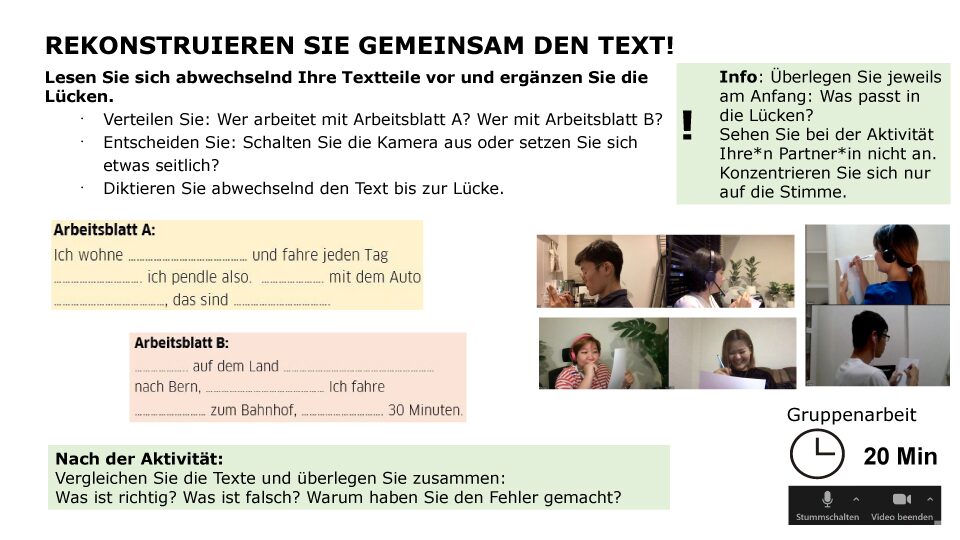 Partner-based dictation
| © Goethe-Institut Thailand
In “speed dating”, each learner asks a partner questions about a given topic, then switches to a different partner in a different breakout session every two minutes or so. This makes for a high degree of interaction.
Partner-based dictation
| © Goethe-Institut Thailand
In “speed dating”, each learner asks a partner questions about a given topic, then switches to a different partner in a different breakout session every two minutes or so. This makes for a high degree of interaction.
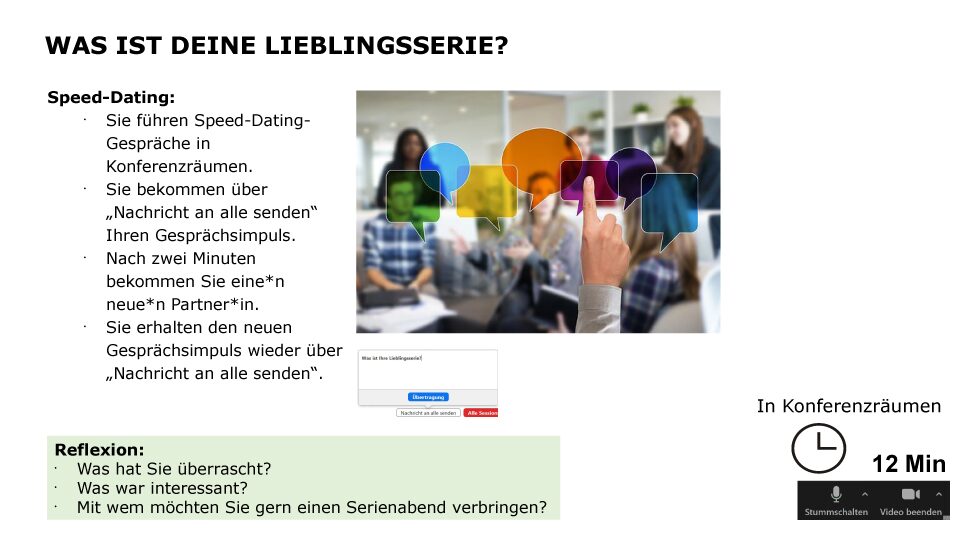 Speed dating
| © Goethe-Institut Thailand
Speed dating
| © Goethe-Institut Thailand
Last but not least: writing with pen and paper
Many people learn more effectively by actually writing down words, sentences and whole blocks of text with pen and paper. This can be done whilst conferencing, too. Besides pen and paper, physical tools like post-its and notebooks can be used to draw on various learning channels and senses. In Ich habe gestern mit meinen Freunden gechattet (“I chatted with my friends yesterday”), the teacher forms groups that divvy up the various elements of a given sentence amongst themselves in a breakout session and write one element per learner on a card. Then they put the elements in the right order and present their results to the whole class, holding the sentence elements up to the camera one after the other.
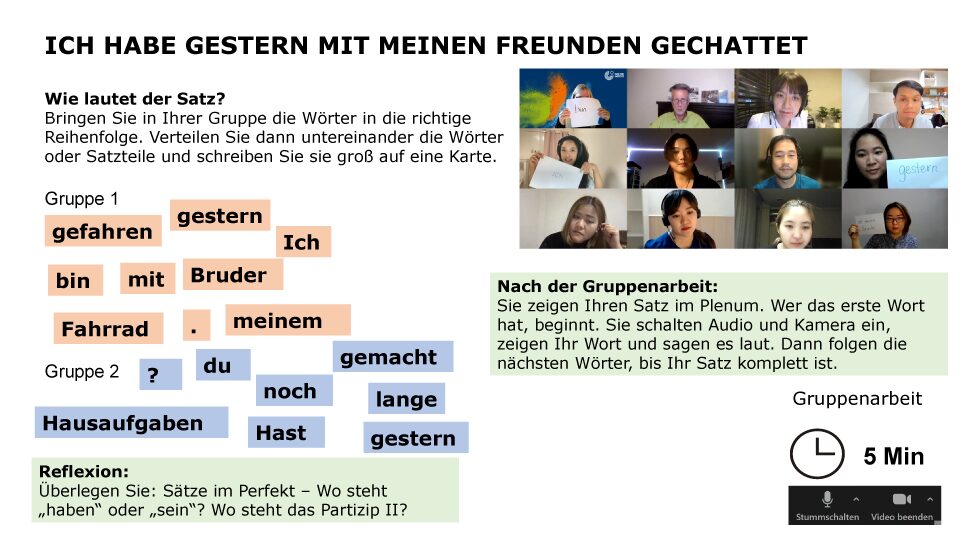 Sorting elements of a sentence
| © Goethe-Institut Thailand
Sorting elements of a sentence
| © Goethe-Institut Thailand