
Artificial Intelligence
KOSI – Practice Speaking With AI

The best way to learn a language is by speaking it – but online courses often fall short on flexible speaking practice. Enter KOSI: an AI chatbot that lets learners have realistic conversations on their own, with instant, personalised feedback. KOSI shows how AI can meaningfully supplement language teaching.
By Lukas Steinbauer and Dr. Moritz Dittmeyer
Have you already worked with AI today – maybe without even noticing it? Probably. AI is now an integral part of our everyday digital life. All kinds of AI technologies are integrated into many of the apps, programmes and websites we use for work or leisure – some more visibly than others. Language learning is no exception, with AI opening up completely new possibilities.
In the Goethe-Lab Sprache, an innovation unit run by the Goethe-Institut, we explore how new technologies can meaningfully enhance digital learning opportunities. For several years now, one central question has been at the heart of our work: Where can AI truly help learners in our online language courses – without replacing what makes teachers so valuable?
How can learners get more speaking practice in online courses?
Surveys of our online course participants show that many learners would like to have more opportunities to actively speak German. One study (Jabeen/Thomas 2015) also confirms that speaking practice is often neglected in online language courses. While reading, writing and listening exercises can be completed independently and assessed automatically, active speaking generally requires instructor-led sessions and real conversation partners.
This is precisely where AI can offer meaningful support: not as a replacement for teachers, but as an additional way to practise speaking regularly and flexibly, with immediate feedback and without pressure to perform. Recent research (Andreeva 2024) confirms this and shows how AI-supported dialogue simulations can genuinely strengthen learners’ oral skills. Building on these findings, the Goethe-Lab developed the KOSI chatbot. The first prototypes were produced in 2023. Since autumn 2024, the conversation simulation has been used in online courses and continuously refined. With this KOnversationSImulation, online course participants can now practise speaking without direct supervision.
How does KOSI work?
KOSI is a chatbot that acts as a virtual conversation partner for learners in a predefined scenario. Tailored to the learner’s language level, the scenarios are integrated thematically and pedagogically into the courses and designed to reflect real-life communication situations as authentically as possible. These range from buying something at a bakery and talking about hobbies with a friend to consulting a doctor or engaging in more complex discussions about controversial subjects.
Within its predefined role, KOSI responds dynamically to learners’ comments, adapting the course of the conversation to their questions and answers. For each conversation, learners are also given several assignments that create a general framework for the conversation. Depending on language level, these range from simple prompts, such as “Greet your conversation partner” and “Tell them about your education and professional experience” to presenting more complex information or expressing personal opinions, such as: “Tell them what you think of the artist’s works”.
At the end of the conversation, KOSI automatically assesses whether the assigned tasks have been completed. Learners then receive personalised feedback on the conversation, along with specific suggestions for improvement in a subsequent attempt. The following video demonstrates how such a dialogue works:
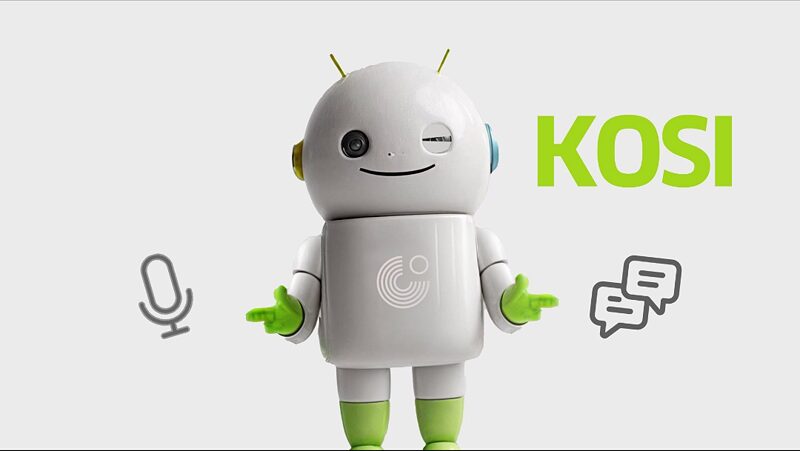
© Goethe-Institut
What does KOSI offer?
First and foremost, KOSI creates additional opportunities for learners to practise speaking in online courses. The tool is available around the clock, so learners can practise anytime – independent of class times or teacher availability. They can repeat dialogues as often as they like and receive immediate, personalised feedback. The conversations and their assessments are automated, allowing multiple learners to use the exercises simultaneously without requiring a teacher to supervise each individual dialogue.
“The most common reaction from learners is: ‘Why didn’t we start using KOSI sooner?’ This reflects the motivation they feel when they navigate communication situations on their own, knowing that their conversation partner will respond and adapt to what they say.”
Elaine Truiz, German teacher in São Paulo
KOSI can also help lighten teachers’ workloads in partially instructor-led online courses. When learners practise speaking outside scheduled class time, the limited teaching time can be used more effectively for interaction and interpersonal discussion. KOSI also provides a safe space for learners to practise conversational situations without performance pressure or the fear of making mistakes. In short, KOSI is not a replacement for teachers, but a valuable complement – and an additional learning opportunity for students.
“What I particularly like about KOSI is that it promotes learner autonomy. Learners can work with the system on their own and use its automated feedback to check their language performance. This makes them more aware of their mistakes and encourages them to reflect on their language use.
Another advantage, in my view, is that learners get systematic speaking practice. This can be particularly useful for more reserved or shy participants. Overall, I think KOSI is a valuable aid for teachers.”
Anna Rymmar, German teacher in Amman
It is also important that KOSI provides realistic communication practice. Learners practise expressing their intentions clearly and engaging in successful dialogue even if they make mistakes. They learn to respond spontaneously and appropriately to different situations. This prepares them for authentic communication in everyday life. During the conversation, learners are shown written correction suggestions for selected errors. They can address these corrections immediately or focus first on the conversation. This enables them to receive language support without interrupting the natural flow of the conversation.
“KOSI is particularly valuable for learners because it allows them to practise speaking on their own in realistic situations, systematically preparing them for everyday communication. Learners frequently ask me how they can learn to speak German more naturally and confidently. KOSI is now the answer.”
Basma Kamal, German teacher in Cairo

KOSI’s suggested correction | © Goethe-Institut
What do learners have to say about KOSI?
Between October 2025 and July 2026, about 76,000 conversations took place with KOSI in our online courses, averaging around 7,600 conversations per month. Learners submitted a rating for 37% of conversations. The results were overwhelmingly positive: around 95% were rated “Excellent” or “Good”, while only around 5% were rated “Poor”.
We are also collecting more detailed feedback through an ongoing survey of KOSI users. A preliminary analysis of more than 150 responses shows that learners value KOSI most for its life-like conversations, its immediate feedback and the opportunity to practise flexibly, independently and without pressure. Another benefit they highlight is the automatic correction, which makes mistakes immediately visible.
The main aim of the survey, however, is to identify areas for improvement. One key issue is deficiencies in speech recognition and transcription; as with many language-learning applications, utterances by learners with strong accents or unfamiliar pronunciation are sometimes transcribed incorrectly – causing KOSI to occasionally misinterpret answers that are actually understandable. There were also minor technical issues, as well as requests and suggestions for additional features, such as more detailed feedback. We use these comments to continuously improve KOSI – resolving issues and integrating new features. Our ultimate goal is to offer German learners a smooth, successful learning experience.
Conclusion
AI-supported conversation simulation cannot replace conversations with real people. Instead, KOSI fills a gap, giving learners in online courses more opportunities to practise speaking independently. In a safe practice environment, they can try out typical communication scenarios as often as they like, with every conversation unfolding differently. KOSI responds to their input, allowing learners to engage in varied, realistic dialogues instead of completing rote exercises. They can practise anytime, anywhere, experiment with different ways of expressing themselves and receive personalised feedback.
KOSI therefore complements the personal support teachers provide in class, enhancing online courses with a flexible tool for regular, independent speaking practice in realistic everyday situations. It integrates AI into German language teaching in a pedagogically meaningful way – without replacing teachers or personal interaction.
Literatur
Jabeen, Shazi Shah and Ajay Jesse Thomas (2015): Effectiveness of online language learning. In: Proceedings of the World Congress on Engineering and Computer Science. Vol. 1, 1–5.
Andreeva, Antonina A. (2024): Interactive scenarios: online dialogue simulators for communication skills. In: Daria Bylieva and Alfred Nordmann (Eds.), Scenarios, Fictions, and Imagined Possibilities in Science, Engineering, and Education. XXIV Professional Culture of the Specialist of the Future, Vol. 2, Cham: Springer Nature Switzerland, 261–271.
About the Goethe-Lab Sprache
The Goethe-Lab Sprache is a digital innovation unit of the Goethe-Institut. It develops digital language-learning resources and explores the use of cutting-edge technologies for language learning, with a particular focus on artificial intelligence.