
C2 IndexC1 IndexA2 IndexB1 IndexA1 IndexB3 IndexC3 Index

[Map]

B2 INDEX
A. Eberly's Sons
H. C. Ewald's
7th & G Streets
Martin Luther King Memorial Library
Kloeppinger's Bakery
Old Patent Office Building
Former Washington Journal Office
Masonic Temple
The Hecht Company
Oriental Building Association
Dietz’s Rathskeller


MASONIC TEMPLE

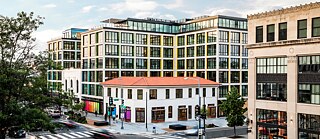
The Masonic Temple at 9th and F Streets, N.W., which was often used for German festivities, was built by German-American architects Adolf Cluss and Joseph W. von Kammerhueber between 1868 and 1870. For many years, the building's elegant façade lay disguised (yet well protected) beneath a "modern" furniture-store sheathing. The building was restored in the 1990s and is now home to The Gallup Organization.

Christopher Weeks, in the AIA Guide to the Architecture of Washington, D.C. (Third Edition, 1994) notes:

"The polychrome stone and cast-iron veneers applied to the brick walls of this Italian Renaissance palazzo offer some of the more eye-catching façades in town. When new, the building exemplified the mixed use of space so characteristic of late-19th-century, pre-zoning code urban architecture: shops jostled one another on the ground floor, and the Masonic Hall filled the space above. President Andrew Johnson, himself a loyal Freemason, laid the cornerstone and led the gala parade that celebrated the start of construction. In its prime the hall witnessed much Gilded Age gaiety: Washingtonians feted the Prince of Wales here in 1876 at a centennial banquet, and for decades society matrons fought for the honor of having their daughters' debutante parties here."

ADDITIONAL INFORMATION

 Cluss Biography
Adolf Cluss (1825-1905), born in Heilbronn, Germany, the son and grandson of architects, had a remarkably successful career in Washington, DC. He came to the United States in the wake of the unsuccessful 1848 revolution and was a follower of Karl Marx, whose works he sometimes translated for the New York Tribune (the newspaper for which Carl Schurz, another "forty-eighter," served as a Washington reporter).

Cluss's buildings dot Washington still today and his prominence in the German-speaking as well as the greater Washington communities is unquestioned.


Details of the facade
 

Details of the facade