Europe

The Goethe-Institut has been working closely and trustfully with the EU institutions for many years.

European flags blowing in the wind Pixabay / Bruno

The Goethe-Institut in Europe

  • The Goethe-Institut Brussels is the Goethe-Institut's liaison to the European institutions and the European and international organisations and networks based in Brussels.
  • With the support and on behalf of the EU, the Goethe-Institut implements EU-funded projects and provides impetus for shaping international cultural and educational work at the European level.
  • In 2021, the Goethe-Institut successfully completed the EU Pillar Assessment and can therefore implement EU funds in the context of indirect management.

Highlights from our EU work

  • Sustainable cultural ecosystems in Europe

    Building resilience in Europe’s cultural and creative sectors

    How can cultural and creative professionals become more resilient to crises, transformations and structural challenges? The final Creative FLIP study identifies the policy, financial and organisational conditions needed to strengthen sustainable cultural ecosystems in Europe.

  • LIBRA.I. Methodology

    Strengthening AI literacy in Europe

    The LIBRA.I. Methodology provides the first practice-oriented European approach to AI literacy in libraries. The handbook supports libraries in providing inclusive, critical and accessible AI education rooted in everyday life, while strengthening their role as spaces for democratic participation.

    LIBRA.I. Methodik © LIBRA.I. Design: Sandra Kastl © LIBRA.I. Design: Sandra Kastl

“Europe is not an abstract project for us, but a vibrant space for exchange, learning and shared responsibility. Through its EU-funded projects, the Goethe-Institut aims to connect people, institutions and ideas across borders, helping to promote cultural diversity as a strength and actively shape the future of Europe.”
Dr. Julia Sattler, Delegate for European Affairs of the Goethe-Institut

Julia Sattler

Selected EU-funded projects

  • Cultural Mobility

    Culture Moves Europe

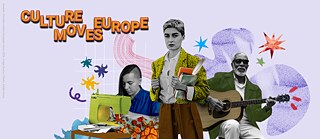
    Culture Moves Europe supports international cultural mobility between 41 Creative Europe countries. Funded by the European Union and implemented by the Goethe-Institut, it is open to artists and cultural professionals from the sectors of architecture, cultural heritage, design and fashion design, literature, music, performing arts and visual arts.

    Collage mit Menschen (c) Culture Moves Europe (c) Culture Moves Europe

  • Eastern Partnership

    EU4CULTURE

    EU4Culture II strengthens the role of culture as a driver for economic growth and social development across the Eastern Partnership (EaP) region (Armenia, Azerbaijan, Georgia, the Republic of Moldova, Ukraine and the civil society of Belarus). EU4Culture II positions culture as a strategic driver of economic growth, innovation and long-term resilience across the Eastern Partnership region.

    College of Europe Event © Khatia Psuturi for Goethe-Institut Georgia © Khatia Psuturi for Goethe-Institut Georgia

  • Cultural cooperation, Exchange, Co-creation

    Africa-Europe Partnerships For Culture

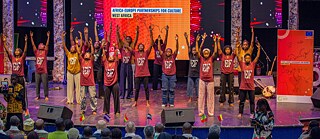
    Africa-Europe Partnerships For Culture (AEPC) reshapes cultural cooperation, exchange, co-creation and circulation within Africa and between Africa and Europe while promoting intercultural dialogue and mutual understanding. Developed with artists and cultural professionals from Sub-Saharan Africa, the programme ensures that African voices remain central throughout implementation.

    Africa-Europe Partnerships For Culture (AEPC) Launch Event © Africa-Europe Partnerships For Culture © Africa-Europe Partnerships For Culture

  • Care in Cultural Exchange

    Halaqat

    Europe and the Arab world are two rapidly changing regions, each with specific and varied local social, economic and political realities, but above all with many connections, historical and present. Building on these connections, the Goethe-Institut and Bozar present the project Halaqat. Halaqat – which in Arabic means multiple links and circles – aims to strengthen these entanglements and build bridges between both regions.  

    An abstract image with geometric shapes in blue, purple, and orange. In the center is the word "halaqat" in Arabic script, surrounded by circles and triangles. © Design Engy Aly © Design Engy Aly

  • Cultural and Creative Industries

    Creative Flip

    The culture and creative sectors perform various tasks for the economy and society. However, there are still structural problems which are holding these sectors back from achieving their full growth potential. The Creative FLIP project – co-funded by the European Union – is aiming to resolve this situation. Its main objective is to establish constructive and sustainable framework conditions in the fields of finance, learning, innovation and patenting for the cultural and creative sectors in Europe.

    Logo Creative Flip © Creative Flip © Creative Flip

  • LIBRA.I.

    Libraries for AI literacy

    The LIBRA.I. project aims to integrate Artificial Intelligence (AI) into media and learning literacy training in public libraries. Libraries play a key role in equipping citizens with the skills to navigate an increasingly unpredictable digital world, serving as safe places.

    LIBRA.I. - About the project © Sarah Kral © Sarah Kral

Publications and studies

Our publications bring together research findings, practical experience and policy recommendations from European cooperation projects. They provide in-depth insights into current developments in cultural, educational and social policy in Europe.

Cooperation and networks

The Goethe-Institut is active in the following European networks.

  • EUNIC

    EUNIC is the network for cultural institutes of the member states of the European Union. It was founded in 2006 and currently has 30 members active in more than 150 countries. Its activities include the arts, languages, youth, education, science, intercultural dialogue and development issues.

  • Culture Action Europe

    Culture Action Europe (CAE) is the leading European network of cultural networks, cultural organisations, artists, civil society actors, researchers and policymakers. As the only cross-sectoral network of its kind, it brings together organisations and strategic partners from all areas of culture.
    Culture Action Europe is the political voice of the cultural sector in Europe and a key source of informed perspectives and debate on arts and cultural policy.

  • IETM

    The Goethe-Institut is a member of the International network for contemporary performing arts (IETM), one of the oldest and largest international cultural networks. IETM represents the interests of more than 500 member organisations and individuals working in the contemporary performing arts worldwide.

  • Practitioners' Network for European Development Cooperation

    As part of a leading network of European development cooperation organisations bringing together 25 organisations from 19 European countries, the Goethe-Institut supports the network's efforts to build knowledge through exchange, coordination and harmonisation. It also brings perspectives from practice into policy debates and contributes feedback to the further development of strategies and policies.

Newsletters

Would you like to stay informed about our work? Subscribe to our LinkedIn newsletter and receive regular updates on our EU-funded projects and commitment to Europe.

EU Liaison Office

The EU Liaison Office is the interface for the worldwide network of Goethe-Instituts to the European institutions. As the EU Liaison Office, it maintains relations with the European Union. It advises the Goethe-Instituts worldwide on EU funding programmes and carries out EU-funded projects itself.

Goethe zieht um © Sandra Kastl © Sandra Kastl

Contact