This book makes the South African land journey easy to understand and follow. A Union's first contact with Dutch was not in 1652. The peasantry put up a brave resistance to violent usurpation of land and livestock. They, therefore, were not seating ducks.
The book put timelines in South African land history and efforts with supposed aims to address it. Ngcukaitobi goes a step further to give a detailed examination. He demonstrates a manner in which acts were found wanting in addressing land injustice.
Surprisingly, private land ownership was exclusively used as a requirement for voting. Peasantry was forced to forgo dependence on land and sought employment, instead. In tandem, sudden change in communal land ownership as they hitherto understood it.
Pussyfooting around implementation of required administrative measures is clearly evident in the book. Ngcukaitobi explored introduction of financial market factors into an emotive human right issue.
He envisages that in the future, land redress ought to rightly be based on equity and justice. Lest, inequality gap would widen. Lastly, Ncgukaitobi suggests measures that could make land reform to be meaningful, impactful and widespread.
Interesting takeaways
It highlights elements that would otherwise be lost to the reader. Ngcukaitobi supports that land reform has to also benefit people who work the land. Currently,nothing stops the state from expropriation land for public interest purposes. However,state more often act as though it has no avenue to address it.
Additionally, no credible audit on land ownership is readily available. It then becomes a daunting task to land reform given that totality of the problem is not understood.
Ingonyama Trust was a last minute attempt to lure political formation to partake in the first democratic elections.
Xhosa people hid a body of their fatally injured king. This was to prevent beheading and having his head shipped off as a momento. They tried to save what was left of their dignity, my take.
Teachings & Nuggets
This challenges previously held beliefs. African National Congress has always advocated for private ownership of land since Convention for a Democratic South Africa (CODESA). Market related payments of land is not a hindrance to land reform.This was confirmed by no less than former president,Hon. Kgalema Motlhanthe in his report.
Educating peasantry did not influence subjects to follow the ways of the oppressor. At times, it solidified their steadfastness on known ways of their people. Some women owned land in the past. Even though,some were denied access to land on arbitrary grounds such as culture and gender.
Ngcukaitobi highlighted projects such as Reconstruction and Development Programme having had unintended consequences for beneficiaries. They could not afford rates and taxes as well as electricity.
Constitution proposed equitable amount for land reform was erroneously interpreted to mean monetary compensation.
Dual problems of corruption and collusion by state officials with land owners slowed land reform. To a large extent,a shortage of state capacity also hampered land reform progress.
Economic repercussions as in Zimbabwe put a damper on successful land reform. Banks have an active role to play as benefactors of stolen assets that are still bonded.
Verdict
This is purely a personal reflection of the reviewer of the book. It brings a reader up to speed with land's lengthy and complicated process. Assessed interventionist measures on their efficacies that mainly amounted to nought. Ngcukaitobi's choice of title is in keeping with content of the book.
Teaser & final comment by the reviewer
Ngcukaitobi put across a convincing argument against payment of market related prices for land reform. He deliberately juxtaposes it against competing social government responsibilities such as health and education.
In the final analysis, a white privately owned land that can be capitalised. Contrasted against black communal/shared land that cannot be capitalised.
About the reviewer
Moon Mokgoro
Moon Mokgoro studies physics and mathematics and is a writer based in Johannesburg, South Africa. She is the founder of Protest Poster Project, a non-profit organisation focused on fighting against gender based violence and building a library/archive of activist, anarchist and feminist literature. She's written for the Are.na 2023 Annual and others as well as occasionally writing on her Substack. Archiving and documenting, collecting and remembering are what Moon aspires to do in all her work.
More information
This review is from the Book of the Month series 2024 from the Goethe-Institut South Africa.
A new review by South Africans for South Africans will be published every month, please check regularly.
All books can be borrowed from our library.
All "Book of the Month" reviews
Here you find all reviews of the series Book of the Month. All books are available in Goethe-Institute library in Johannesburg.
It’s simply not good enough to have a great business idea, because that idea needs to work financially. Do you have the ability to make business decisions quickly based on facts, not the heart?
Mhudi is a historical novel set in the 1800s that tells the story of an African woman living during a war between the Barolong people, Matebele people and the Boers. Mhudi’s tribe, the Barolong, is attacked one evening by the Matebele. Amid the screams, bloodshed, and destruction—Mhudi escapes.
The women of 1956 marched to the Union building in unison because the pass laws that were oppressive. These women, from all backgrounds and races were torchbearers to a poet, social and legal advocates. These women, who are as colorful as their backgrounds and professions, share something common: the need to be somebody.
Maru is a story about a Masarwa woman, Margaret Cadmore, who was adopted and raised by a white woman during a time when the Masarwa people of Botswana were heavily discriminated against. Head writes “Masawra is the equivalent of ‘nigger’, a term of contempt which means, obliquely, a low filthy nation.”
As a young girl, during a drought in Zimbabwe, Elizabeth collapsed under a tree as a result of hunger and starvation. She was weak and in and out of consciousness. Moments later, a woman that Elizabeth did not recognise, gave her a meal.
Tshepo, a young student at Rhodes, has a difficult time keeping up with his own strange mind. He is absorbed in making sense of a traumatic past in a violent country and so when he finds himself at the Valkenberg mental facility it is perhaps not entirely due to “cannabis-induced psychosis”.
Carried by impeccable lyrical writing, the 2022 novel examines themes of queerness, grief, friendship, and family. Set in the United Kingdom with hints of Nigerian life, this enthralling book reads like capricious weather.
“The book brings the reader up to speed with land's lengthy and complicated process. Assessed interventionist measures on their efficacies that mainly amounted to nought.”
Penguin Random House South Africa | Tlou Meso
Penguin Random House South Africa | Tlou Meso
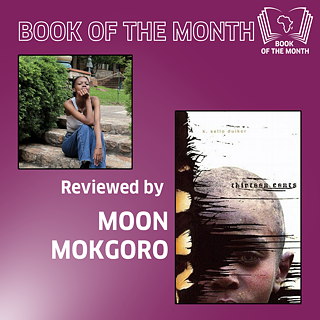
Thirteen Cents - Book of the Month March
Books like Thirteen Cents are essential for social change.
They provide impetus for growth, change and the development of a caring and supportive society.
“It is all at the same time filled familiarity, warmth and danger, fear and opportunity – the myriad of contradictions that is Johannesburg, and South Africa itself.”
The AFRO-Freedom Book Club is a public book club that focuses on African writers to inspire dialogue and civic engagement in the community. We strongly believe in the voice of Africans and the importance of telling our own stories. Everyone is invited to join our circle!
Silent Book club is about meeting other like-minded readers, chatting about what other people are reading and then reading together in companionable silence.