


“Tautology” is built on sonic research seeking to establish a connection between two aspects of Tunisian culture: Islamic religious traditions and music. The artist presents different vocal performances of the adhan (call to prayer) in an attempt to show some of its unique features within the territory of contemporary Tunisia. Hazgui’s approach to the sounds of adhan come as a conscious attempt to showcase Islamic heritage as a cultural phenomenon.
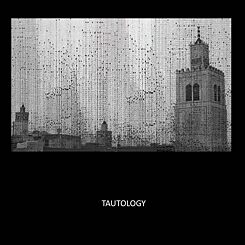
In line with her personal approach, Rehab Hazgui uses her own field recordings of the Tunisian call for prayer; collected over the last two years in various places in Tunisia. Considered one of the most significant musical manifestations of Islamic culture, the adhan summons the faithful to the mosque and announces the structuring of prayers five times a day. As a ritual, it consists of a set of phrases that are repeated following an exact pattern (Iqamah) daily, at a precise moment in time. The words of the call to prayer have a fixed mode of pronunciation for the phrases and a special sequencing, divided by breaths. These sequences are always the same, but the melody differs. Each country has its own minor variations in the fluidity of pronunciation.
In this piece the artist captures the sonic nuances of different recitation methods creating a sound sensation of the geographic diversity within Tunisia. Hazgui uses the long vowels in the last words of most phrases and applies sample-based synthesis, generating sonic environments. The sounds mingle with the unique (in)harmonic structures of the world, such as car horns and street noises, which provide (poly)rhythmic loops and tones that stretch and reverberate beyond space.
“Our contemporary world of mobility has proven that sound-space relations are and always have been cultural, and are constantly being reconfigured both historically and socially. With ‘Tautology’ I invite listeners to question the idea that sounds are “naturally” tied to certain places and contexts, as many sounds have found new homes in new contexts.”
Hazgui produced this piece with an interactive element in mind. By using a VCV synthesizer rack the audience would be able to add their own recordings to the track. Unfortunately, due to technical difficulties, this could not be realized within the framework of this exhibition.
Duration: 5’22
Producer: Rehab Hazgui
Composer:
Field Recordings: Rehab Hazgui
Instruments: synthesizers
Date of original composition/work:
Dates of field-recordings: 2019 - 2021
Recorded: August 2021
Lyrics: n/a
The Why Behind the Music
For me, “heritage”, the concept that was at the heart of this musical exploration, is loaded with unpleasant connotations. This is due to the word’s almost mythical status. Referring to traditions, roots, and folk, the term has a broad and malleable use. Anyone can claim heritage for themselves, as one person’s “heritage” may be another’s “pop song.”
In this project, I took a personal approach, exploring what the term means through music, especially because I believe that individual heritage differs from that of the group. The personal experience of the concept can be just as valid, as it is lived through family memories, space, place, and practice. It manifests through music production, instrumentation, methods of performance, and deeper concepts related to sounds. All of these aspects involve interactions and experiences. Hence, for me, heritage is something you make, and it is constantly changing and evolving.
In some countries ”authentic” musical heritage is perceived to be under threat, because of the ongoing changes being experienced. However, the idea of a work’s “authenticity” acquires a fetishistic quality, in comparison to the basic sense of being faithful to the idea of self within culture. Heritages are built on interactions between the self, place, time, experiences, and people. Sound helps to capture and communicate these complexities, and to bring forward the unique characteristics that emerge when these various aspects and elements are joined. This puts us as sound-artists on a wider cultural and sonic continuum.
My approach for this project is built on fluidity and on openness to the changing nature of sounds, heritage, and the role of the individual within the group. My two works build on Tunisian vocal heritage, as vocal music can be both the voice of the culture it relates to and the voice of the individual who is singing.
November 2021