Michael Buthe
“My inner Marrakesh”

Arabian prince, magician, master of ceremonies and traveller between worlds: Michael Buthe (1944–1994) is one of the most vivid personalities of the German art scene. As a participant in Harald Szeemann’s legendary exhibition “When Attitudes Become Form” in the Kunsthalle Bern (1969) and “Individuelle Mythologien” (Individual Mythologies) in connection with Documenta 5 (1972), he belongs to a generation that turned towards mythical worlds and other cultures in the wake of the expansion of the concept of art. Munich’s Haus der Kunst is devoting a retrospective to Michael Buthe with works from 1960 through 1994.
“A few centuries ago, a wondrous encounter took place in Samarkand, which was ruled by a wise king who generously and benevolently fostered the arts at his court …,” writes Buthe in his Hommage an einen Prinzen aus Samarkand (i.e. homage to a prince from Samarkand), 1977. This fairy-tale world corresponds to the spatial installation of the same name that one enters as if it were a treasure-chamber from “A Thousand and One Nights”: a fragrant interior, shimmering in red, with heavy fabrics, glittering, feathered objects, and a golden sun disc as if put aside there by chance. In this interior space, created in 1977 in the Kunstmuseum Düsseldorf, one could linger, immerse oneself, or go on playing as one touches, smells and feels, enveloped by an inviting world of the senses, liberated from practical constraints, considerations of profit and other pipe dreams of western adulthood.
Wanderer between worlds
Michael Buthe’s work creates a vital narrative atmosphere in which colours, signs and found objects from everyday life from his own and foreign cultures are arranged into mythical symbols and play worlds. Colours, signs and forms sweep one away into the world of “Michel de la Sainte Beauté,” as Buthe, who occasionally made his appearance in eccentric feathered headgear, named himself. Starting in the 1970’s, Buthe lived between Cologne and Marrakesh, and was conceived as a wanderer between worlds just as was his contemporary Joseph Beuys. In the exhibition in Munich’s Haus der Kunst as well, fabric pictures, drawings, assemblages and spatial installations call on the viewer to set off on this journey, to open up an inner orient – on which the artist’s locus of desire lends itself as playing surface.-
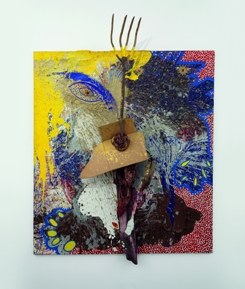
Michael Buthe | Landscape (Spanish Energy) 1985
-
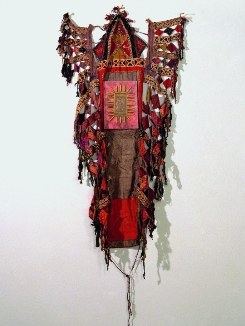
Michael Buthe | without title 1979
-
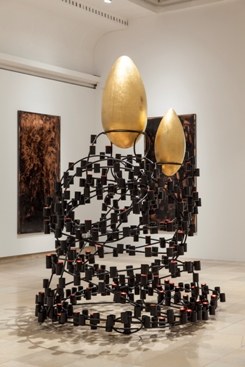
Michael Buthe | The Holy Night of Virginity 1992
-
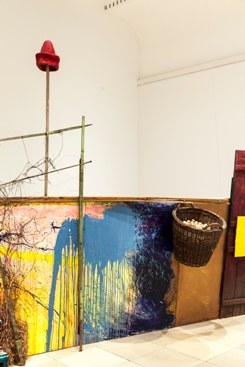
Michael Buthe | Installation view Haus der Kunst 2016 | Photo: Maximilian Geuter
-
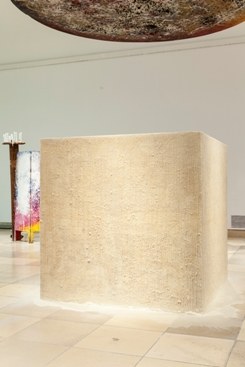
Michael Buthe | Baptismal chapel with mum and dad 1984
-
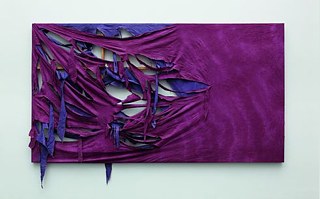
-
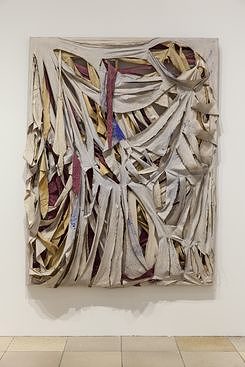
Michael Buthe | Installation view Haus der Kunst | Photo: Maximilian Geuter
-
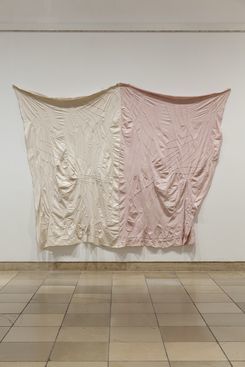
Michael Buthe | Installation view Haus der Kunst | Photo: Maximilian Geuter


