Virtual Reality in the Arctic
»Polar Sea 360°«

To travel across the Arctic and back, watch whales and polar bears, see eternal ice fall into the ocean, encounter ancient Inuit – all from your own living room, but as if you were there. Virtual reality (VR) makes it possible.
With Polar Sea 360° (2014) the German-French network Arte produced a VR experience that feels like television of the future. The project presents a multimedia research expedition through water, ice and snow. In the documentary Polar Sea – Die Eroberung der Nordwestpassage (The Conquest of the Northwest Passage), Tanja Dammertz and Kevin McMahon follow the traces of the disastrous nineteenth century polar expedition of Admiral John Franklin. A ten-part documentary series Per Anhalter durch die Arktis (Hitchhiking through the Arctic), also by Kevin McMahon, shows the impact of climate change in the region today.
The linear TV feature is complemented by an interactive extension: an all-round 360-degree view that virtually beams viewers to the Arctic, giving them the opportunity to take a look around themselves. The experience was originally designed fot the Oculus Rift headmounted display. Since at the time of production the Oculus was not yet on the market the 360-degree video was also made accessible for smartphones through the use of a simple cardboard frame.

When Wallner started the Arte project in 2011, the television editors had the idea of creating 360-degree panoramas for web browsers. Shortly thereafter, when the first prototypes of Oculus Rift were introduced, they wanted to work with Virtual Reality. There were only a few service providers for the production of spherical films, however. Equipment, shooting and post production were prohibitively expensive. Wallner therefore decided to experiment and search for ways to produce 360-degree videos quickly and cost-effectively.
Two technological innovations brought about the breakthrough: the 3D printer and the small GoPro camera. With a 3D printer special rigs could be produced on which several GoPros could be mounted in a circle. The low weight of the cameras and their ability to record images without being directly connected to a computer made it possible to mount spherically arranged camera sets on drones and to film HD panoramas in flight.
-
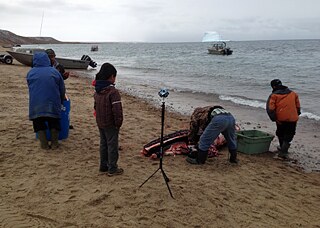
Capturing a scene where Inuit are harvesting a freshly caught narwhal on the beach of Pond Inlet, Nunavut, Canada
-
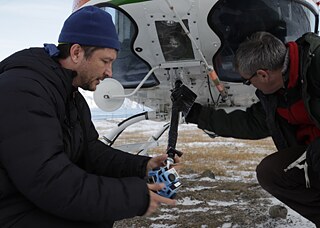
Polar Sea Director Thomas Wallner and 360 drone flyer Ian Hannah mount a 360 camera on a chopper to capture images of the Canadian Northwest Passage.
-
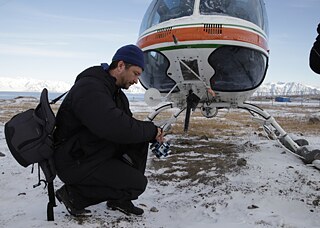
Polar Sea Director Thomas Wallner mounts a 360 camera on a chopper to capture images of the Canadian Northwest Passage.


For media users, the final experience is like this: The data glasses and the headphones almost completely blend out the perceptions of their real environment. Instead, users find themselves transposed into another world. The virtual space automatically adapts to their movements and behaviour. If a motion controller is also integrated, users can interact even more with the digital world, giving the illusion that they are really somewhere else. This illusion is called “presence.”
The VR piece for POLAR SEA 360° has been made not only to show the Arctic, but also to convey a message. This raised the question of the appropriate film language. How can the viewer’s attention be steered? How should camera shots, cuts, scene changes be done? How can a focus be put on characters?
“It works very differently from cinema,” explains Wallner. “Virtual Reality breaks through the fourth wall.” The user is in the middle of the action looking at the world from the inside out. While viewers of 2D or 3D movies look at the characters and can project their own desires and feelings onto them that is not possible in VR. What does the person in the centre of the sphere, the user, represent? What role does she play? The juxtaposition of contrasting images, which has been part of cinematic grammar since the invention of film editing, would only cause confusion in VR. While the full scope of a film narrative is only assembled in the mind of the viewer, who connects the dots between the images she gets to see, this is not possible in VR. The new medium directly addresses the senses. Rather than using a symbolic formal language, as all other media do, VR provides an immediate experience that requires neither a temporary suspension of disbelief nor an act of interpretation by the user.

Ever since Facebook acquired Oculus Rift in 2014, there has been major hype about VR. A wide range of headmounted displays has become available on the market. The pressure is on in the games, education and medical sectors – to name just a few – to create content for the new medium. But what does the future of storytelling in Virtual Reality look like? Thomas Wallner sees the narrative foundation in the coherent handling of spatial experiences. “Virtual worlds are reminiscent of the theatre, where the eye can roam freely through the space, and also of dreams, with their intuitive, associative transitions,” he explains. How stories will be told in Virtual Reality, how interactive they will be, what role the media user plays in them, and how long these experiences can practically last – are all things we will need to learn through a long process of trial and error. Richard Wagner's notion of a work unifying all art forms, André Bazin’s Cinéma Total, even the holodeck from the science fiction series Star Trek seem to be within reach today. “Whatever the future of VR is,” says Waller, “it won’t be what we think today. And that’s what’s so exciting about it.”