City Sound Colombo
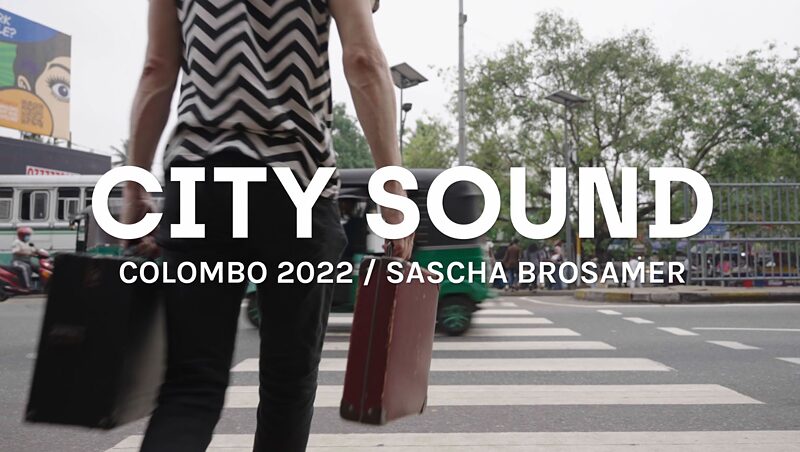
City Sound is a South Asian residential music project implemented in Dhaka, Kolkata and Colombo. In the framework of which the Goethe-Institut Sri Lanka hosted the Berlin-based interdisciplinary sound artist Sascha Brosamer. During his one-month residency, Brosamer met, exchanged, shared and collaborated with musicians and producers in different locations around the island which resulted in weekly performances, talks and listening sessions inviting audiences in Jaffna and Colombo to engage with Brosamer’s experimental approach. Brosamer was also invited to contribute a performance to the Theertha Performance Platform and spontaneously performed in an offset printing house in Colombo.
© Goethe-Institut
About the Artist
Sascha Brosamer is an interdisciplinary artist and electronic music composer from Berlin. He is exploring the archaeology of sound and its projection into the digital future.
Brosamer studied Music and Media Art at HKB in Bern, Switzerland and graduated as Meisterschüler in 2014 with honors in Painting from the State Academy of Fine Arts Karlsruhe, Germany. His work has been shown at Zwinger Gallery Berlin, Club Silencio Paris, Bundeskunsthalle Bonn, WP8 Düsseldorf, BB15 Linz, Oz Gallery Tokyo, Le case d'Arte Milan, and Cooper Union Gallery New York. He is the founder of Global Forest, an artist residency in the former studio of Martin Kippenberger in the Black Forest/Germany and curator of Dual Sessions, a multidisciplinary format that brings together turntable industry, science, art, music and pop.
Currently he is engaged in early technology of sound reproduction, especially the gramophone and 78" shellac records, an ancestor of today's club culture. Brosamer's studio is the sound archive. He researches and works in the Phono Museum Paris, the Berlin Phonogramm-Archive and the Schmauder Collection, one of the most extensive collections of historical sound recordings.
Research Travel to Jaffna
Sascha Brosamer on his City Sound residency explored the sounds of the Northern region of Sri Lanka. In Jaffna founder of Kälam, Kirutharshan Nicholas helped Brosamer to find his way around and connected him to the local music scene. Nicholas organized a day trip to Mullaitivu where Sascha Brosamer got the chance to listen to the local Parai drummers. Parai is an ancient percussion instrument that is traditionally played at temple festivals and funerals. Historically it was used as a tool for making public announcements during special occasions. The Parai drummers from Mullaithivu have preserved this art form over generations despite extreme hardships during the civil war.
Sascha Brosamer also conducted a workshop at the University of Jaffna where he shared his experimental sound with interested students of the Drama and Theater Arts Faculty.
He further collaborated with the Ambha Paadu singer Sebastiampillai Vasanberk for recordings and a performance at Kälam. Ambha Paadu songs are typically sung by fishermen in Sri Lanka. The rhythm of the songs helped fishermen perform physically hard (mostly monotonous) work such as pulling heavy lines or nets and steering their boats across the sea. Due to modern technology such as motorized fishing boats and hydraulic equipment that make the fishermens’ lives easier, Ambha Paadu songs are slowly disappearing. Sebastiampillai Vasanberk is one of the few singers who still practices and preserves this musical heritage.

Performances and Listening Sessions
During his residency Brosamer collaborated and worked with local musicians, artists and record collectors about the history and materiality of recorded sound and how infrastructures of the music industry are entangled with colonial and militaristic histories of the western world.
With sound artist Dinelka Liyanage as well as Asvajit Boyle and Nigel Perera (Jambutek Recordings), Brosamer performed live at Foozo Mantra Lake Gardens, a guesthouse situated by the urban backwaters of Colombo. Both live performances invited the audience to connect their smartphones to Brosamer’s guitar. Via the web-based application "Grainfield" Brosamer’s alternative guitar tunings were then repeated through the multiple connected mobile devices and created an immersive listening experience.
A particularly unusual performance playing on the idea of man vs machine, articulated by Walter Benjamin in his essay “The work of art in the age of mechanical reproduction” took place on a Sunday morning in a small offset printing house in the multi-cultural low-income neighborhood of Kirulapone: Man and machine both blurred the lines between noise and music, rhythm and intention, creating an organic cacophony of mechanical sounds.
In the frame of a local performance art festival, the Theertha Performance Platform which took place in the semi-abandoned Rio Cinema and Hotel complex, Brosamer gave the dark spirits, rampant in this historic venue an audible voice. Using his electric guitar, he performed within the charred walls and violent memories of pogrom encapsulated in them since the Black July riots of 1984.


