About the Project
Background
In recent years, cultural institutions such as the Goethe-Institut have repeatedly been forced to suspend or relocate their work at various locations. In countries including Ukraine, Afghanistan, Syria, Belarus, and Sudan, this has led to the loss of key spaces for international exchange, artistic practice, and critical discourse. Artists and partners with whom the Goethe-Institut had collaborated for many years were compelled to leave their home countries and continue their work under changed conditions in Germany.
Against this backdrop, the Goethe-Institut in Exile was founded in Berlin in October 2022.
Tasks and objectives
The project understood itself as a platform for artists and cultural practitioners who, due to war, censorship, or political repression, were no longer able to work in their countries of origin.
It created space for encounter, exchange, and artistic production, contributing to the preservation of existing networks and the formation of new international and civil society connections. In this way, regional and global discourses on exile, migration, and cultural practice were continued and made visible.
The programme included film series, readings, concerts, performances, exhibitions, as well as discussions, workshops, and networking formats. A key component was collaboration with artists with experiences of displacement and exile, as well as with international partner institutions.
Events were held primarily at Kunsthaus ACUD in Berlin, as well as at other venues in Germany and in digital formats.
Project History
In its first phase, the project was strongly structured around country-focused strands. It opened in 2022 with a launch festival dedicated to Ukraine. In 2023, this was followed by programmes on Iran, as well as an extensive focus on Afghanistan, which foregrounded the Afghan diaspora and perspectives of women and minorities. In 2024, Belarus became a central part of the programme through an interdisciplinary festival and a strong emphasis on diasporic networking. Collaborations with Goethe-Instituts in Warsaw, Kraków, Vilnius, and Tbilisi marked an expanded form of international cooperation.
From autumn 2024 onwards, the project increasingly developed towards transnational and thematically oriented formats. It evolved into a platform for polyphonic, international discourses in the context of exile and migration.
Projects such as the festival “Mapping Sounds in Exile”, in collaboration with the Berlin School of Sound, or “Once We Were Trees, Now We Are Birds”, together with the Martin Roth Initiative, brought together artistic positions from diverse contexts.
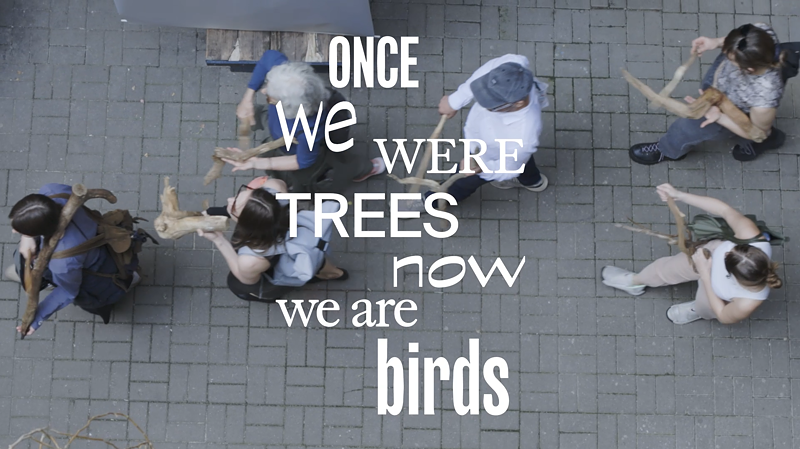
© Aleksandra Kononchenko
Transnational Programme 2025-2026
A recurring motif of the project was the question of which voices are heard – and which remain unheard. At the beginning of 2025, a curatorial framework titled “Through the Cracks” emerged in a workshop with four curators from Belarus, Sudan, Iran, and Afghanistan.
The title refers to an approach that seeks out cracks and in-between spaces in the present – beyond clear attributions, fixed orders, and binary modes of interpretation. It points to those moments in which perception shifts and something becomes visible that cannot be clearly categorised. “Through the Cracks” describes the deliberate search for such spaces: for formats in which artistic practice and discourse can be sustained even in situations of political, social, or biographical rupture.




Event Archive
The complete programme across the entire project period is documented in the event archive. It contains all events and formats from 2022 to 2026. The listings reflect the information available at the time of their original publication.


