


Hajouri is a vocal form popular in Darfur and has been known since antiquity; with time, Hajouri even acquired great social significance by addressing various upheavals and events. Its names differ from one region to another; some groups call it Badawa, Al-Mandus, and others Al-Hajouri and Al-Kushouk. The difference is in tempo; Badawa is slower and now almost extinct; Al-Mandus is slow, Hajouri has a medium fast rhythm, while Al-Kushouk is fast. The latter two are the most prevalent scales in the region.
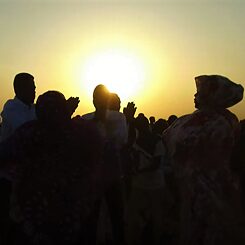
The Hajouri is performed individually or collectively by men and women, accompanied by rhythmic clapping. A solo performer sings, followed by a chorus and accompanied by the kerir (a type of moan sung by men). This style utilizes contrapuntal melodies (multiple horizontal melodies) and has regional variants. It can also be performed collectively in a simple monophonic style.
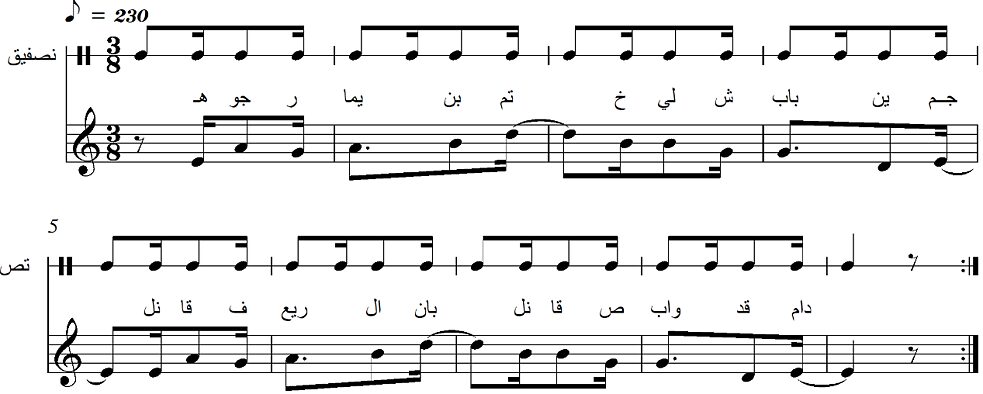
Hajouri melodies use quadruple and pentagonal scales that are free of half-tones, on a simple tritone scale 3/8.
The music is accompanied by the Hajouri dance, in which one or more young men leave the line formation, and choose a female companion for the dance. The men thereby stand in front of the women and stomp the ground with one foot, a move that is called sakka or sagga with which the individual dancer signals to his partner of choice. The men and their partners then proceed to jump in rhythm, while boys clap and move in the background. The dance ends with one or both dance partners stopping and returning to their position, in order to give others the opportunity to perform. Future life partners are often chosen at this dance.
Hajouri, like a lot of folk singing traditions, addresses different aspects of society, such as the successive revolutions, and the social and economic upheavals that happened in Sudan.
Some of the most famous Hajouri singers are Mubarak Korma, Adam Niqai, and Halima Sasa (who takes her name from her performance of this song). The lyrics of the song, composed by Adam Ibrahim, include the lines, “Hush, I want to ask the girls who went to the well today, did you see my beloved there? I met my beloved yesterday, but my yearning wasn’t fulfilled…” This is the work that Mohammad Adam based this track on, inspired by the Hajouri dance and song, as sung in the local dialect by Halima Sasa.
Mohamed Adam wanted to introduce listeners to West Sudan through its songs, and to bring forth the peoples of this dance, who live in Darfur - especially since the Tunjur people (except in the Baggara Belt) also perform this dance, which showcases the tolerant nature of the people of Darfur.
Lyricist: From popular memory
Composer: Adam Ibrahim
Arrangement:
Instruments: Sequencer instruments: Calabash, Bongo, Conga, Guitars, Bells, Kalimba
Date of original composition/work: Old
Singers: Mohamed Adam
Instrumentalists:
Solina Organ: melody lines, virtual instrument
Mohamed Sharhabil: Bass, drums
Mohamed Araki: Sequencer
Recorded: August 2021
Lyrics: n/a
The Why Behind the Music
My childhood in the village of Grabbishi, Darfur, made me acutely aware of the linguistic, musical and cultural diversity that exists within the central cities in Sudan and its peripheral regions. My interest in music since childhood prompted me to compare the melodies I heard. From there on, my auditory memory began to take shape, which is an integral part of the diverse Sudanese cultural production.
Despite Sudan’s ethnic, racial, cultural and linguistic diversity, what has dominated the media since the establishment of the radio and the beginning of the documentation of Sudan’s music is a specific musical color and style such as Al-Hakiba music (which developed with the emergence of radio in Khartoum during the 1940s), linked mostly to the center of Sudan, Khartoum.
Nonetheless music from all of Africa’s corners brings us together, despite our cultural and social differences. Therefore, through this project, I want to introduce the listener to various Sudanese musical styles that I consider capable of erasing the religious and ethnic boundaries between different peoples. The fact that various governments failed to spotlight certain cultures, while choosing to focus on others, created an increased awareness of differences between different groups. This was further exacerbated by the presence of social class divides accentuating the diversity between urban and rural inhabitants, making each aware of their own dialects and cultures. These differences melt away in urban centers like Darfur and Khartoun, as inhabitants from rural areas try to assimilate into the majority culture of the city.
Because of my obsession with documenting our rich musical heritage and presenting it to listeners, I turned to what I call the “auditory memory” of the Sudanese people. I spoke with many musicians, instrumentalists, and dancers. I also contacted researchers to help me parse the materials I found in the archives. Through interviews and field research, I realized that the Sudanese people have developed their own cultural archive through memory, as the archive has become a part of their being, residing in their own conscience.
It was difficult to reflect all this cultural richness in my songs, which merely constitute examples of every corner of this great country. They are, however, a shy attempt to get to know parts of our beloved Sudan. This project and documentation confirm that Sudan is a mixture of musical and cultural identities, and a true example of diversity.
Related Links
-
YouTube
-
YouTube
-
Mirath:Music
November 2021