


Ero Hoke belongs to the heritage of the Bertha tribe who are a part of the Funj tribes present around the Blue Nile State, linking the south of the Blue Nile with Ethiopia.
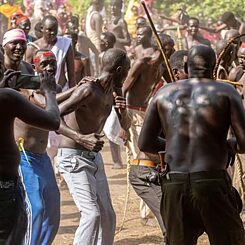
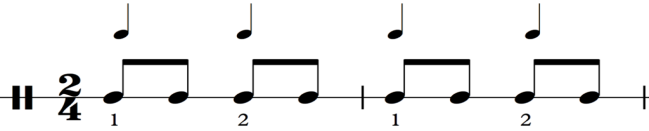
The dance is performed by men and women with a main vocalist, whose refrains are echoed by a chorus. The dance has three different rhythms known as ero, manqa, and ab-boom-oom-wa’aqzu. Rhythmically, it uses the naqqāra (a percussive instrument) and simple two-by-four taps .
This song is performed during the harvest festivities in a circle that includes men and women, who move slowly, followed by quick jumps in unison around the rhythm keeper. The dancers hit the ground with their feet, creating a rhythm that matches the naqqāra’s, accompanied by the ululations of women, horn sounds, and claps that are emitted by banging two safariq () against each other.
Ero Hoke is also called “The Stem of Fire” and is considered the representative song of this tribe. During the last night of the harvest festivities, which lasts until dawn, everyone gathers around to “throw fire” at the edge of the village, signaling the end of the festival, after “defeating evil spirits with fire”. This is followed by cries, ululations, and sprinting, to force out scary spirits while stoning them, thereby expelling “hunger, poverty, disease, and harm against the tribe.”
This rite has cultural and religious significance, as it preserves the cultural heritage of the tribe, connects younger generations with their ancestors, and renews the social contract. It also provides an opportunity for forgiveness between antagonists, in addition to religious and spiritual connotations that are represented by giving thanks to God, the Granter of rain, growth, and all that is good.
Mohamed Adam found a recording of the song in the “Berlin Phonogram Archive”, then rerecorded and rearranged it. He was keen to include the Funj heritage in his project due to its social and cultural dimensions. However, Mohamed had great difficulty in finding sources and information about this particular song given that it is sang in a language barely know and spoken nowadays. There was also no vocabulary compendium or lyric sheet available.
To find out more about the song, Mohamed sought the help of Eng. Abdul-Jalil Mahjoub Abdul-Sayed (civil engineer and music researcher) and Dr. Salah Musa Al-Akkad (researcher and one of the few who are still able to speak the Bertha language), who explained the song’s context and connotations. Upon examining the lyrics, Mohamed Adam found that some of the lyrics are sexual in nature and would be considered inappropriate by some listeners nowadays. Thus, the artist adjusted the lyrics to suit the ears of the modern listener and make them acceptable. He also replaced the sexual connotations with lines related to work and the reconstruction of the country. It was the help of Eng. Abdul-Jalil Mahjoub Abdul-Sayed and Dr. Salah Musa Al-Akkad that enabled Mohamed to overcome the difficulties, and facilitated the research.
Duration: 3’20
Lyricist: From popular memory
Composer: Folk
Arrangement: Mohamed Adam
Instruments: Calabash, Bongo, Conga, Guitars, Bells, Kalimba, virtual instrument, Drums, Bass
Singers: Mohamed Adam
Instrumentalists: Sequencer instruments done by Mohamed Araki,
Melody lines done by Solina Organ, virtual instrument),
Drums, bass by Mohamed Sharhabil,
Bongo done by Al doma Dreij
Recorded: August 2021
Lyrics: n/a
Engineer: Abd Al-Jalil Mahjoub Abd Al-Sayed
Dr. Salah Musa Al-Akkad
The Why Behind the Music
My childhood in the village of Grabbishi, Darfur, made me acutely aware of the linguistic, musical and cultural diversity that exists within the central cities in Sudan and its peripheral regions. My interest in music since childhood prompted me to compare the melodies I heard. From there on, my auditory memory began to take shape, which is an integral part of the diverse Sudanese cultural production.
Despite Sudan’s ethnic, racial, cultural and linguistic diversity, what has dominated the media since the establishment of the radio and the beginning of the documentation of Sudan’s music is a specific musical color and style such as Al-Hakiba music (which developed with the emergence of radio in Khartoum during the 1940s), linked mostly to the center of Sudan, Khartoum.
Nonetheless music from all of Africa’s corners brings us together, despite our cultural and social differences. Therefore, through this project, I want to introduce the listener to various Sudanese musical styles that I consider capable of erasing the religious and ethnic boundaries between different peoples. The fact that various governments failed to spotlight certain cultures, while choosing to focus on others, created an increased awareness of differences between different groups. This was further exacerbated by the presence of social class divides accentuating the diversity between urban and rural inhabitants, making each aware of their own dialects and cultures. These differences melt away in urban centers like Darfur and Khartoun, as inhabitants from rural areas try to assimilate into the majority culture of the city.
Because of my obsession with documenting our rich musical heritage and presenting it to listeners, I turned to what I call the “auditory memory” of the Sudanese people. I spoke with many musicians, instrumentalists, and dancers. I also contacted researchers to help me parse the materials I found in the archives. Through interviews and field research, I realized that the Sudanese people have developed their own cultural archive through memory, as the archive has become a part of their being, residing in their own conscience.
It was difficult to reflect all this cultural richness in my songs, which merely constitute examples of every corner of this great country. They are, however, a shy attempt to get to know parts of our beloved Sudan. This project and documentation confirm that Sudan is a mixture of musical and cultural identities, and a true example of diversity.
Related Links
-
YouTube
-
YouTube
-
Mirath:Music
November 2021