Robot in Residence II
Diversity in Artificial Intelligence

On Wednesday, 26th April 2023, the Goethe-Institut Ghana in partnership with enpact, Africa Berlin Network, IoT Network Hub Africa, and Innovation Spark, organised an event at the Google AI Center Accra to discuss the topic of Diversity in AI in Africa.
By Joseph-Albert Kuuire
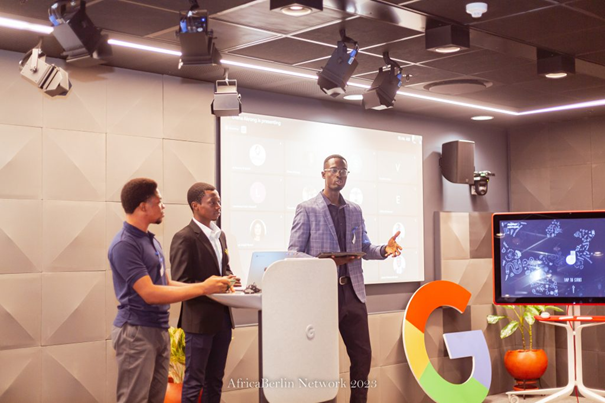
The event kicked off with a welcome address by Ammishaddai Ofori from Innovation Spark, and started off with a presentation from Hamza Mohmmed and Abdulrauf Abdulganiu, two developers who worked on the NAO robot. They gave a presentation on their work with the robot and how they developed skills for the robot to recognise objects using computer vision.
The robot was developed in November 2022 with the ability to converse in English and translate to Ga and detect Ghana's Adinkra symbol.
The developers highlighted a couple of challenges with their development of the Nano robot including the lack of quality datasets, particularly for text-to-speech and speech-to-text, for Ghanaian languages. They also stated that the robot SDK was designed with Python 2 and would have been better if the programming language was in Python 3.
Panel Discussion
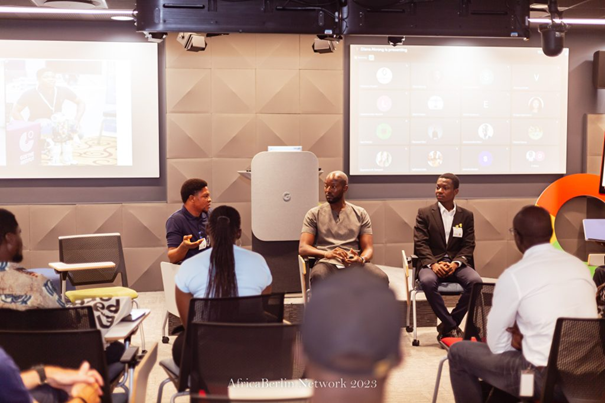
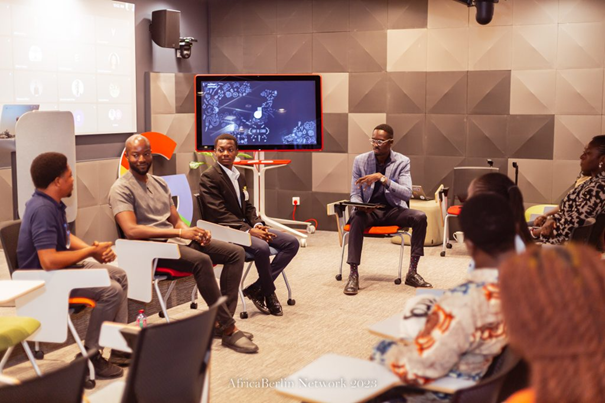
After the presentation, there was a small panel discussion led by Ammishaddai, and panelists included Perry Nelson from Google Ghana and the two robot developers, Hamza Mohmmed and Abdulrauf Abdulganiu.
Amongst the topics discussed were data protection and privacy when it came to AI in Ghana and Africa. When asked about how Google uses data, Perry stated that Google has a policy where the company steers clear of personal information when conducting AI research.
Hamza stated that when working with the NAO robot, they most used open-source data in their programming endeavors.
-
-
-
-
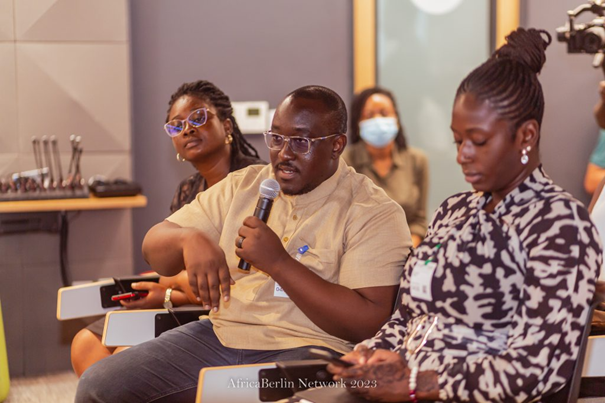


The panel also discussed local languages and how dialects could affect the use of language in AI in the African context. An audience member gave an example of how certain Ga words could have different meanings in different contexts.
Hamza Mohmmed and Abdulrauf Abdulganiu discussed the difficulty of finding data sets for local languages to program the information into the robot.
There were questions from the audience including how best to use robotics and AI in Ghana's healthcare system and its challenges. The panel answered that there were disadvantages of using anonymized data, particularly in healthcare because certain data categories could still be used to decipher a patient's personal information.
There was a statement from an audience member about getting the process started for the standardization of languages in Africa and how that could be a benefit for the use of AI in natural language processing for African languages.
Second Panel Discussion
After a short break, the event jumped into a second-panel discussion which had panelists including Winifred Kotin from Superfluid Labs, Rashida Musa (formally of Bluespace), and Lawrence Adu Gymafi from Ghana's Natural Language Processing (NLP) team.
The panel discussed current use cases for AI in business. Rashida cited some examples including the optimization of business workflows using AI and stated how companies like ADB bank were using AI.
Winifred stated that they had worked on some use cases with some clients, who were mostly private sector companies.
She stated that private enterprises are more open compared to the public sector because private enterprises are further along in the digistation phase.
The group spoke about bias in AI with Rashida noting some of the algorithms used tended to be biased because of where and when the data was created and collected and spoke of the lack of data readily available in Africa. Winifred also added that there were other factors including gender and geography which could also affect the algorithm.
When discussing the topic of inclusivity in AI, Winifred noted that hiring of more women in the space was still an uphill challenge and there was more work to do to bring in more women into AI.
Rashida brought up the point of Africa data for use in AI and how the data was still not as readily available.
There were questions from the audience including how the current public perception of AI and the ethical considerations were being taken for its usage with the public.
Winifred noted that there should not be "fear" when it comes to AI because AI is currently being used in areas including emails and voice assistants. The panel noted that in Africa, there needs to be a consideration to regulate AI and the appropriate government entities would need to take up the mantle.