© Thabang Taukobong
© Goethe-Institut Johannesburg
1996
June to July 1996
Establishment and Consolidation
By January 1996, the Goethe-Institut moves into its own office and training facilities at 17 Baker Street in Rosebank, Johannesburg. The number of employees doubles to six and by February the institute is fully operational.

17 Baker Street building in 2025 | © Goethe-Institut Johannesburg
The first German course starts on February 5, 1996, 10 months after the institute begins work.
In May, the event The role of the Writers in a changing society using the example of South Africa and Germany with Nadine Gordimer, Thomas Brussig and Wolf Biermann takes place.
© Bundesregierung | Christian Stutterheim
1996
23. July 1996
Official Opening
On 23 July 1996, the Institute is officially opened by the then German Foreign Minister Klaus Kinkel and the South African Foreign Minister Alfred Nzo.
Read also the speech by Federal Foreign Minister Klaus Kinkel at the opening of the Institute.
-
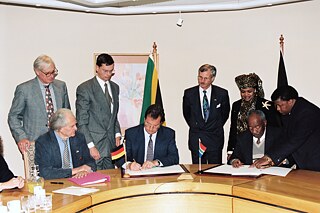
Klaus Kinkel, Federal Minister for Foreign Affairs (centre), Hilmar Hoffmann, President of the Goethe-Institut (l.) and South Africa's Foreign Minister Alfred Baphetuksolo Nzo at the signing of a contract to inaugurate the Goethe-Institut. In the background (centre right): Uwe Kaestner, German Ambassador © Bundesregierung | Christian Stutterheim -
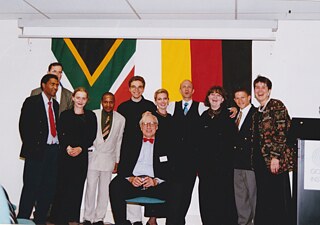
People from left to right. Peter Bafana Mahlangu (technician and driver), behind hidden cultural officer of the German Embassy Pretoria, Wiebke Wilhelm-Makgabo (reception), Khutso Makgabo (German teacher), trainee (name unknown), sitting Dr. Matthias Rick (institute director), Susan Sandison (head of administration), Stefan Hüsgen (head of language department), Elna Coetzer (language course management), Abel Farao (German teacher), Marina Snyman (information center) © Mattheus Els -

Picture of the speech manuscript from Federal Minister for Foreign Affairs Klaus Kinkel © Bundesregierung | Klaus Kinkel -

Picture of the speech manuscript from Federal Minister for Foreign Affairs Klaus Kinkel © Bundesregierung | Klaus Kinkel


July to December
1996
© Goethe-Institut Johannesburg
2000
at our current location
new home
Since the turn of the millennium, the institute was at home at the German Consulate General in Parkwood, Johannesburg.
The former old villa functions as an administration building and was extended by the annexe with library, auditorium, training rooms, gallery, atrium and further offices.
The new premises are necessary because the institute is growing continuously: the number of employees has grown to seventeen.
-
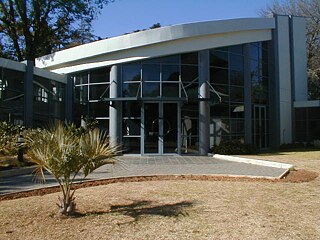
A new building was built for the Goethe-Institut, which is connected to the former old villa as an administration building. © Goethe-Institut Johannesburg -
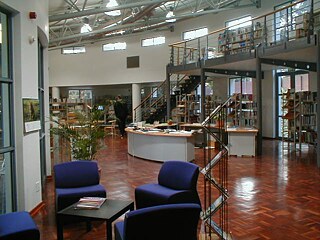
The Infocenter was designed from the outset to be used in a variety of ways. © Goethe-Institut Johannesburg -
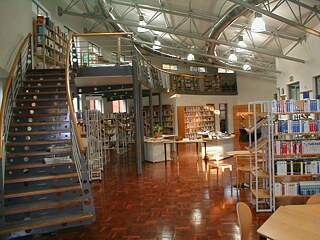
The Infocenter is today the multifunctional space Library-Gamebox-Hub © Goethe-Institut Johannesburg -
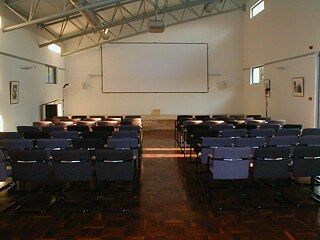
The auditorium is designed as a large event space and is multifunctional. © Goethe-Institut Johannesburg -

The foyer with reception area and part of the gallery, which is used for exhibitions. © Goethe-Institut Johannesburg -
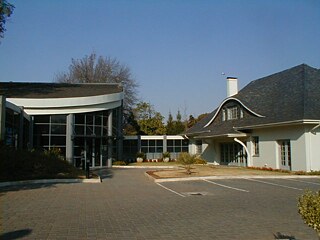
The former old villa on the right as the administration building and the new building on the left. © Goethe-Institut Johannesburg


© Goethe-Institut Johannesburg


?
2009
'Cracking Walls' hosted by the Goethe-Institut was a series of events with the theme of bridging walls and the necessity of civil commitment to ensure a healthy democracy. 'Cracking Walls' culminated with the demolishing of a part of the wall that surrounds the Goethe-Institut on 9 November 2009.
Cracking Walls Documentary
© www.icon-world.com
2010
FIFA World Cup 2010 in South Africa
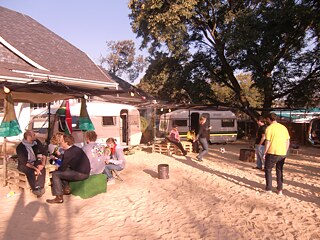
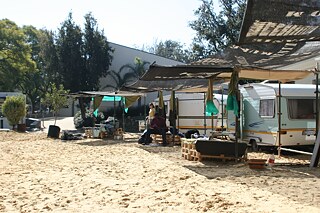
Together with the Federal Foreign Office, the Goethe-Institut organizes the largest cultural programme for the 2010 FIFA World Cup in South Africa: from art exhibitions in the Johannesburg Art Gallery and Freedom Park, to DJ sets by Whirlpool Productions, the theater production X Apartments in Hillbrow and Soweto, as well as a trailer park with public viewing on the institute's sand-filled parking lot: the programme presents selected cultural events from Germany, the country of the previous World Cup, in South Africa. Abdullah Ibrahim, the Ensemble Modern, Frank Dellé, 2raumwohnung, Haroun Farocki and many others are invited by the Institute and represent Germany's commitment to both soccer and culture.
-
© Goethe-Institut Johannesburg -
© Goethe-Institut Johannesburg -

© Goethe-Institut Johannesburg -

© Goethe-Institut Johannesburg


© Music in Africa (MIAF)

2011
From an Idea to an Institution
Music in Africa Foundation
The Success
Music in Africa started as a project by the Goethe-Institut in 2011 and has fully-fledged in a pan-African organisation, which celebrated its 10th anniversary in 2023. Music in Africa is operating across the continent and committed to the development of the African music sector.
The Basis
The basis of Music in Africa's work is the Music In Africa Portal, which today is the largest information platform for the African music sector. The portal provides recent content from the music sectors all over the continent, informs about opportunities and serves as a platform to present and connect musicians, producers, distributors, festivals and organisations
The Conference ACCES
The ACCES music conference has been another flagship project of the foundation, being the leading pan-African music conference for stakeholders in the music industry to exchange ideas, discover new talent and drive the development of a dynamic music sector in Africa. The event spans three days and offers a dynamic programme of industry talks, keynotes, live performances, networking sessions, pitch sessions, training workshops, exhibitions and shared recording spaces for participating artists.
The Sounds Connects Fund
The largest co-operation project was Sound Connects Funds - a joint initiative of the Music in Africa Foundation and the Goethe-Institut. The Sound Connects Fund (SCF) is a multi-faceted initiative that aimed to accelerate the development and increase the capacity of the cultural and creative sector in Southern Africa by supporting eligible creative and cultural industry organisations in Southern Africa by providing financial support in the form of grants of various sizes and comprehensive capacity building programmes.
Other notable projects of the Music in Africa Foundation are:
- Gender@Work
- Instrument Building Workshops
- Revenue Streams for African Musicians (RSFAM) Research

© Goethe-Institut Johannesburg
2015
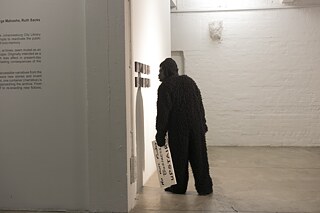
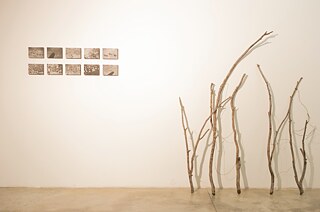
GoetheOnMain was an innovative art space of the Goethe-Institut South Africa. It was located in Maboneng in downtown Johannesburg, at 245 Main Street, from 2009 to 2015. GoetheOnMain was created to provide a platform for artistic expression outside of the Goethe-Institut and to address cultural segregation in the city.
The project aimed to promote artistic projects that work with different urban and social contexts. They were to be offered a platform on which they could present their work and enter into an exchange with an audience. The exhibitions and performances that took place there over the six years were deliberately experimental, interdisciplinary and socially relevant. For example, there were performances with shopping carts or exhibitions about forced evictions - themes that reflected everyday urban life and social tensions. Some of the artists presented were Lerato Shadi, Georg Dietz, Alexander Opper, Vaughn Sadie and many more.
GoetheOnMain saw itself as a bridge between the city center and the suburbs, between established art scenes and new voices. It was an attempt to allow art to take place not only in galleries or elite spaces, but in the middle of urban life - accessible, critical and dialog-oriented.
Since 2017, the “Goethe Project Space (GPS)” has continued the basic concept of GoetheOnMain without a fixed location.
-

© Goethe-Institut Johannesburg -
© Masimba Sasa -

© Masimba Sasa -
© Masimba Sasa -

© Goethe-Institut Johannesburg


Henrike Grohs
14.03.

2016
Goethe-Institut as kick-off partner
Abantu Book Festival
The first Abantu Book Festival takes place from 8-10 December. The aim is to present the work of black authors and - by choosing Soweto as the festival's location - to make them easily accessible to a black audience. The festival programme includes panel discussions, one-to-one talks, film screenings and performances on the theme of ‘Our Stories’, exploring current issues through courageous voices dealing with social phenomena.
Five authors from sub-Saharan Africa are invited with the support of the Goethe-Institut (Zukiswa Wanner and James Murua from Kenya, Chika Ungwe from Nigeria, Hawa Golakai from Liberia, NoViolet Bulawayo from Zimbabwe). Thanks to this support, the festival is enriched with the voices of black authors who are able to place the South African problem in a wider context.
Another aim of the Abantu Book Festival is to create connections between different communities that share similar experiences beyond the boundaries of ethnic, national, religious, gender and linguistic affiliation.
The Goethe-Institut's work receives a lot of attention at the festival's closing event on Saturday evening for its own "Literary Crossroads" series.
© Goethe-Institut Johannesburg