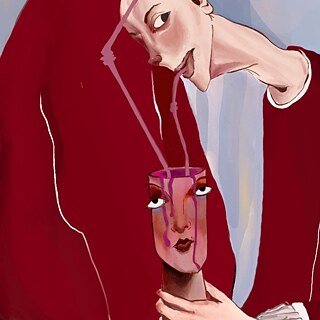
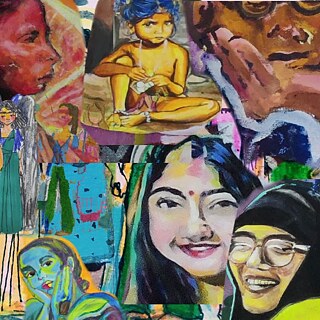
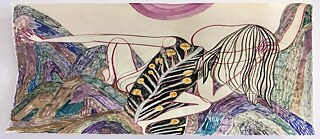
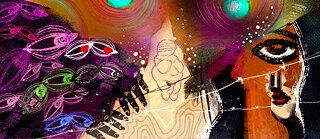
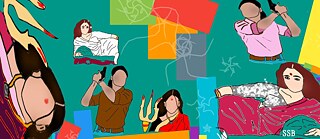
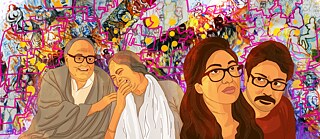
This is a space where we invite women (and their others) to imagine ‘culture’ as a site of contention and possibility, time and superluminal travel.
Is the imagination pure? Cassandra’s end, in the Greek myth, is a night just beyond the grasp of justice; her eyes become her fatal calling, for her vision of the Fall of Troy frightens the men around her. Even ‘the gods,’ Apollo.
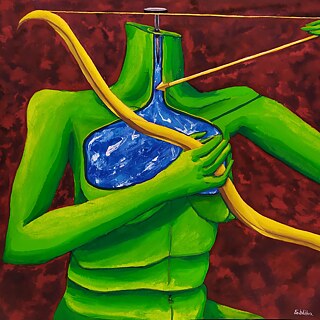
The word extreme, so oft-used now, barely explains this counterintuitive actuality, the blood that flows, below the discursive code, the pink iceberg melting colossal neo-colonial excavations, expansions and bypasses.
They reminded me of her as if I were looking at her, as if sisterhood is a balcony I am on, and I’m looking at other balconies, and also there’s a gentle earthquake going on.
It was an ordinary morning, or was it?
All mornings were weighed down by those phantom expectations that always came along with an anticipation of inevitable disappointments. They came slouching from across the hazy pages of the days and months of her forced amnesia.
How can the paradigm of a woman’s sexuality get revolutionized in a religiously restrictive country like Bangladesh? Can we ever understand the complexity of female sexuality through critical eyes? Will rendering voices according to political or social contexts be enough? We need to dig deep to sort out the mud.
A woman can only be considered a hero when she has walked many miles to ensure justice. The problematic aspect here is that - the constant portrayal of a savior as hero/heroine invalidates the struggles of a victim. A rape victim’s will to live with the trauma and a prostitute's way of negotiating her place within the society as a part of reality is never shown as heroic, despite the struggles the choices come with.
Considering the debate regarding the rigidification of the gender roles being a colonial imposition, the exaggerated romanticization of the sustenance of marriage solely for the sake of marriage itself is mostly backed up by some oral references to the “pure” Bengali values, norms, and culture.
Contact us at communications-dhaka@goethe.de. Please allow us 3 weeks for a response, but let us know if your work is accepted elsewhere. We have a pay scale for pieces and their illustrations.
Seema Amin writes and occasionally performs; she is the author of two poetry books (UPL) and was Senior Feature Writer of the art magazine Depart. Her first home was Bangkok, Thailand but she lived across Europe, Asia and the US before re-inhabiting Bangladesh, where she teaches literature. Presently, she edits Cassandra’s Eyes and is in the process of publishing her third manuscript. Several of her poems from the latter are being published this year, in The Aleph Review and in an upcoming anthology, Quicksand Borders.
Cover Illustrations
Farzana Islam is currently an undergraduate student of English Literature at Brac University. She is an independent artist working in traditional and digital media, and has worked with BYEI (Bangladesh Youth Environmental Initiative) in various creative projects as a creative insider. Taking inspiration from the real and the abstract, she aims to create a liaison between the two in her work, often integrating the people and experiences in her life into them.