On Tour with...
... Martin Kämpchen through Santiniketan

Writer, translator and educationist Martin Kämpchen had first set foot in Santiniketan, a small provincial town located in the Birbhum district of West Bengal, almost three and a half decades ago, to pursue a PhD at the Visva-Bharati University. He took an instant liking to the place and by his own confession has never since been away from it for more than three months at a stretch. We cycle with Martin Kämpchen through the town to revisit places and people which now symbolise to him the essence of the place.
Martin Kämpchen, or Martin Da (At Santiniketan it is customary to call elders of any age da, meaning elder brother in Bengali.) travels between his two worlds in a bicycle. Such a thing can be said and implied at both literal and metaphorical levels. Speaking literally, anyone visiting Santiniketan might find Kämpchen cycling through its streets with the characteristic warm smile on his face, probably travelling between his two worlds at Santiniketan: the small room at his home in Purva Palli where he sits and writes, and the school he has facilitated to establish at Ghosaldanga, a small tribal village located eight kilometres from the town. In a metaphorical sense, he shifts between these two worlds – one of scholarly and creative pursuits and another of social engagement – with an uncharacteristic ease.

In his writing career, too, Martin Kämpchen has travelled between themes and genres. His body of critical work concerns personalities as varied as Ramakrishna, Vivekananda, Rabindranath Tagore, Hermann Hesse, Günter Grass and others. He has the most authentic translations of Tagore, Ramakrishna and Vivekananda’s works in German to his credit. He has worked as freelance journalist for the well-known German daily Frankfurter Allgemeine Zeitung since 1995 and also for The Statesman in India. His travels around India have resulted in a collection of short stories first published in German and then in English translation done by the famous British Tagore scholar William Radice. Kämpchen has also published his diaries as well as one novel based on his experiences in Ghosaldanga. Besides these he has edited a number of books and essays on various themes connected with India.
A Hermit’s Abode
For his second PhD thesis Martin Kämpchen had compared the lives of the two saints, Ramakrishna from 19th century Bengal and the 11th century Italian saint, Francis of Assisi. Both had preached the benefits of leading a simple life devoid of luxury and excess. As soon as one enters the premises of Martin Da’s rented residence at Purva Palli in Santiniketan one finds a sincere and rigorous attempt to abide by such principles.
The Accidental Co-Traveller
As we set out from Martin Da’s house on our cycles one afternoon, I took the opportunity to ask Kämpchen about his cycle. It is quite old and heavy and I wonder what interesting anecdote makes him cling to it. Indeed, Martin Da tells me how he found his age-old co-traveller in Santiniketan. Arriving at Santiniketan he had promptly bought a new cycle as it was the convention at Santiniketan in those days when bikes and cars had not yet arrived. Martin Da’s washerman who was from Bihar was rather taken by the new cycle and asked to borrow it for some days. In exchange, he left his own sturdy cycle which was his old marriage cycle, with Martin Da. With his characteristic mellow sense of humour, Martin Da concludes: “The washerman never bothered to return the new cycle which since he has abandoned long ago”, while that ancient one continues to be Martin Da’s co-traveller in Santiniketan.The Fine-Arts Connection
Martin Da feels Kala Bhavan still preserves most of what once put Santiniketan on the world cultural map. The architecture is splendid with trees all around forming a backdrop. Apart from the architecture a series of strategically placed murals and sculptures by legendary artists like Nandalal Bose, Binod Behari Mukherjee, Ram Kinkar Baij, Somnath Hore, K. G. Subramanyan greet the visitor to Kala Bhavan.-
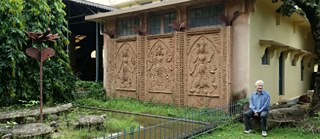
Martin Kämpchen in Kala Bhavan
-
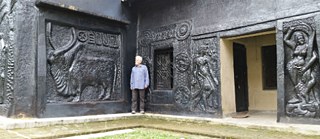
Black House in Kala Bhavan
-
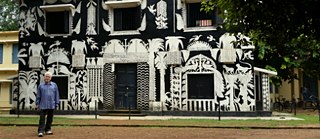
Kala Bhavan


We were visiting the Kala Bhavan campus on a Wednesday which is the weekly holiday at Visva-Bharati. Therefore, from Kala Bhavan campus we wandered to the residence of the well-known art historian Prof. R. Siva Kumar who is a faculty at Kala Bhavan. It was almost evening, the right time for an “adda”, the Bengali popular term for an informal chat, along with chai and biscuits. Martin Da was meeting Prof. Siva Kumar after some time and they had a lot to share on each other’s work.
In the Presence of History
The Uttarayan Campus in which the Rabindra Bhavan is located contains the best specimens of architectural, environmental and craft experiments done in Santiniketan. It is not surprising that the Uttarayan Campus attracts a heavy influx of tourists throughout the year. As soon as we enter Martin Da takes me to his favourite place, the Guha Ghar (Cave Room), planned and constructed by Rathindranath, the son of Rabindranath, to execute his own carpentry work. The Guha Ghar is a unique piece of one-story architecture, small and cosy, made of stone, and surrounded by a sprawling Japanese Garden. Both the Guha Ghar and the garden are located at the back side of the Uttarayan Campus. Till very recently it was closed to visitors. Martin Da confesses that he used to cherish coming to the garden. He appreciates that the garden is not over-decorated and organised but full of creepers and natural growth, much like the “jungle” around his own house. The garden has some nicely designed places to sit and enjoy its beauty.-
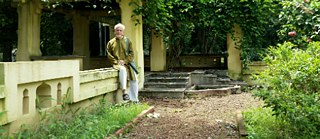
Martin Kämpchen in Rabindra Bhava
-
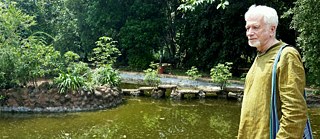
Martin Kämpchen in Rabindra Bhavan


The Fruit of Love and Labour
Last but not the least is the place closest to Martin Da’s heart, the Rolf Schoembs Vidyashram, a Santal-medium school near Ghosaldanga. It was a warm and humid day and I proposed that we take my motorbike, but Martin Da insisted on going by cycle. As we left the metalled roads of the town and entered the mud roads of the villages, I silently thanked him for insisting, as I realised the sheer pleasure of cycling through the rural landscape with green on all sides, soothing to the eyes. The reader must have realised by now which I haven’t spelt out: Martin Da loves nature. As I asked Martin Da about the roots of such nature love he shared that his birthplace in Germany, a small town named Boppard, situated beside the river Rhine, is famous for its natural beauty; the roots may lie there.-
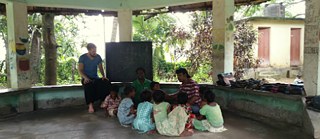
A class in progress
-
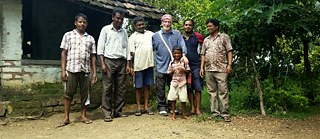
With Teachers, stuff and a student at the school
-
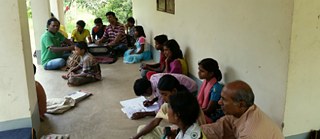
Rehearsal in progress


As we entered the school, the classes were in progress. Some teachers who did not have classes and two volunteers who had come from Germany to work at the school, joined us for a chat. Soon afterwards, we left for a short tour of Ghosaldanga on our cycles. I realised how dear to the people of the village Martin Da is, as every now and then we met people who greet him joyfully. We met a young father with his two kids with whom Martin Da spoke for a while. I learnt that the young man had lost his mother soon after his birth. Martin Da provided milk powder to feed him. Jokingly, he calls Martin Da his “second mother”.
