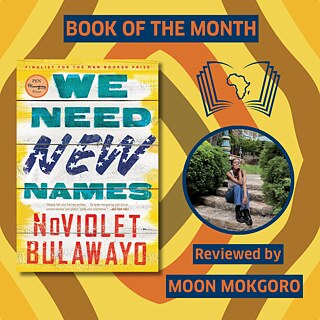
NoViolet Bulawayo’s debut novel, We Need New Names, is a powerful coming-of-age novel about poverty, political instability, migration and the struggle of finding yourself and where you belong. It follows Darling, a young Zimbabwean girl growing up in a town called Paradise, before tracing her move to the United States. Across these two settings, Bulawayo examines how social crises shape individual lives and experiences, and how migration transforms a person’s relationship to home and identity.
The first half of the novel is set in Zimbabwe, where Darling and her friends grow up in a community experiencing severe poverty and political turmoil. Their adventures are set against a world in which survival is part of everyday life – fighting to live is not an option; it is necessary. When the children steal guavas from the wealthier suburb of Budapest, the contrast between the two places becomes a clear representation of social inequality. Paradise and Budapest are not just different neighbourhoods; they reflect unequal access to more than just food, but to opportunity in all parts of life.
This contrast also invites a postcolonial reading of the novel. Bulawayo presents colonialism not as a closed historical period, but as a continuing structure whose effects remain visible in the unequal organisation of society. The divisions between communities and the distribution of resources available to Darling and her neighbours reveal the afterlife and lingering effects of colonial systems. Poverty is not presented as an individual failure as we’re often taught, but as the result of political and economic conditions that shape the lives of those suffering from it.
The novel is also highly sceptical of political promises. When the children help put up political posters proclaiming “Change, Real Change,” one of them, Godknows, asks what this “change” actually means. It’s clear he has not seen it. His question reveals the distance between political promises made to us by politicians and lived reality. The children are expected to participate in a political system that is failing them, yet they are given no clear explanation of how that system will improve their lives (it doesn’t). Bulawayo shows how political language can create hope while concealing the absence of meaningful transformation – an unfortunately common experience across the African continent.
The novel challenges the idea that migration necessarily leads to uncomplicated progress. Darling may be materially better off in the United States, but migration also involves loss. Home becomes both a source of memory and a reminder of what can no longer be recovered. The title captures this pain and this grief. New names are necessary, but the old names continue to shape the person who has left. The title captures grief and distance from what once was.
Bulawayo’s use of language strengthens the novel’s treatment of displacement. She incorporates Shona expressions, African idioms, code-switching, and inventive forms of naming. This hybridity reflects something that cannot be contained within one language or cultural identity. This is also common across the African continent. It is a form of experimentation. English becomes a negotiation and is made flexible.
The novel also preserves cultural practices and forms of knowledge that might otherwise be overlooked. When Darling says, “Jesus Christ died on this day, which is why I have to be out here washing with cold water like this,” she is referring to a religious and cultural tradition practised in certain communities. Bulawayo presents this as an experience that is part of ordinary life, not just for Darling as a fictional character, but for communities in the real world, outside of the book. Moments like this allow the reader to encounter a belief system through the experience of the character.
In this sense, fiction becomes a form of cultural memory and storytelling beyond what is imagined. Bulawayo uses fiction to carry practices and beliefs that are grounded in lived experience. Paradise is fictional, but the cultural world it contains is recognisable by many. The novel demonstrates how literature can preserve forms of knowledge and heritage that are often ignored by official histories.
The strength of We Need New Names lies in its ability to connect personal experience with larger historical and political forces. The novel is not only about one girl’s migration. It is also about the consequences of political failure, the persistence of colonial inequalities and the difficulty of creating a sense of home after displacement.
We Need New Names is an important work of contemporary literature because it shows how identity is shaped by history, colonialism, geography, and other systems built to divide us. Bulawayo’s novel asks what happens when inherited names, languages and cultural experiences no longer describe the lives people are forced to live. New identities must be created, but they remain connected to personal histories. We must ask ourselves how we navigate that.