Conference
Halima Elkhatabi at the Canadian Embassy
Ozan Abdelhafidi and Elyes Chafia tell us about their encounter with Halima Elkhabati and their enthusiasm for her inspiring work.
By Ozan Abdelhafidi and Elyes Chafia
As part of our internship at the 75th Berlinale, we were lucky enough to attend a conference organized for us by Telefilm Canada. Telefilm's representatives in Berlin, including Myriam Blais, were extremely generous in allowing us to meet director Halima Elkhatabi in a magnificent screening room at the Canadian Embassy in Berlin. After passing through security checks, we were finally able to meet the director of the short film Fantas, which had its world premiere at the Berlinale in the Generation 14plus section.
After five funding rejections from SODEC, many months of hard work in pre-production and several shooting difficulties, Halima Elkhatabi can finally savor her victory and celebrate the screening of her film at the 75th edition of the Berlinale. Inspired by real events that took place in France, the film focuses on Tania, a young Afro-descendant with a passion for horseback riding, who wants to share her passion with her friends and the inhabitants of her working-class neighborhood by paying them a visit with her horse Fantas. Unfortunately for them, this rodeo in town is short-lived, interrupted by the arrival of two policemen who want to seize the animal. The rebellious youngsters form a blockade so that Tania can escape on her stallion.

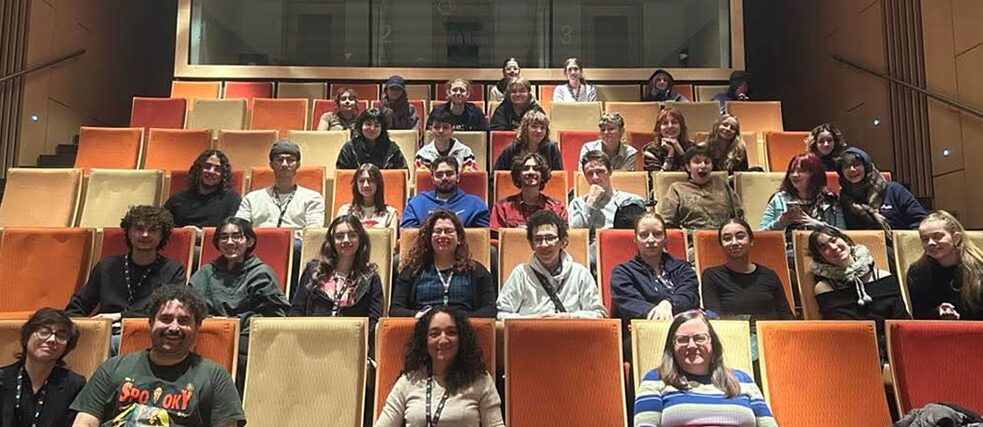
The students of the Collège Maisonneuve during the conference | © Ozan Abdelhafidi

Halima Elkhabata | © Ozan Abdelhafidi
A zest of fantasy
In Fantas, Elkhatabi masters various Western codes, adding a touch of modernity and a zest of the fantastic to give her film a unique character. Indeed, when we watch her work, we witness a collision between two very distinct worlds: life in the countryside and life in the city. Strong images emerge from this contrast, such as Tania galloping on her horse wearing a scooter helmet as a cowboy hat, or the encounter between the working-class neighborhood and the sport of horseback riding. As for the zest of fantasy, it manages to blend seamlessly with the western genre, adding a unique trait to the story that allows viewers to disconnect from reality and let themselves be transported by the film. Added to this is the socially engaged story, which highlights the misdeeds of the police force and the unequal opportunities of different social classes. There is, however, one distracting detail. During the police intervention, Tania hands over her identity papers and proof of ownership of Fantas. The film thus ends on an open note. In short, apart from this script detail, Halima Elkhatabi has succeeded in delivering a film that is concise yet rich in content. An example for us to follow!Finally, we have to mention that Halima Elkhatabi has been very generous with her time with the CEGEP de Maisonneuve students, for which we are very grateful. The political dimension of her film, woven into a captivating fiction, enabled us to understand many things about how to comment on our society without necessarily making a documentary. Thank you Halima!