06.07.2020 | Maria Stepanova
“Have we relinquished our rights too recklessly?”
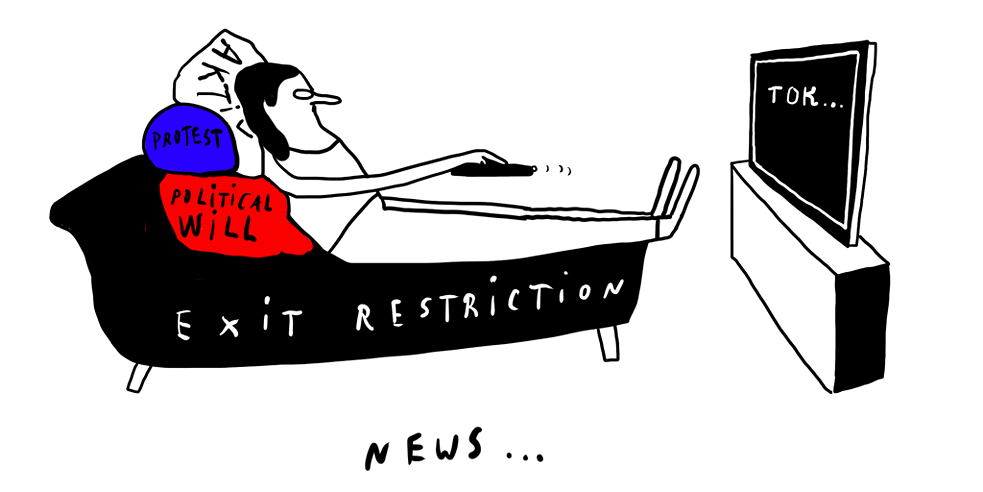
Community spirit, military language, and the search for guilt at close quarters. How does COVID-19 change Russian society; and is the curtailment of basic democratic rights really temporary? Maria Stepanova writes to us from Russia, where shortly before the publication of this article Vladimir Putin won a political victory, which allows him to hold the office of president until the year 2036.
By Maria Stepanova
Dear friends,
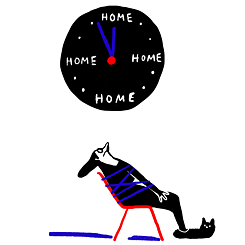
I’m writing this on the seventy-ninth day of my self-isolation. I’m spending the day in my flat in Moscow: I can only leave with an electronic keyfob that entitles me to be out and about in the city, which means that – apart from walks with our dog, which are also restricted to a radius of a hundred metres around our home – I virtually never go outside anymore.
The pandemic has made the already clear division in society even more obvious
 © graphicrecording.cool
City life as we knew it until a few months ago is dead – cafés and bookshops are shut, boulevards and parks closed off, not a soul on the streets, you only come across couriers in green and yellow uniform. The pandemic has made the already clear division in society even more obvious: it’s divided into those who can afford the luxury of not stepping outside their front door, and the others, who provide their goods and services. Not only do they have to carry on working, they are exposed to a higher risk of infection on all levels. In Moscow this primarily affects the migrant workers, in other words the part of the city population that’s least socially secure. Even before the pandemic they effectively had no rights – employed in illegal work with miserable pay, cramped together in temporary accommodation, where sometimes fifteen or twenty people sleep on the floor. Now, with work at a standstill in most companies by order of the state, they face a dilemma: they don’t have enough money to return home, but they also no longer have work from which they could live here. Delivery jobs for restaurants, supermarkets, pharmacies and courier services are amongst the few remaining earning opportunities. The voices of these people are practically never heard, neither in the official media nor on social networks. The debates in recent weeks about the need to rebalance the relationship between freedom and safety, and the resulting unavoidable losses, are conducted by people who actually have a choice, who are in the fortunate position of not having to go outside their homes.
© graphicrecording.cool
City life as we knew it until a few months ago is dead – cafés and bookshops are shut, boulevards and parks closed off, not a soul on the streets, you only come across couriers in green and yellow uniform. The pandemic has made the already clear division in society even more obvious: it’s divided into those who can afford the luxury of not stepping outside their front door, and the others, who provide their goods and services. Not only do they have to carry on working, they are exposed to a higher risk of infection on all levels. In Moscow this primarily affects the migrant workers, in other words the part of the city population that’s least socially secure. Even before the pandemic they effectively had no rights – employed in illegal work with miserable pay, cramped together in temporary accommodation, where sometimes fifteen or twenty people sleep on the floor. Now, with work at a standstill in most companies by order of the state, they face a dilemma: they don’t have enough money to return home, but they also no longer have work from which they could live here. Delivery jobs for restaurants, supermarkets, pharmacies and courier services are amongst the few remaining earning opportunities. The voices of these people are practically never heard, neither in the official media nor on social networks. The debates in recent weeks about the need to rebalance the relationship between freedom and safety, and the resulting unavoidable losses, are conducted by people who actually have a choice, who are in the fortunate position of not having to go outside their homes.The debate about the need to rebalance between freedom and safety, are led by people who actually have a choice, who are not forced to go outside their homes.
People are using military metaphors to talk about Covid-19: They speak about a war, a battle, victory, heroism, liberation and victims.
 © graphicrecording.cool
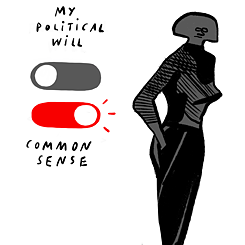
The fact that the restrictions associated with the pandemic are necessary for public welfare, and therefore for a higher interest, seems to be undisputed. What’s interesting is how every single one of us experiences these limitations, the way our concept of self changes. The reality of not being able to make long term plans anymore, of being obliged to focus on the present (and a very immediate future that looks almost identical to the present), could in theory make this present time more intensive – but apparently that isn’t happening. My experience is similar to the one described by Jonas – enclosed within my own four walls, I suddenly find it difficult to do things I’ve been doing all my life: thinking, writing, reading. This incapacitation of a person trapped in the present can be experienced as an existential comedy, because after all there have always been people who carried on working under much more unpleasant conditions – in prison, in hospital, on a psychiatric ward. Just me, in my cosy little apartment in Moscow, I can’t manage it. On the other hand, the breakdown of personal will (not to mention political will – or maybe even more so) is exactly the reaction that the state and society (it doesn’t matter which) expect of individuals in the event of a sudden emergency.
© graphicrecording.cool
The fact that the restrictions associated with the pandemic are necessary for public welfare, and therefore for a higher interest, seems to be undisputed. What’s interesting is how every single one of us experiences these limitations, the way our concept of self changes. The reality of not being able to make long term plans anymore, of being obliged to focus on the present (and a very immediate future that looks almost identical to the present), could in theory make this present time more intensive – but apparently that isn’t happening. My experience is similar to the one described by Jonas – enclosed within my own four walls, I suddenly find it difficult to do things I’ve been doing all my life: thinking, writing, reading. This incapacitation of a person trapped in the present can be experienced as an existential comedy, because after all there have always been people who carried on working under much more unpleasant conditions – in prison, in hospital, on a psychiatric ward. Just me, in my cosy little apartment in Moscow, I can’t manage it. On the other hand, the breakdown of personal will (not to mention political will – or maybe even more so) is exactly the reaction that the state and society (it doesn’t matter which) expect of individuals in the event of a sudden emergency.I remain sceptical of a safety mentality, which attributes an absolute value to human life – or more precisely to literal, stark survival. For its sake we are meant to forego basic democratic rights and freedoms.
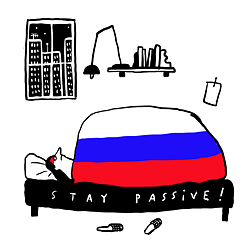
No one can take away my right to be careless with my own health, my own body, my own life. But in a pandemic situation, my personal decision is directly associated with the survival and health of others, it’s linked with the fate of dozens, or even hundreds, of people I don’t even know. My mere existence can become a threat for them, because an asymptomatic carrier of the virus is dangerous just by the fact that she breathes. In these circumstances, isolation seems to be the only practical solution – to ensure that other people can survive, a responsible citizen has to put herself into a sort of embryonic state, hide away from people like herself, stop interacting, she needs to draw boundaries not just between countries, but also between people.
 © graphicrecording.cool
And yet while I stay at home, warehouses, shops, couriers and all sorts of other service providers continue to work, making my isolation bearable and even comfortable – and that means thousands of people. These people are invisible, marginalised. In the popular black-and-white view of doctors and healthcare workers fighting on the corona front line while everyone else is saving lives by heroically sitting at home, they don’t exist. Their survival doesn’t count, and no one cares that they don’t get to choose between self-isolation and work for the good of society, because they simply can’t afford not to work.
© graphicrecording.cool
And yet while I stay at home, warehouses, shops, couriers and all sorts of other service providers continue to work, making my isolation bearable and even comfortable – and that means thousands of people. These people are invisible, marginalised. In the popular black-and-white view of doctors and healthcare workers fighting on the corona front line while everyone else is saving lives by heroically sitting at home, they don’t exist. Their survival doesn’t count, and no one cares that they don’t get to choose between self-isolation and work for the good of society, because they simply can’t afford not to work.In addition to them, members of the so-called risk group had no choice either – in other words anyone over sixty. In Russia (and not just here) those people are categorically banned from leaving the house – physical survival ranks above everything. This age discrimination disguised as concern, which has effectively robbed an entire demographic group of their capacity to act and make decisions, is fatally similar to the reasoning of robots in some old science fiction novel: to ensure that people don’t cause themselves any harm, they have to be kept under control – as strictly as possible.
The logical consequence is that I increasingly perceive myself to be a threat to society, someone who would be better off locked up. This diffuse feeling of guilt, the restriction of elementary rights and the lack of understanding of the big picture cause our self-image to blur – everyone’s a potential danger and a potential victim at the same time, everyone’s afraid for themselves and their family, yet at the same time fears harming an unknown person. For most people that’s reason enough to enter a state of inertia, at least temporarily.
The shared misfortune seemed to have a logic of community, not an enemy – but a problem that could only be solved by combining forces.
It seems to be the case that hatred is a substance that generates of its own accord despite everything, as a product of uncertainty and fear – but since no clear vision of the enemy has materialised, projected on a distant horizon, people are now looking for that enemy right amongst them.
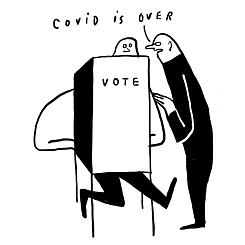
While I was writing this letter, the Kremlin announced the end of the pandemic. The motives behind it are clear. On 1st July the country is meant to be voting on the planned changes to the constitution, with the help of which Vladimir Putin could remain de facto president for his lifetime.
 © graphicrecording.cool
While I was writing this letter, out of the blue the Kremlin announced the end of the pandemic. As of 9th June, Moscow’s residents are allowed back out on the streets, cafés, hair salons and museums are open again, on social media they’re all cheering and discussing their holiday plans. The summery parks are full of people, with and without masks. Meanwhile the number of Covid-19 cases continues to rise, and even according to official statistics the curve is only just starting to flatten. Where it will all lead, releasing the people from their imprisonment unexpectedly like this, is unclear – however the motives behind it are clear. On 1st July the country is meant to be voting on the planned changes to the constitution, with the help of which Vladimir Putin could remain de facto president for his lifetime. For this election to be possible, the polling stations need to be full, and Covid-19 needs to have been officially overcome. Then we’ll probably have to brace ourselves for a second wave of infections, and the first victims of those are likely to be the people throwing themselves back into public life today. Maybe we have been a little too reckless about relinquishing the right to make important decisions on our own.
© graphicrecording.cool
While I was writing this letter, out of the blue the Kremlin announced the end of the pandemic. As of 9th June, Moscow’s residents are allowed back out on the streets, cafés, hair salons and museums are open again, on social media they’re all cheering and discussing their holiday plans. The summery parks are full of people, with and without masks. Meanwhile the number of Covid-19 cases continues to rise, and even according to official statistics the curve is only just starting to flatten. Where it will all lead, releasing the people from their imprisonment unexpectedly like this, is unclear – however the motives behind it are clear. On 1st July the country is meant to be voting on the planned changes to the constitution, with the help of which Vladimir Putin could remain de facto president for his lifetime. For this election to be possible, the polling stations need to be full, and Covid-19 needs to have been officially overcome. Then we’ll probably have to brace ourselves for a second wave of infections, and the first victims of those are likely to be the people throwing themselves back into public life today. Maybe we have been a little too reckless about relinquishing the right to make important decisions on our own.