Elemental Imprints
Bio Design Lab South Asia

About The Project
Biodesign recognizes life as an interconnected web and encourages design practices that work with ecological systems rather than exploiting them. By viewing materials as part of living, dynamic systems, the project promotes creative approaches that value symbiotic relationships between nature, technology, and culture, aiming to support balanced and respectful coexistence with the environment.
Elemental Imprints: Bio Design Lab South Asia addresses pressing environmental, economic, and social challenges across South Asia by exploring sustainable, non-extractive uses of undervalued local resources such as invasive plants, agricultural byproducts, algae, and industrial waste. Through a multidisciplinary collaboration involving designers, scientists, craftspeople, engineers, architects, and humanities scholars, it seeks context-specific solutions rooted in local cultures and ecosystems while informed by global perspectives. Its objectives include transforming overlooked resources into valuable materials, building collaborative networks between South Asian and international experts, fostering innovative design processes, and establishing a Resource Center to share knowledge through a public material library, prototypes, and publications.
A project initiated by Goethe-Institut South Asia in collaboration with the Bio Design Lab at the Karlsruhe University of Arts and Design (HfG) and conducted in Sri Lanka in partnership with the Department of Integrated Design, University of Moratuwa and Kälam.

THE SRI LANKA LAB — SEAWEED
Seaweed is far more than a simple marine vegetation abundantly growing in the seas around Sri Lanka — it is a powerhouse of unique properties with immense potential. Unlike land plants, seaweed requires no freshwater, fertilizer, or fertile soil to thrive, growing faster than terrestrial crops. Its natural ability to absorb carbon dioxide and excess nutrients makes it a vital tool for mitigating ocean acidification and eutrophication. Rich in bioactive compounds like alginates, seaweed has many underutilized healing properties. From regenerating marine ecosystems to replacing fossil-based materials, seaweed’s versatility makes it a promising blue resource to explore further. The lab invites participants to work with seaweed at the intersection of biology, design, and architecture. Through hands-on experimentation — growing, molding, observing, and co-creating with seaweed systems — participants will explore what it means to design alongside a living organism that does not follow instructions. What kinds of forms, structures, and ways of thinking become possible when growth itself is the method and structure? What happens when the material has agency? What kinds of designs emerge when control is shared with a living system?
Working with local partners, the lab will examine how seaweed networks can support circular, low-impact production and regenerative material systems. It will also open broader questions about material agency, ecological thinking, and alternative design philosophies grounded in the evolving relationship between humans and living matter.
THE LAB
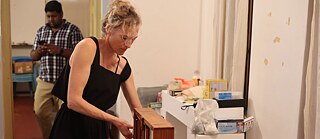
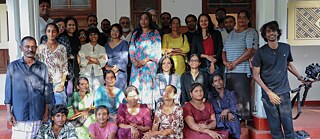
Tracing a path from the shoreline to the laboratory, and transforming observation into possibility, the Elemental Imprints Bio-Design Lab South Asia brought together participants from diverse disciplines to explore the untapped potential of seaweed as a sustainable biomaterial.
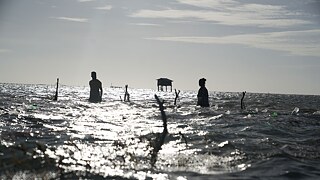
Held in Jaffna, Sri Lanka, the ten-day lab created a space where designers, architects, artists, researchers, and makers could come together to learn, experiment, collaborate, and imagine new futures using one of the ocean’s most abundant resources. Visits to the seaweed cultivation sites of Vallaipadu, based out of Jaffna, allowed participants to engage directly with farming communities and gain first-hand insight into the seaweed cultivation sites of northern Sri Lanka.
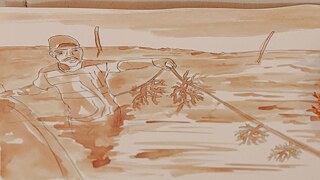
Conversations with local cultivators provided valuable insights into the full seaweed cycle, from growing and harvesting to drying and selling, while highlighting its potential to support sustainable livelihoods.
Throughout the ten days of the bio-design lab, seaweed was transformed into a wide range of applications, including handmade paper, lamps, bioplastics, biofertilisers, natural dyes, textiles, leather, and many more. Participants extracted pigments from different seaweed species to create paintings and artworks, explored weaving and material combinations for textile design, and experimented with dyeing and depigmentation processes to produce unique fabric designs. In the field of material innovation, numerous failures were navigated before successfully creating a flexible and durable seaweed-based leather alternative.
The explorations extended further as they worked to improve the products, such as making the seaweed leather water-resistant and the bioplastics edible. Other teams investigated seaweed’s potential within architecture and infrastructure, testing its suitability for bio-based construction materials and prototype bricks. Another team returned to Vallaipadu to engage further with members of the local farming community, conducting interviews and conversations that provided a deeper understanding of the systemic realities, opportunities, and challenges shaping seaweed cultivation and local livelihoods.
The lab embraced experimentation as a process rather than a destination. Failures were viewed as essential steps that opened pathways to new ideas and discoveries.
Participants learned from one another’s perspectives, mistakes, methods, and experiences, fostering a truly collaborative environment at the intersection of science, design, craft, and local knowledge. The programme concluded with an Open Lab exhibition, where participants shared their research, prototypes, and findings with students, community members, and visitors including development officials as well as fisheries and livelihood experts. More than a presentation of outcomes, it became a space for dialogue and reflection on how local resources can inspire innovative and sustainable solutions.
The Elemental Imprints Bio-Design Lab invited us to look closer: to find possibility in overlooked materials, value in collaboration, and innovation through experiment, failure, and fresh starts.