Berlinale Bloggers 2025
Berlinale: 10 Years of Films and Memories
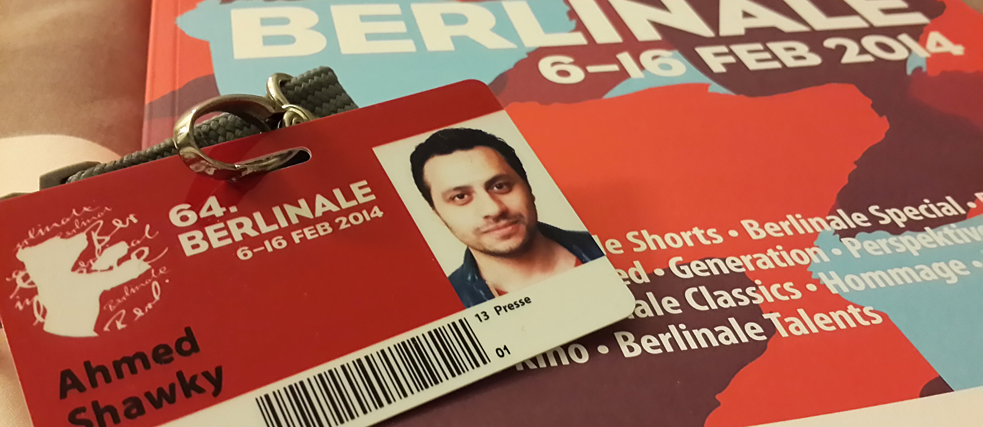
Ahmed Shawky, Berlinale blogger for RUYA magazine, has a special relationship with the Berlinale international film festival. Over the course of 10 Berlinales - first as a freelance film critic and then as this year's jury chairman of the International Federation of Film Critics (FIPRESCI) - he has witnessed the changes and evolution of the festival and collected many special memories that he tells us in his first blog.
By Ahmed Shawky
In February 2014, I attended Berlin International Film Festival, “the Berlinale,” for the first time. It was my first experience of a major global film festival. Later, I extended my experience to include Cannes, Venice, Toronto, and Sundance, among others. Today, I have been to almost all the most prominent international festivals, but the day I visited Berlin for the first time, I was so inexperienced—I look back on it today and laugh—that I hastily and naively booked a room in Alexanderplatz, simply because I love the famous Rainer Werner Fassbinder series that immortalised the square’s name.
Why didn’t I find the main festival venue and choose a hotel nearby, in Potsdamer Platz? I can’t find a logical answer. But in a way, the mistake opened an early door into the city. Perhaps if I had stayed near the festival, I would not have become accustomed to riding the U-Bahn, which I later realised was one of Berlin’s visual landmarks. I would not have become familiar with the capital’s huge buses, with their endless stops at every traffic light and their drivers who specialise in surprising passengers with sudden halts. Nor would I have found my way across Museum Island and “Unter den Linden,” which I later learned means “Under the Linden Trees”—the title of Alphonse Karr’s novel, translated into Arabic by the pioneering Egyptian writer Mustafa Lutfi al-Manfaluti.
First Night at the Berlinale
My beginner’s error, however, protected me from film festival visitors’ syndrome, in which you spend a week or more in a city, then leave and realise that you know nothing of it except the exhibition hall and the road leading there. I formed a special relationship with Berlin from the first night, when I headed into the streets to find the way to the festival’s main venue, only to discover that the press centre had closed for the day. I rushed to the Friedrichstadt-Palast theatre and bought a ticket from box office to see Rachid Bouchareb’s film “Two Men in Town.” The first of hundreds of films I have seen in Berlin, it was the only one I paid to see; after that, for the following 10 festivals, my press accreditation card became my key to discovering Berlinale films.
Ahmed Shawky in the old Arkaden Mall 2014. | ©Ahmed Shawky

The only ticket I paid for 2014. | ©Ahmed Shawky

First ticket and catalog 2014. | ©Ahmed Shawky
Berlinale and the Coronavirus Pandemic
I haven’t miscounted. Over the years, I should have attended 11 Berlinales, but when I contracted Covid-19 just before the 2022 session, it prevented me from attending that year. I did make it to the 2020 session, as the virus was starting to spread, but before it turned into a pandemic. In early March, just days after the festival ended and we returned to our countries, the airports were closed. I also attended the 2021 session virtually. It was a confusing feeling to see the Berlinale logo before the films on my screen at home. The house was warmer and more comfortable, but a feeling was missing—one that I did not regain until I went back to running every morning to the festival palace.
Ghostbusters at Berlinale 2016. | ©Ahmed Shawky

Berlinale 2016 | ©Ahmed Shawky
My memory holds so many moments and situations that it’s difficult to list them in one article. I remember being amazed by the distinctive architectural style of the Kino International and all the buildings on Karl-Marx-Allee, in what used to be East Berlin. I remember first attending the Teddy Awards, dedicated to queer films, and being amazed at everyone’s openness in declaring their sexual identities and being proud of them. I come from a society that is extremely conservative when it comes to showing feelings and tendencies in public.
I smile as I remember Dieter Kosslick, the longtime director of the Berlinale, strolling the streets around the festival palace in his hat and scarf, distributing smiles to everyone. Kosslick was so good at hiding the pressures of work that every time I saw him, I imagined he was on holiday, enjoying the festival, rather than carrying the big responsibility of leading a huge festival. Also in my memory is the special dinner I was invited to in honour of the great Egyptian critic Samir Farid, where Kosslick presented him with the Berlinale Camera award for his lifetime cultural contributions.

Dieter Kosslick at the Samir Farid Tribute 2017 | ©Ahmed Shawky

Workshop Berlinale Bloggers 2017 | ©Ahmed Shawky
As for the films, what can I say? I don’t have the space to mention the dozens of great works that have become embedded in my memory: “Boyhood” by Richard Linklater, “The Pearl Button” by Patricio Guzmán, “Victoria” by Sebastian Schipper, “On Body and Soul” by Ildikó Enyedi. These were just some of the many moments when I left the cinema, my mind and emotions immersed in what I had just seen.

Berlin subway 2018. | ©Ahmed Shawky
A Berlinale Full of Pleasant Surprises
This was the transformation of a young man visiting Berlin and its festival for the first time and staying half an hour away from his daily destination, into a critic who has attended enough editions to claim that he is an old hand at the festival. It has been a long journey full of memories, films and friendships—a personality that has evolved over the years and lost much of its innocence. What never changes is that great excitement before each edition, and the anticipation of what the new edition of the Berlinale will add to the store of memories.So having attended 10 Berlinales as a journalist, here I am attending my 11th edition in a dual role, as president of the jury of the International Federation of Critics (FIPRESCI) and as a journalist and critic. I am ready to experience another new edition of the Berlinale, knowing that it will be what I have come to expect over the years: a festival full of pleasant surprises.