Eloain Lovis Hübner
Pushing musical boundaries
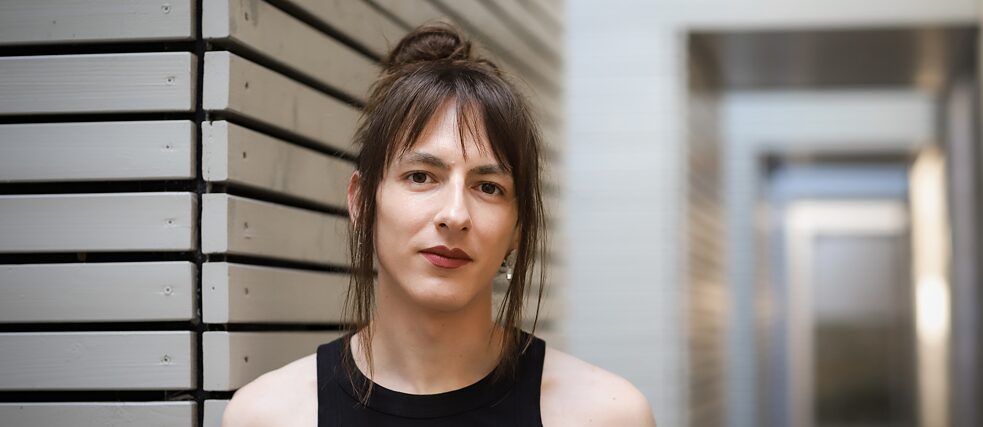
Eloain Lovis Hübner is one of the defining voices in contemporary music. She composes concert music, vocal and electronic works and contemporary music theatre. Hübner measures her success in terms not of prestige, however, but of resonance. A portrait.
What constitutes good music theatre? Various possible answers spring to mind: perhaps it is a sense of being fully immersed in the sounds, music and singing on stage, or its ability to provoke discussion and debate, or the fact that it is inclusive and open to all kinds of different people – professional and amateur musicians alike, the young and the old. Eloain Lovis Hübner is bored by such a utopian view, however. Though she describes just such a scenario with great relish in an essay she contributed to the 2024 anthology Schnee von morgen, she writes that this ultimately “doesn’t do justice” to the true value of musical theatre.
She should know: Hübner has been composing, devising and curating new music for more than a decade. The artist – a non-binary person who uses the pronouns “they” and “she” – develops immersive formats, teaches at universities and is engaged in cultural politics. Be it in her composition, performance and music theatre, curation or teaching, Hübner pursues a transdisciplinary approach, melding concepts of sound and space, vocal music and collaborative formats.
An artistic individual who “stands out among her generation” was the verdict of the jury of the German Music Authors’ Award when it picked Hübner as the winner of the Newcomer category in 2022. According to the jury, Hübner skilfully combines instrumental, vocal and electronic sounds, blending lyrics and theatre with analogue and digital imagery to create a broad-ranging oeuvre. The Bremen Composition Award, the Composition Prize awarded by the state capital of Stuttgart and residency scholarships at places like the Villa Aurora in Los Angeles and the Cité internationale des arts in Paris are testimony to the reach of the artist’s work.
Simultaneously learning to read music and the alphabet
Born in Bremerhaven in 1993, Hübner developed an early interest in music: by the age of five she was already starting to play the trumpet, followed soon afterwards by the piano and organ, and learning to read music. And because reading music seemed hardly any different to reading and writing the alphabet, writing music came just as naturally to her. This is how she began composing, as she tells the soprano singer Irene Kurka in her podcast Neue Musik leben (Living New Music). Hübner only later discovered that the system of musical notation can also be restrictive – and quickly set to finding ways to push the creative boundaries of this format.
At the age of 14 she began studying composition at Hanover University of Music, Drama and Media and took part in young composer competitions such as “Jugend komponiert”. She graduated with a bachelor’s degree in composition from the Cologne University of Music and Dance. But that wasn’t enough for her. She felt a lack of “wider horizons,” of collaboration and discourse with other artistic disciplines. “Three people simply come up with more ideas than one,” she firmly believes, saying that this provides opportunities for “constructive criticism”. So she additionally took a degree in theatre studies in Giessen – at the university where she would one day teach. Later, this was followed by a master class in composition in Dresden, with a semester abroad in Oslo.
Does composition work? Self-testing with her own voice
Hübner’s compositions are the result of combining meticulous scoring with experimental, improvisatory processes. She makes and adapts instruments, coaxing sounds out of different objects. She is also fascinated by the human voice – “the most individual sonic device we have,” she says in the podcast. Hübner works with both youth choirs and shanty singers. To check whether her composition really works for the voice, she sings her music out loud to herself. Collaborations with vocalists such as Frauke Aulbert, Julia Mihály and Michael Taylor also characterise her oeuvre.
Hübner’s works are performed by numerous renowned ensembles, including the Ensemble Modern, the Decoder Ensemble, the Klangforum Wien, the Schallfeld Ensemble and the Arditti Quartet. Her recordings have been released by WERGO (“BIG DATA”) and NEOS (“Encounter”), with a portrait album also appearing in the Edition Zeitgenössische Musik. Currently, and until März 2026, Hübner is an artist in residence at Villa Concordia in Bamberg.
She obtains important impetus from collective collaboration: working with The Navidson Records or performance collective the paranormal ϕeer group she develops projects involving sound installation, continuous performance and theory opera. This gives rise to works that consistently cross the boundaries of music theatre, installation and participatory practice.
Audiences of schoolchildren or festivalgoers – resonance is what matters
Alongside her artistic activities, Hübner is also committed to promoting the independent scene. She has been chair of the board of the Initiative Neue Musik Berlin since 2024, is an active member of the spokesperson council of the Netzwerk Freies Musiktheater and involved in funding organisations. Her goal is to bring about greater visibility, fairer funding structures and a climate in which artistic processes can flourish. “Being able to remain authentic is a luxury,” she says in the podcast. The various strings to her bow afford her a certain security and, by extension, freedom.
But how does she keep on top of all her different activities and all the enquiries she receives, not to mention all her own ideas? By being structured, she says, by not putting anything off, by quickly getting to work on things and making them happen. She doesn’t find prestigious events particularly appealing. What constitutes success in her eyes is “to realise that what you’re doing resonates with people,” be it an audience of festivalgoers in Donaueschingen or a group of schoolchildren. “Both can be equally rewarding and valuable.”
And music theatre? How can she ensure its success? Hübner, who wrote her first chamber opera at the tender age of 19, is full of encouragement in her essay: “Die Mischung macht’s!” (It’s the mix that counts!) She lists 28 attributes – everything from “colourful”, “instructive” and “vibrant” to “sustainable”, “collective”, “responsible” and “properly funded”. She believes that every production should fulfil at least five of these 28 attributes. And for anyone who finds it difficult to imagine such music theatre, she has an uplifting message in her final sentence: “We, a highly committed independent scene bursting with ideas, are ready and waiting!” And this promise should definitely be taken seriously – after all, putting things off has never been Hübner’s style.