Ranbir Kaleka
-

-
-
-
-
-
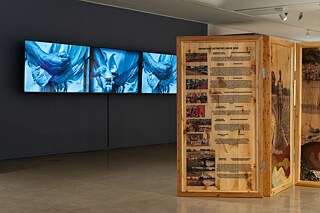


House of Opaque Water
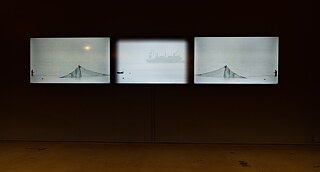
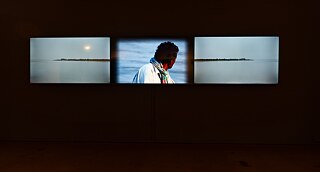
3 channels on 65” LED monitors 10 min 33 sec
2012
After a long careful look, the man says, "This is my home”…”Our cows grazed by the Banyan tree.”…"over there was a tree which fell in a storm and the children played amongst its branches”. We see nothing…he is in the midst of the sea.
The islands of the Sundarbans in Bengal, home to the world's largest mangrove forest, are being swallowed by the ever rising sea-level due to global warming and other man-made calamities.
Sheikh Lal Mohan, whose name is a curious mix of muslim and hindu names, took us to the spot on the sea under which lies his submerged village.
He now lives on another island, Sagardweep, and has returned to the site of his abyssal village. But there is no true returning. In a ritual of reclamation, he sculpts a mud map of his village and house as a healing rite. We follow him and enter a feverish dream of loss and desire.
In a kind of overflow from reality, invented events are enacted in fictive spaces which project the imaginary interiority of the protagonist. Binaries of art and documentary are dissolved to point to another kind of truth which goes beyond the informational. My engagement with the man and the island was about being-in-the-world and of opening the world. The man and the island becoming a portal into the rest of the world.
Two wide screen-panels placed far apart on the floor and the third projection in the middle on a wall between them create an immersive ambient with sound.
Note: The seed for this installation was a passage in "Mean Sea Level" by environmentalist/activist Pradip Saha.
Location: Gallery MMB, Goethe-Institut / Max Mueller Bhavan Mumbai
About the artist

"Ranbir Kaleka has worked both in Britain and India. Across the three and half decades decades of his artistic activity, he has produced both a remarkable body of paintings, vibrant with phantasmagoria and epic disquiet, as well as a body of trans-media works that combine conceptualist sophistication with a calibrated opulence of image." Ranjit Hoskote.
Ranbir Kaleka’s work reflects a view of the world that is highly internalised and appears to place much reliance on the juxtaposition of improbabilities. In iterations of figurative painting and sculpture the relationship with the metaphysical and surrealist imagination is oblique rather than direct; he incorporates personal experience with wider and more general issues. A later body of work sees him as a painter of expressionist fabulism. Kaleka’s movement into video art, in which he projected video onto a painted canvas, has been an essential endeavour in his further exploration of the ‘psychological event’, one which can take place only outside the physical confines of the frame of the painting, through the use of light to create the image and the subsequent aura of the image. Kaleka has also created and exhibited constructed photographs, sculptures and installations. From his early years on, his work has been honored with various awards, exhibited in major cities of the world and collected by museums, institutions and private collectors in India and abroad.