Past Projects

Black and White photo of institut in Germany © Michael Friedel

As the Goethe-Institut, we promote culture, language and dialogue worldwide. Here we present selected projects from recent years – from exhibitions and residencies to digital formats. They reflect our commitment to cultural diversity and international collaboration.
  • Dance

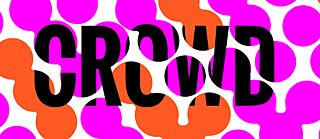
    CROWD – International Dance Exchange

    CROWD - international dance exchange is a collaborative network of dance organisations, which seeks to support dance artists who engage with communities as part of their practice.

    The logo for the CROWD dance residency © Goethe-Institut London © Goethe-Institut London

  • Literature / EUNIC London Cluster and Literature Wales

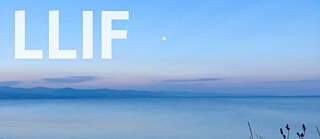
    LLIF Residency with Literature Wales

    German writer, Kristin Höller joined a group of 14 European writers to collaborate during a creative retreat with Literature Wales in May 2025. The retreat focused on themes of ecology, the climate emergency, and community with a specific emphasis on minority languages and dialects, culminating with a presentation at Hay Festival as well as in London.
     

    LLIF Residency © 2025 Literature Wales © 2025 Literature Wales

  • Journalism/Writing

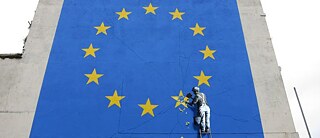
    (Re-)Collecting Europe

    This residency invites two journalists from European countries to investigate, question, debate and reflect on the impact of Brexit on the British civil society.


    Street art by Banksy: a man on a ladder chiselling away at one of the stars on the European flag. © dullhunk © dullhunk

  • Art and Technology

    Generation A Residency

    With the AI Residency Programme we aim to initiate both a dialogue between art and technology and a dialogue reaching beyond the borders of European countries. The programme aims to promote artistic access to developments in the field of artificial intelligence.

    Cartoon of Generation A © Lena Ziyal © Lena Ziyal

  • Digital Residencies

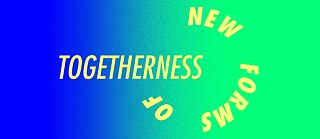
    New Forms of Togetherness

    Consisting of three online artist residencies, this programme generates an interdisciplinary discourse between artists and partners around the topic of Artificial Intelligence.
     

    New Forms of Togetherness © studio Nüssli+Nuessli © studio Nüssli+Nuessli

  • Visual Art/Design

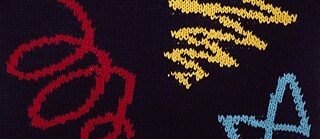
    Goethe V&A Residency

    Selected artists work with the V&A’s collection exploring a particular topic in this design residency of two to six months.
     

    Close-up image of a knitted pullover with a red spiral and a yellow and blue zig-zag pattern © Victoria and Albert Museum, London © Victoria and Albert Museum, London

  • Film/Moving Image

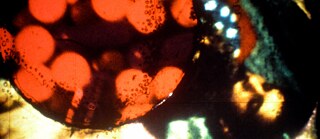
    Goethe@LUX Residency

    This three-month long residency offers artists working with the moving image to investigate LUX’s collection in London and Glasgow.


    Freeze frame of an artistically stylised moving image collage: a ball with red circles and a man's face © Luther Price © Luther Price

  • Digital Technologies

    Goethe/SPACE Residenz

    Since its inception in 2013, the collaboration between the Goethe-Institut London and SPACE supports artists and projects who explore the critical application of emerging technologies and digitalisation. 
     

    Goethe/SPACE Residency © Clara Jo © Clara Jo

  • Studio Quantum

    An international events and artist-in-residence programme from the Goethe-Institut, exploring emerging quantum technologies through the lens of art.
     

    Quantum London logo with red and black abstract artwork esp51 esp51

Film and Podcast

  • Fokus – Films from Germany 2020

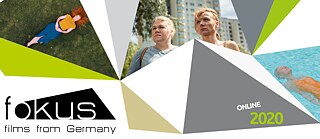
    The 2020 winter season of new films from Germany. Online for the first time, the Glasgow based festival offered a wider distribution of stories between the real and the fictional.

    Festival Banner © Goethe-Institut © Goethe-Institut

  • Talking Culture

    Talking Culture is a platform for thought-provoking discussions about the future of Europe, the UK, and the world. For episode 7, Natalie Taylor, Urban Radicals and Adam Harris talk together about their "SouthKenGreenTrail" installations, which aimed to bring greener infrastructure and more sustainability to London.

  • German Pop - Our Spotify Playlist!

    Oldies, goldies, chart hits and rare gems - we are updating our Spotify playlist every month to satisfy your curiosity and awaken some more! Singing along misheard lyrics is highly recommended!

    Spotify Playlist Teaserbild © Goethe-Institut © Goethe-Institut

Literature and Translation

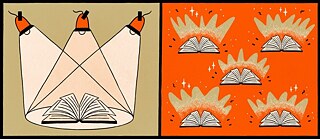
  • Vorzeichen. Whom, What, and How We Read.

    Through online readings and talks at the intersection of scholarship with the literary scene, as well as book reviews on Instagram, the series intends to open up spaces for texts and readers, different ways of reading and new perspectives on literature. 

    Illustration, on the left-hand side you can see an open book against a beige background, illuminated from above by three spotlights. On the right-hand side, the same motif is smaller and can be seen five times on a bright orange background. © Goethe-Institut/ El Boum © Goethe-Institut/ El Boum

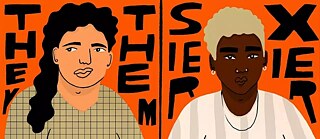
  • Artificially Correct

    With Artificially correct, we are developing a tool with experts that minimises the bias in translations. We want to strengthen the position of translators and a conscious approach to translation machines and include the reality of as many people as possible in them.    

    An illustration of two POC © Goethe-Institut. Illustration: EL BOUM. © Goethe-Institut. Illustration: EL BOUM.

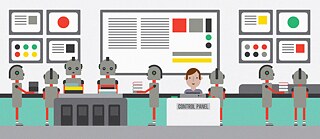
  • A.I. and Literary Translation

    Is Artificial Intelligence advanced enough to grasp and process literary texts in all their linguistic richness, and translate them into another language? Will it ever be advanced enough? Or will it remain "artificial" instead of "artistic"? Perhaps it doesn't have to be perfect to be useful and can work as a tool to support literary translators in their work – Let's ask some experts! 

    Illustration: Several robots carry books through a control room, a human oversees their activities. Philippos Vassiliades | CC-BY-SA Philippos Vassiliades | CC-BY-SA

  • German literature in English translation

    Here you will find an overview of translated publications, information on authors, translators and publishers as well as news from the German literature and book market.

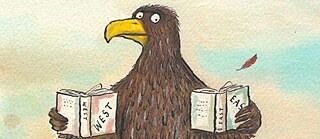
  • German Riveter

    Recommended books by the European Literature Network can be found in our library and in our digital library.

    'The German Riveter' by the European Literature Network © Axel Scheffler © Axel Scheffler

Europe

  • A Victorian Love Story

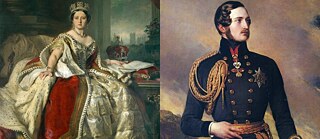
    German is the language of love – no-one would have agreed more than Queen Victoria when she fell head over heels with the Prince Albert of Saxe-Coburg and Gotha. Learn more about the relationship between the two, and why they communicated in German.


    Queen Victoria and Prince Albert © Franz Xaver Winterhalter (1859 | 1842) © Franz Xaver Winterhalter (1859 | 1842)

  • European Songbook

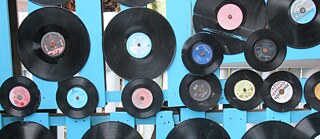
    The European Songbook is a collection of songs that people associate with Europe. As diverse and melodic as Europe itself are the songs and the inhabitants' views about their continent.

    Golden Oldies Foto: © Magda Ehlers Foto: © Magda Ehlers

  • Heirlooms. European Stories

    On the occasion of the European Cultural Heritage Year 2018, we are collecting European “heirlooms” – inventions and accomplishments created in European exchange – an tell their stories

    Heirlooms. European Stories Illustration: Tobias Schrank © Goethe-Institut Illustration: Tobias Schrank © Goethe-Institut

  • Traces of Resistance: A European story

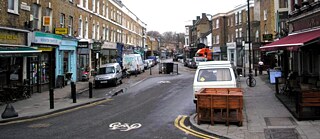
    With populism and nationalism on the rise, Fabian Saul takes to the streets of Europe in search of traces of resistance. His method of choice: Ambling
     

    Hackney Broadway Market © Geograph, Foto: Dr. Neil Clinton © Geograph, Foto: Dr. Neil Clinton

  • The European Project

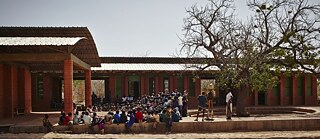
    The debate on how Europe will move forward in these uncertain times.

    Opera Village Africa - School, December 2015 Photo: © Lennart Laberenz Photo: © Lennart Laberenz

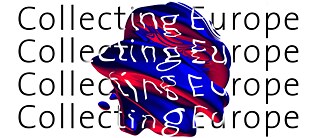
  • Collecting Europe

    In 2017, the Goethe-Institut London and the V&A have commissioned twelve international artists and designers to imagine what Europe might look like 2,000 years from now. How might our present be viewed from the future?

    Collecting Europe visual identity Design: The Beautiful Meme Design: The Beautiful Meme

  • Tell Me About Europe

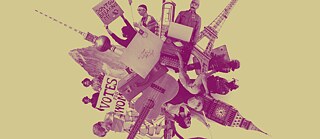
    Europe is more than a continent or an idea. Europe consists of many different stories – personal stories of people from different generations. The project “Tell me about Europe” brings the memories of well-known Europeans alive and invites you to listen and join in the discussion.

    Collage of various people and landmarks of Europe © Groupe Dejour © Groupe Dejour

  • Voices.Europe

    The generation of people born around 1945, from England, France and Italy, are the ones being given a voice in our music and exchange project about the past, present, and future of Europe. The Russian-German composer Michael Langemann has created this Europe-wide musical dialogue for amateur singers and choirs, and other interested people. Voices.Europe can be experienced in both digital and analogue form, on social media and in person.

    Voices.Europe © Goethe Institut, Groupe Dejour © Goethe Institut, Groupe Dejour

  • Europe Talks 2021 - Was Brexit worth it?

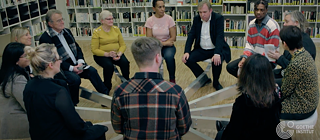
    Europe Talks invites people from all over Europe to engage in cross-border debates to tackle controversial topics such as immigration, the universal basic income and climate change. The project aims to use the power of conversation to create a space for dialogue and fight polarisation. For the 2021 edition we were hosting a discussion on Post-Brexit on our Seat #12 in our library.

    Europe Talks 2021 © Europe Talks © Europe Talks

  • The Disappearing Wall – Belfast

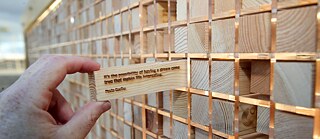
    The interactive art installation Disappearing Wall was set up across Europe between autumn 2020 and spring 2021. Built from 6,000 wooden blocks inscribed with quotes from European high and pop culture, the walls represented the diversity of the continent. Set up in Belfast and 15 other European cities, the pan-European project travelled through overall 10 countries, celebrating the European identity with all its facets of languages and ideas.

    A hand pulls a small wooden block out of a wall that is built out of nothing but small wooden blocks. On the block, the following writing is engraved: "It's the possibility of having a dream come true that makes life interesting. - Paulo Coelho" © Duffy Rafferty © Duffy Rafferty

Cultures of Equality

  • Karl Marx

    Marxist ideas have played a role in film for more than 100 years, since Marx and his ideas are not just to be found in Germany and the world during the bicentennial year 2018. The self-test "How much Marx is in me?" provides facts for your opinion in this anniversary year.

    Michael Thielen is Karl Marx double in Trier. He sits in the garden of the Karl Marx House. Photo: Stefanie Preuin © picture alliance / SZ Photo Photo: Stefanie Preuin © picture alliance / SZ Photo

  • Women Working in Culture Network

    Listen to women in leadership positions, see how they are more and more shaping arts and culture, and follow the discussion topics of this international networking format.

    Frances Morris, Milota Sidorova, Khadija El Bennaoui, Juliette Duret, Alisa Prudnikova © Ana de Matos / Goethe-Institut © Ana de Matos / Goethe-Institut

  • Living Between Town and Country

    How do we want to live? In view of skyrocketing rents and property prices in cities worldwide, this is not so easy to answer.

    Beyond the grey: a different way to live. Photo (detail): © picture alliance / dpa / Jens Wolf Photo (detail): © picture alliance / dpa / Jens Wolf

  • Summer in Germany

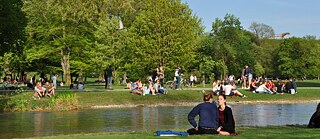
    Summer in Germany means barbecuing by the river, relaxing in the garden and eating ice cream. But who works while we relax?

    A woman plays badminton with her daughter Photo (detail): Svetlana Kerestely © Goethe-Institut Photo (detail): Svetlana Kerestely © Goethe-Institut

  • Freiraum

    A Europe-wide project of the Goethe-Institut asks what is our freedom based on and what endangers it.

    Mann mit Ball Copyright: Caroline Lessire Copyright: Caroline Lessire

  • Freepost

    Anti-liberal, nationalistic and populist movements are gathering momentum around the world.  Can democratic values be protected?

    Freepost © Bernd Struckmeyer © Bernd Struckmeyer

  • Picture Politics

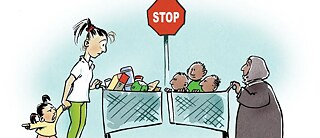
    A joint project of several Goethe-Institutes bringing together comic artists and illustrators dealing with topics like immigration, stereotypes and prejudices about foreignness.

    Picture Politics - Illustration by Lars Jakobsen © Lars Jakobsen © Lars Jakobsen

  • E-MAIL CHAT - YOUTH CLIMATE ACTIVISM

    Two young climate activists exchange their views on different aspects of their engagement and give us an insight into their motivations and thoughts but also let us see their anger and frustration.
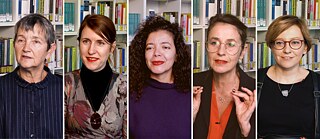
    Young climate activists © Asuka Kähler / Geo Teslaru © Asuka Kähler / Geo Teslaru

  • Dramatic Episodes

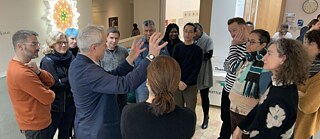
    A workshop series taking place over three years invites twelve theatre and festival directors from across four continents to reflect on the role of theatre in a rapidly changing world. Together they will work on practices that will enable change.

    International theatre and festival directors listen to their guide during an exhibition. © Goethe-Institut © Goethe-Institut
  • This Side of Populism

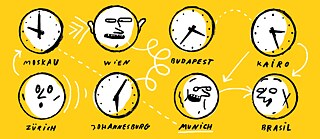
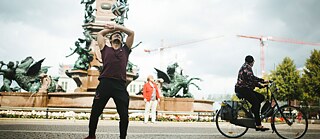
    In global conversations between Budapest, Cairo, Brasilia, Nairobi, Moscow, Salzburg and Zurich we debate common narratives of populists in different countries: Has the “elite” really lost contact with the “people”? What does it really mean to take people’s fears seriously? What is hidden behind the phrase “You still have to be allowed to say that”?

    Zeitgeister © Johanna Benz © Johanna Benz

  • Pop Feminism: Greetings from the Other Side of Self-Empowerment

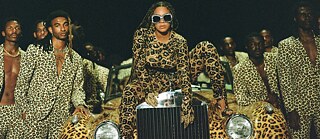
    Do Beyoncé and Netflix feminism really liberate us? And if so, who is this “us”? Our Berlin columnist Margarita Tsomou has written a feminist manifesto in the seclusion of the lockdown. Because everything is closed outside, she takes us into her world of thoughts today

    Beyoncé in a scene from her visual album “Black is King” Photo (detail): Travis Matthews © picture alliance / ASSOCIATED PRESS Photo (detail): Travis Matthews © picture alliance / ASSOCIATED PRESS

Art and Technology

  • The Synthetic Sacred

    A research initiative by Lucy Rose Sollitt and supported by Goethe-Institut London, the Synthetic Sacred explores pathways for ecological restoration amidst hybridity. The notion of the Synthetic Sacred, is both a provocation and an attempt to forge sustainable narratives and practices. Weaving together posthuman and Indigenous knowledge systems, it explores the sacred as a means to heal fractured relations with nature and resist capitalist-colonialist extraction. It proposes the sacred as a framework to guide and detoxify our synthetic creations. In this way, the Synthetic Sacred aims to shift the compass of development away from extraction and exploitation of life and towards restoration, kinship and flourishing.
    Yellow/beige background with orange graphics with project name Nero Nero

  • When AI takes a familiar form

    Learning to live with robots

    How are new technologies such as robotics impacting our educational and cultural experiences in the UK and beyond? And how does culture impact how we adopt new technologies into our everyday lives? 

    Cartoon of a robot walking dogs © Goethe Institut London. Illustration: Carlos D'Agaro. © Goethe Institut London. Illustration: Carlos D'Agaro.

  • Interviews, articles and videos

    #Heritage_digitised

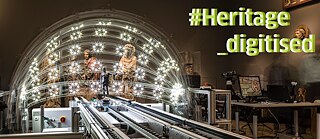
    How can cultural heritage be preserved digitally? With #Heritage_digitised we delve into discourses surrounding the digitisation of art and cultural heritage to ask what does this imply for narratives around postcolonialism, sustainability, representation and diversity? 

    Automated Scanning Technology for 3D Digitisation © Public domain © Public domain

  • Design

    Bauhaus

    Walter Gropius founded the Bauhaus in 1919 – and in doing so revolutionised architecture, design and the way we think about it. What influence does this art school have today?

    Neues Bauhaus in Dessau Photo (detail): commons.wikimedia.org/wiki/User:Lelikro Photo (detail): commons.wikimedia.org/wiki/User:Lelikro

  • Fading Memories

    Privacy and data ownership in the digital age.

    Fading Memroies - Key image © Goethe-Institut. Design: Heike Sinn © Goethe-Institut. Design: Heike Sinn

  • Mapping the Weather in Arts & Science

    The project is an interdisciplinary research in the region of North-West Europe. Through hackathons, artistic research and a concluding symposium it explores the questions of how weather and climate change are experienced and how we communicate about them.

    Weather Glass or Crystal Ball? © Goethe-Institut, LABLAB © Goethe-Institut, LABLAB

  • Generations

    Kultursymposium Weimar

    The Kultursymposium Weimar is a festival for new networks and ideas. Every two years, the Goethe-Institut invites over five hundred people from all over the world to come together in Weimar to attend the event. 

    Logo von Kultursymposium © Goethe-Institut © Goethe-Institut

  • Caught between euphoria and despair

    Ebooks, smartphone apps and online reading platforms: The digital publishing world is vibrant and colourful, but remains a niche.

    The book is dead; long live the book, which has survived every swan song so far. Photo (detail): © picture alliance/dpa/Jens Kalaene Photo (detail): © picture alliance/dpa/Jens Kalaene

  • Installations

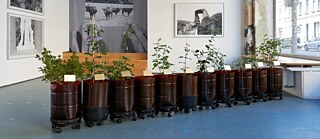
    #SouthKenGreenTrail: Green Interventions

    Many people would like to emerge from the pandemic with a different attitude to nature - one that values repair and protection, and addresses global exploitation and destruction. We have launched a series of artworks and collaborations on this topic. 

  • #DAOWO Sessions - Artworld Prototypes

    How to Prototype the Artworld with Blockchain

    The theme of the DAOWO Sessions: Artworld Prototypes was remarkably relevant to the times we are living: a pandemic prompting us to work with each other differently, calls for a fairer society, art spaces looking for new strategies to remain relevant and the hysterical (or just baffled?) media interest for crypto art. The topic also inserts itself into a broader, much older context in which contemporary art follows market logics that don’t work for most artists.

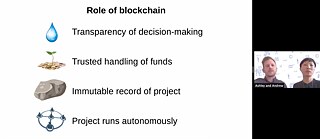
    The Role of Blockchain in the Arts - Ensembl (Hong Kong) - DAOWO © Goethe-Institut © Goethe-Institut

  • #DAOWO Sessions - Artworld Prototypes

    Can Blockchain Democratise Arts Commissioning?

    So far, blockchain systems have been mostly used in the world of finance or supply chain but they have so much more potential. An article about the Berlin contribution to the DAOWO Sessions - Artworld Prototypes: Black Swan DAO.

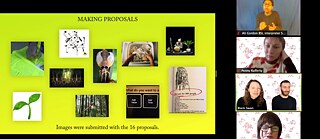
    Screenshot from the “Berlin: Black Swan DAO” Zoom online session, 28 January 2020 © Goethe-Institut © Goethe-Institut

Libraries