The Goethe-Institut / Max Mueller Bhavan offers a bangaloREsidency in collaboration with 1Shanthiroad Studio/Gallery, a reputed atelier in Bangalore with simple, yet pleasant working and living spaces.
Since its inception in 2003, the gallery and residence at 1Shanthiroad have evolved into a popular meeting point for national and international artists. 1Shanthiroad offers a platform for several artists to create installations, performances and exhibitions. It provides space for local artists and a networking hub with international artists. It supports emerging artists from around the world, who want to realise their vision, whereby interaction, creative exchange and the experience with the local art community are integral elements.
As is well known to its large circle of well-wishers, 1Shanthiroad has acted as an eclectic and alternative art and social space for dialogue, discussions and creativity. Since its conception, 1Shanthiroad has supported emerging artists who might otherwise have few opportunities for showcasing their work, as well as nurtured talks and shows by seasoned artists and scholars.
1Shanthiroad’s inclusive and creative approaches have helped it become very rapidly a critical hub for visual culture not only in Bangalore but also within the country and outside, as is evident from the several artists and scholars from the US, Australia, Europe as well as other South Asian countries who have used this residency for creative symbiosis. In the process, 1Shanthiroad has helped challenge and push the boundaries of visual art practice.
The art residencies at 1Shanthiroad support international art exchanges that venture deeper into socio-cultural and emotionally-involved dialogues between the host, local art community and the artist-in-residence. Collaboration, critique and conversation are considered the main building blocks that foster a relationship with and at 1Shanthiroad. 1Shanthiroad is keen to work with artists who are able to react and work in local circumstances, through their intent in the wider field of visual arts.
The Archives at NCBS is a public centre for the history of science in contemporary India that opened in February 2019. It has three main objectives going forward:
continuing to build up archives as spaces to strengthen the commons
a focus on education through archival material and
to build a broader consortium of archives with a discovery layer for the public to find, describe and share archival material and stories.
NCBS is a centre for research and teaching in frontier areas of biology in India. Situated in Bangalore, research at NCBS covers a diverse set of subjects in areas of modern biology ranging in scope from atomic to population level studies.
The campus encourages scientific and cultural interactions by hosting events such as lectures, workshops and exhibitions periodically, thus enhancing the exchange of ideas and knowledge between scholars involved with the programme and the community at large.
Our Artist-in-Residency Programme is an extension of this effort. Artists-in-Residence are free to work with any lab or group on campus. The campus is situated in a lush environment that provides steady support for its residents.
Subscribe to our Newsletter for updates on the next bangaloREsidency.
The Goethe-Institut / Max Mueller Bhavan offers a bangaloREsidency in collaboration with Attakkalari Centre for Movement Arts.
Attakkalari Centre for Movement Arts is India’s premier organisation dedicated to contemporary movement arts. Established in 1992 and based in Bangalore, Attakkalari is led by its Artistic Director, Jayachandran Palazhy. Over more than three decades, the organisation has played a formative role in shaping contemporary dance practice, education and discourse in India through a wide spectrum of programmes. These include education and outreach initiatives, the Diploma in Movement Arts and Pedagogy, Sankshipta, the Incubation Centre for the Arts and Media, research and documentation projects, and NAGARIKA, an archive of Indian somatic traditions and contemporary expressions. Attakkalari also curates the Attakkalari India Biennial and is home to the Attakkalari Dance Company.
Attakkalari has been a long-standing residency host and encourages the invited artist to participate in teaching students of all levels.
Diploma in Movement Arts and Mixed Media
This path-breaking project in the Indian contemporary dance scene, started in September 2006 and is led by eminent national and international artists. The curriculum emphasises vocational skills development and advanced training in various techniques focusing on performance, dance pedagogy, choreography, dance therapy, interdisciplinary studies, aesthetics, dance theory and arts management. The Diploma programme aims to help launch young dance artistes from the South Asia region as performers, choreographers and teachers in the national and international scene.
Building on Attakkalari's tremendous track record, the course is structured to provide overall fitness and body awareness, deeper insight into working with the concepts, principles and techniques of Indian physical and performance traditions as well as contemporary dance idioms, opportunities for research, working knowledge in stage technologies, tools for choreography and teaching.
Certificate Course in Movement Arts and Pedagogy
This unique, comprehensive and professional dance education programme draws from India’s rich physical and performance traditions and combines it with the latest developments in the global contemporary dance scene. It includes inputs in pedagogy, modules in fitness and stage technologies, and an extended apprenticeship. The programme is powered by Attakkalari’s huge expertise and experience gained over the years, through its interdisciplinary networks. Along with equipping young dancers with performance-oriented skills, the programme also aims to provide them with pedagogical training so that they may be able conduct classes on their own in the future. A carefully crafted internship programme at Attakkalari also offers students much needed work experience that helps them build their careers. The emphasis is on introducing students to physical skills and safe practices while nurturing their creativity and providing them in-depth experience in pedagogical methods and strategies.
The Incubation Centre for the Arts and Media (ICAM)
ICAM provides opportunities for artists to engage in transdisciplinary exploration involving dance and performing arts. Leveraging the fast-evolving ecology of creative entrepreneurship of Bangalore and the presence of an increasing number of arts practitioners from diverse backgrounds in the city, ICAM will help to forge creative collaborations and partnerships among artists and organisations. Working with Attakkalari’s national and international partners, ICAM strives to bring artists and resources under a collective umbrella to offer a safe, supportive and encouraging space to engage in creative experimentation leading to prototyping, production and performance of original performance works.
Attakkalari Studios
Attakkalari Studios are fully equipped spacious studios with mirrors, sprung wooden dance floor, and Wifi. We are able to provide technical equipment such as light, sound, camera and projectors. Attakkalari also has an intimate performance space called ‘Rangamandala’ which can host dance, theatre, conference, music, workshop or any other event format. We offer participants active mentoring support and studio space during the development of their work as well as limited production and technical support for the performance outcome. The resulting work may be showcased in Bangalore.
Centre for Innovation in Performing Arts (CIPA)
Attakkalri’s efforts at research, pedagogy, and production finds institutional articulation in the Centre for Innovation in Performing Arts (CIPA). Conceived as a space for interdisciplinary experimentation, CIPA supports research driven projects that bring together performance, technology, design, and critical inquiry. It reflects Attakkalari’s commitment to remaining attentive to contemporary shifts in artistic practice, while grounding innovation in embodied knowledge and process-based thinking. Set on 1.65 acres by a serene lake near Bangalore University, CIPA will become a space where traditional knowledge, contemporary creativity, and new technology come together to shape the future of the performing arts.
Most recent bangaloREsident@Attakkalari Centre for Movement Arts: ♦ Michael Maurissens
Subscribe to our Newsletter for updates on the next bangaloREsidency.
The Goethe-Institut / Max Mueller Bhavan offers a bangaloREsidency in collaboration with Indian Music Experience Museum (IME), India’s first and only interactive music museum.
Nestled in the heart of South Bengaluru, the Indian Music Experience Museum is a non-profit initiative supported by the Brigade Group. It is a part of a thriving ecosystem of public spaces, community centres, residential complexes and a bustling commercial zone.
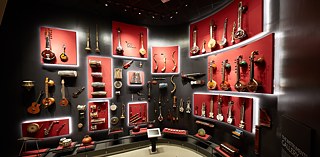
As such, IME is a hub of community and intergenerational activity with community outreach forming a core pillar of the work the museum does. Since opening its doors in 2019, IME has shared the wonder of Indian music in its many forms through its multimedia exhibitions spanning nine galleries, a stunning display of 100+ instruments and memorabilia from renowned Indian musicians, a unique Sound Garden, and several performance spaces. Each year, IME hosts 40-50 public programmes, 2 festivals as well as a Summer Music Discovery programme for young learners. The IME Learning Centre, founded in 2016 before the museum was even built, holds formally structured music and dance classes for all age groups, supporting the development of music lovers, musicians, and music connoisseurs.
For the bangaloResidency programme, we encourage artists and musicians to explore and reinterpret Indian musical heritage through diverse creative and scholarly avenues.
• Create an expression (performing, visual, digital) based on the museum’s collection or ongoing projects – IME provides an enriching and conducive environment for artists to immerse themselves in a musical heritage that is many centuries old and has influences from around the world. This is ideal for artists seeking inspiration from the different forms of Indian music, and to exploring local forms of music traditions and practices. Artists may also pursue research-driven practice and collaborative engagement within IME's ongoing programmes, community initiatives, workshops, and knowledge-sharing platforms as part of the residency experience.
• Interpreting our collection – IME invites musicologists, historians, artists and professionals working in the field of music to interpret the museum’s collection through different lenses to offer new perspectives that may broaden the scope of scholarship around the museum’s collection.
• Digital archive of Indian music – There is abundant material in the museum to spark inspiration and encourage artists in residence to work on project ideas and form collaborations with local musicians for study, research or performances.
• Music across borders – Music knows no borders. There are countless accounts of several path-breaking Indian musicians who have travelled the world and collaborated with international artists to produce seminal works of fusion in the museum. There is ample scope to research and unravel interesting stories on fusion music, the socio-political contexts in which they evolved, the influences they imbibed along the way, and their significance today that could make for a great exhibition, documentary or paper.
Residents are welcome to go through our website and pursue independent project ideas, immerse themselves in cross-cultural musical dialogues, and contribute to a deeper understanding of India’s rich musical traditions within a globally resonant context.
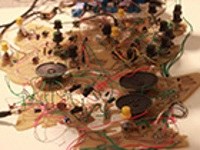
The ISRO is a collective dedicated to the proliferation of creative music and experiments in sound. They are instrument builders and artists. Performances incorporate DIY and home-made instruments made with discarded electronics and other found objects.
Kāṇike— which translates to gift in Kannada — was created in October 2019 by Vivek Muthuramalingam, Indu Antony, Krishanu Chatterjee and Aparna Nori as a space for sustained artistic practice outside institutional frameworks. Conceived as a site for experimentation, dialogue, and material engagement, Kāṇike has continued to evolve with those who inhabit it.
Today, the studio remains anchored by Vivek Muthuramalingam, Indu Antony, and Krishanu Chatterjee, with Nia Thandapani joining the space and expanding its scope into book-making and publication practices. While individual practices remain distinct, the studio values proximity, conversation, and the productive exchange that shared space makes possible.
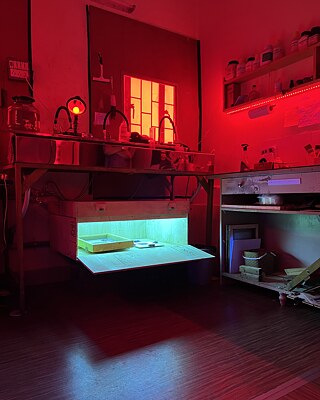
At its core, Kāṇike is committed to slow, material-driven processes. The studio houses a dedicated darkroom designed for alternative and historical photographic printing processes — including cyanotypes, salted paper prints, albumen prints, Van Dyke brown prints, gum bichromates, gum oil and wet plate collodion techniques. Conventional black-and-white and colour film processing and printing are also possible.
Alongside its photographic facilities, the studio maintains a workspace and basic paraphernalia for olfactory art and clay practices, particularly suited for small-scale, hand-built, and experimental work. Artists working with scent and other sensory-based explorations will find an environment supportive of experimentation across material and perceptual boundaries.
With Nia’s presence, Kāṇike also offers mentorship in artist books and book design. Residents interested in developing publications can receive guidance on sequencing, editing, organising content, choosing materials, and thinking of the book as both tactile object and conceptual form.
Kāṇike is located in the quiet, old neighbourhood of Cooke Town. The studio occupies an independent two-floor building with a terrace. Its position — bordered by an upper-middle-class residential enclave on one side and a working-class migrant locality on the other — offers a layered urban context shaped by interdependence, disparity, and everyday negotiation.
A semi-covered section of the terrace can be used for small-scale carpentry, clay work, and material experimentation that benefits from open air. The studio extends across floors and informal working zones, allowing practice to spill beyond fixed boundaries.
Resident artists are offered a dedicated living corner on the first floor within the studio building, with access to a shared washroom and common kitchen.
Profile of our bangaloREsident:
The residency at Kāṇike prioritises sustained engagement with process over rapid production. We do not prescribe outcomes. Instead, we support artists who are attentive — to materials, to context, and to dialogue. Engagement with the surrounding neighbourhood or the city may take many forms: collaboration, research, listening, response, or quiet observation.
Subscribe to our Newsletter for updates on the next bangaloREsidency.
The Goethe-Institut / Max Mueller Bhavan offers a bangaloREsidency in collaboration with Science Gallery Bengaluru (SGB), a not-for-profit public institution for research-based engagement at the intersection of the human, natural, and social sciences, with engineering, art, and design.
SGB is a two way bridge between science and the public. The goal is to provide insights into the processes of knowledge creation in order to enable critical perspectives on science in everyday life. SGB offers everchanging thematic research festivals; learning and mentorship programmes for young adults; and experimental facilities led by artists and scholars with an aim to ask better research questions and imagine shared futures. SGB also draws on the intellectual capital of three of India’s leading research institutions: the Indian Institute of Science is our lead partner, and the National Centre for Biological Sciences and International Center for Theoretical Sciences are our collaborating partners. SGB is Asia's first, India’s only and the world’s largest member of the Global Science Gallery Network which includes sister galleries at King's College London, University of Melbourne, and Tecnológico de Monterrey. SGB looks forward to welcoming the bangaloREsident to their premises in 2026.
Profile of our next bangaloREsident:
We welcome artists working in any medium which includes but is not limited to visual arts, mixed media, sound, video, performance, craft, AR/VR, generative art, game design and socially-engaged art. We are especially interested in artists who are interested in connecting, through the theme of the exhibition-season, with any one or more of our six upcoming experimental spaces — Natural Sciences Lab, Materials Lab, Food Lab, New Media Lab, Black Box Theatre and Humanities Lab. We expect the bangaloREsident to create a public engagement programme for the city in a format of their choice including but not limited to workshops, masterclasses or public talks.
We encourage the artists to document their time in residence in the form of reflective lab notes or journal notes that can be archived as knowledge commons and made available through our commitment to Open Access.
Subscribe to our Newsletter for updates on the next bangaloREsidency.