Word! The Language Column
What Is the Language of Capitalism?
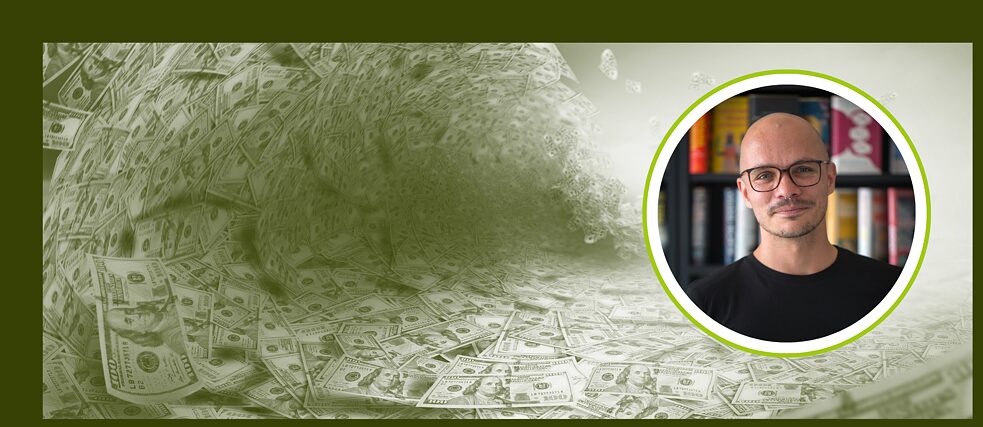
‘Price tsunami’ - when economic events are declared to be forces of nature, political decisions are lost sight of.
|
© mauritius images/ Arda savaşcıoğulları / Alamy / Alamy Stock Photos
Language shapes the way we think — and that includes how we talk about the economy. In his column, Daniel Stähr explores the language of capitalism and shows that it is not a law of nature – but a way of speaking that shapes what we believe to be true.
You may well remember how uncertain the months following Russia’s invasion of Ukraine in February 2022 felt — economically, too. The media spoke of “energy price tsunamis” rolling towards us. Supermarkets warned of “price explosions”, and at petrol stations we were told to brace for “price quakes”. All these metaphors aimed to make one thing clear: inflation was back — and prices were set to soar.
Do prices rise on their own?
Here’s the thing: prices don’t rise by themselves — they are increased. That might sound like hair-splitting, but it has a significant impact on how we perceive the world around us. The prices of electricity, butter or petrol are not natural events that rise automatically, like river levels after heavy rain. Our economy is made by people — and it is people who make active decisions to raise prices. They could just as well choose not to. When we talk about “rising prices” or use metaphors like “price explosion”, we reinforce the misleading notion that people are powerless in the face of economic forces.Together with cultural and literary scholar Simon Sahner, I call this way of talking about economic matters the language of capitalism. By this, we mean a linguistic system that shapes how we speak and think about the economy, and what kinds of stories we use to describe it. The language of capitalism makes our economic system appear as if it were a natural order — and hides the fact that it is ultimately the result of societal choices.
Not a conspiracy — but still a problem
This language is not the result of a conspiracy by investment bankers operating in Wall Street back rooms. Rather, it has developed gradually over the centuries in which capitalism has existed. We live in capitalism; we speak capitalism. And this language comes to the fore especially in times of economic crisis. The term “price explosion” is just one example. The 2008–2009 financial crisis was described as a “perfect storm” — and not by just anyone, but by Olivier Blanchard, then Chief Economist at the International Monetary Fund. And how often did we read that Germany had once again become “the sick man of Europe” due to its economic struggles? All these metaphors shift economic issues into the realm of illness or natural disaster — forces we are usually powerless to resist. But that’s not how our economic system works.I can already hear you sighing: More language policing? Isn’t it enough that we’re debating gender-neutral language and scrutinising our speech for racist expressions? And does it really matter how we talk about economic issues? Well, when I criticise the language of capitalism, what I’m calling for is precision. I want to make it clear that the price increases of 2022 and 2023 were not some inescapable natural disaster. The energy price cap introduced by the German government in 2023 proved exactly that — there are always political alternatives during economic crises.
Are rising costs really to blame?
Let’s return to the inflation crisis of recent years. A common argument is that companies had no choice but to raise prices due to rising costs. But that, too, is misleading. Numerous studies show that companies often take advantage of crises to hike prices far beyond their own increased expenses — and thus expand their profits. The takeaway is clear: prices do not rise on their own. They are actively increased.Word! The Language Column
Our column “Word!” appears every two weeks. Itis dedicated to language – as a cultural and social phenomenon. How does language develop, what attitude do authors have towards “their” language, how does language shape a society? – Changing columnists – people with a professional or other connection to language – follow their personal topics for six consecutive issues.
Our column “Word!” appears every two weeks. Itis dedicated to language – as a cultural and social phenomenon. How does language develop, what attitude do authors have towards “their” language, how does language shape a society? – Changing columnists – people with a professional or other connection to language – follow their personal topics for six consecutive issues.