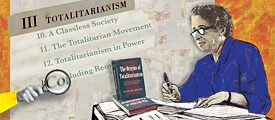
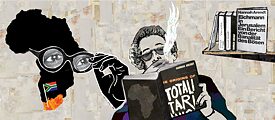
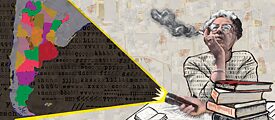
Articles on Hannah Arendt Illustration: © Eléonore Roedel “The Origins of Totalitarianism” The Relevance of Hannah Arendt The disturbing relevance of Arendt's work is well-known. Nowhere is this more evident than in her three-volume work, “The Origins of Totalitarianism”, published in 1951. Illustration: © Eléonore Roedel Marie Luise Knott Hannah Arendt’s Power of Judgement How can we confront the incomprehensible? How can we arrive at a new understanding of the world and politics after the collapse of all certainties? Hannah Arendt asked these questions with an intellectual radicalism that continues to fascinate us to this day. Our leading article on a thinker who still encourages us to think for ourselves. Illustration: © Eléonore Roedel Unfiltered Thoughts The Banality of Smoking Hannah Arendt was a smoker – as countless iconic photographs reveal. Katharina Holzmann asks how this simple ritual shaped the philosopher’s thinking. Illustration: © Eléonore Roedel Thomas Meyer Action as Freedom Hannah Arendt, perhaps the most influential thinker of the 20th century, died 50 years ago. In an interview, philosophy professor Thomas Meyer reveals why her ideas remain so relevant today and how her years in exile shaped this thinking. Illustration: © Eléonore Roedel Life in Paris Eight Rather Happy Years In 1933, Hannah Arendt left Germany and fled to Paris. The eight years she spent there before emigrating to the United States had a profound impact on the life and work of the political theorist. Yet for a long time, researchers largely overlooked this period of her life. Illustration: © Eléonore Roedel Flight and Philosophy An Intellectual Kinship What connects Hannah Arendt and Walter Benjamin beyond their shared exile in Paris? Sigrid Weigel and Uta Staiger explore their intellectual paths and surprising parallels between the two thinkers – and examine why their ideas are more relevant today than ever before. Illustration: © Eléonore Roedel Roger Berkowitz Learning to Think Again Hannah Arendt warned that real thinking demands courage and solitude. In an age of algorithms, outrage, and fear of speaking out, Roger Berkowitz shows why her voice is more urgent than ever and considers whether Arendt would succeed as an influencer today. Illustration: © Eléonore Roedel An Impossible Relationship Hannah Arendt and Martin Heidegger Can you remain loyal to someone who aligned with the Nazis? Hannah Arendt did – and, in the process, wrote a quiet chapter of German postwar history. This was a relationship that tested the very boundaries of thought and morality. Illustration: © Eléonore Roedel Life in New York Places, People, and Intellectual Passages Between exile and arrival, Hannah Arendt found in New York not just refuge, but a stage for her thinking. From cramped rooms to riverside views, the city shaped her intellectual journey — and became the backdrop for some of her most influential work. Illustration: © Eléonore Roedel Letters The many friendships of Hannah Arendt Author Madeleine Thien explores the aspect of Friendship as one of the great and palpable joys of Hannah Arendt’s life. Illustration: © Eléonore Roedel Chen Wei How Loneliness Favours Totalitarian Systems How does loneliness affect modern man – and why is it a breeding ground for totalitarian rule? Chinese philosopher Chen Wei analyses Hannah Arendt's thinking and shows how political participation can counteract withdrawal into private life. Illustration: © Eléonore Roedel A Series Analysis Approaching Arendt's Thinking What do the series Andor and Sense8 have to do with Hannah Arendt’s reflections on the banality of evil? Susann Kabisch and Michael Seemann reveal the fascinating connections. Illustration: © Eléonore Roedel A Critical View The Shortcomings in Political Theory In a time marked by the resurgence of white nationalism, Hannah Arendt’s work on totalitarianism is frequently invoked as a guide to our socio-political crises. From South Africa's perspective, however, reading her work reveals a fundamental paradox. Illustration: © Eléonore Roedel Latin America Right to Have Rights Argentine sociologist Claudia Bacci discusses the enduring relevance of Hannah Arendt's thinking in Latin America and asks who could be considered “stateless ” today. Illustration: © Eléonore Roedel Thinking and Art The Human Condition Today Three artists, Milena Zović, Anja Ranđelović and Emilija Đonin, who were selected to be mentors as part of the “Conditio Humana” programme in Belgrade, discuss how they are inspired by Hannah Arendt's work.