Quick access:

Go directly to content (Alt 1) Go directly to first-level navigation (Alt 2)
Logo Goethe-Institut

Max Mueller Bhavan | India

Life in Paris
Eight Rather Happy Years
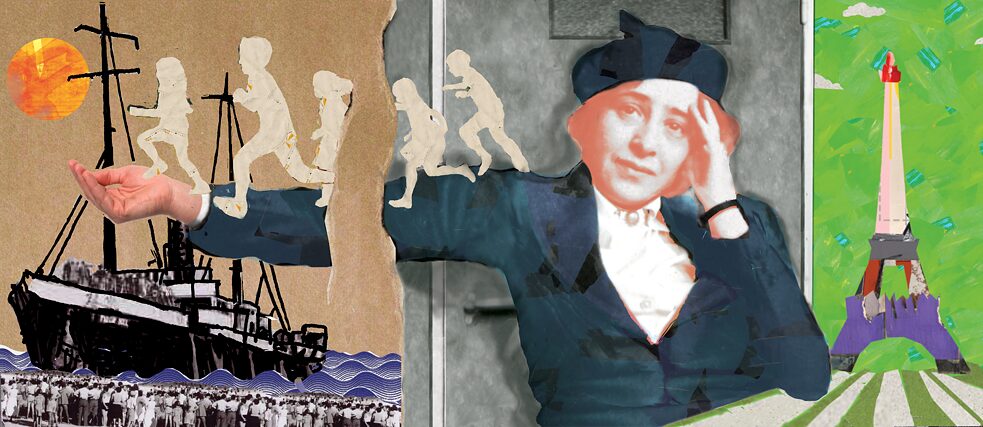
Illustration: Hannah Arendt in Paris
Illustration: © Eléonore Roedel

In 1933, Hannah Arendt left Germany and fled to Paris. The eight years she spent there before emigrating to the United States had a profound impact on the life and work of the political theorist. Yet for a long time, researchers largely overlooked this period of her life.

By Gina Arzdorf

When Hannah Arendt emigrated to Paris in October 1933, she was determined to leave behind for good the academic circles she had moved in during her studies in Marburg and Heidelberg. For the 27-year-old, it was too painful to watch Martin Heidegger – the man who had been both the first great love of her life and a pivotal figure in her philosophical education – embrace National Socialism, joining the Nazi Party in 1933. Confronted with what she saw as betrayal, Arendt resolved never again to “touch any kind of intellectual history”. Years later, in 1964, during her most famous interview with journalist Günter Gaus, she reflected on this turning point: “The personal problem was not what our enemies did, but what our friends did.”

Activist commitment

Indeed, the eight years Hannah Arendt spent in France were not those of contemplation. As the political climate darkened and antisemitism in Germany intensified, mere reflection was no longer an option. She firmly believed: “When one is attacked as a Jew, one must defend oneself as a Jew.” So in Paris, Arendt worked for several Jewish relief organisations whose mission was to prepare young German Jews – arriving in the French capital in the 1930s with little hope for the future – for emigration to Palestine.

For a long time, scholars paid little attention to Arendt’s years of social work, or to her time in France more broadly. Yet what she lived through between October 1933 and May 1941 not only shaped the course of her later life, but also laid the groundwork for her writings in the United States. Her direct experience of antisemitism and its history, which she began to study in Paris, underpin the first chapter of her seminal work, The Origins of Totalitarianism. In France, Arendt also experienced firsthand what it meant to live without freedom. When German troops invaded in May 1940, she was deported as an “enemy alien” to the internment camp at Gurs in southern France, from which she was released a month later. Two years after fleeing to the United States, she recalled in her essay We Refugees how she and her fellow German exiles had “for seven years played the ludicrous role of people trying to be French” – only to be interned as Germans at the outbreak of war, despite having long since lost their German citizenship.

Metaphorical home

Yet just a few months before her unexpected death in 1975, Hannah Arendt described her time in France as “eight long and rather happy years” – despite the many challenges she faced: the struggles to adapt, the impossibility of securing a work permit in Paris or French citizenship, precarious living conditions, financial hardship, the hostility some French citizens towards German immigrants, and ultimately her deportation. If, at the end of her life, she felt a sense of reconciliation with those Paris years, it was undoubtedly shaped, at least in part, by her meeting Heinrich Blücher – the Berlin communist she married in January 1940 at the town hall of the 15th arrondissement, and with whom she would share the rest of her life. Even until his death, she is said to have called him “Monsieur”, a nod to their early years together in Paris, where the couple found a metaphorical home among other exiled German Jews and communists.

South of the Seine

The heart of this community of exiles lay in the districts south of the Seine – the Latin Quarter and the area around Boulevard du Montparnasse – which, during the 1930s, became a refuge for an increasing number of German intellectuals. At Café Le Dôme, a popular gathering place for Paris’s bohemian circles since the early 20th century, not far from Jardin du Luxembourg, one reportedly heard more German than French in 1934. And at 10 Rue Dombasle, also in the southern part of the city, most of the rooms were soon occupied by German tenants. Today, a plaque on the wall of the building commemorates that this was also the home of Walter Benjamin. “Benji” became Hannah Arendt’s closest friend during the Paris years. Despite their existential fears, they shared a deep appreciation for the city’s beauty. Unlike Arendt and Heinrich Blücher, Benjamin was unable to escape to the United States. Denied passage just across the Spanish border, he took his own life. Only days earlier, he had entrusted Arendt with the manuscript of his final work, On the Concept of History. After arriving in New York in May 1941, she dedicated herself to its publication. It was in the United States that Arendt achieved her breakthrough as a writer. She later noted, “I have never in my life loved any people […], I indeed love only my friends” – words that surely reflect, at least in part, the experiences and connections forged during her eight years in France.

Top