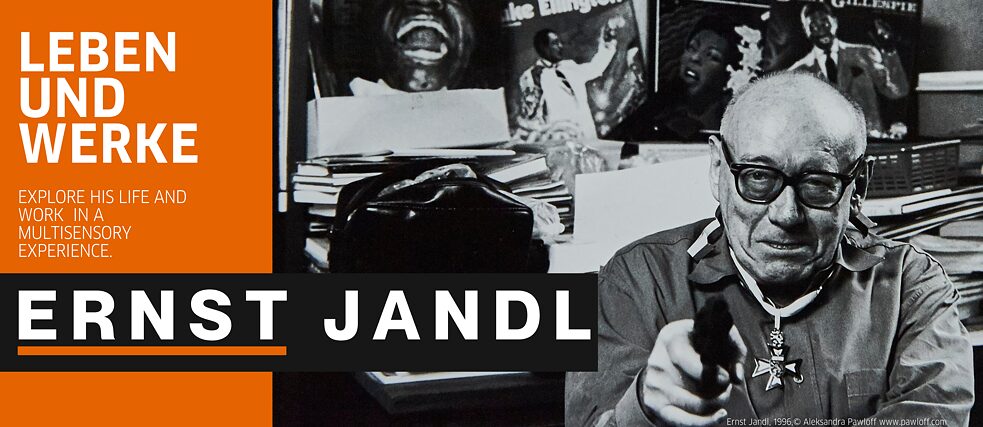
To celebrate the life and work of Ernst Jandl, Goethe-Institut / Max Mueller Bhavan Pune is presenting a special exhibition that brings his poetry to life in a multisensory format. Through 3D installations, soundscapes, visual projections, and artistic interpretations, the exhibition explores Jandl’s groundbreaking use of sound, structure, and space. This initiative is part of the Goethe-Institut’s ongoing efforts to promote German as a foreign language and to celebrate German culture in innovative and engaging ways. Visitors are invited to experience poetry beyond the page—to see, hear, and feel the inventive creativity of Ernst Jandl. Ernst Jandl was a leading figure in the German-speaking world’s concrete poetry movement. His poems challenge conventional reading and reward audiences with layered, multisensory experiences of language.
Concrete poetry is a form in which the visual arrangement of words becomes a key component of meaning. Instead of relying solely on rhyme, rhythm, or metaphor, concrete poets use typography, spacing, and visual structure to convey ideas—often blurring the line between literature and visual art. These works invite readers not only to read the poem but also to see and hear it.
Ernst Jandl
Austrian Poet (1925–2000)
Ernst Jandl was one of Austria’s most influential and innovative poets of the 20th century. Born in Vienna, he studied German and English literature and worked as a schoolteacher before dedicating himself fully to writing. His experiences during World War II—he served briefly in the German army and was held as a prisoner of war—profoundly shaped his later work. Jandl gained recognition for his experimental use of language, often bending and breaking the rules of grammar, spelling, and sound to explore new poetic forms. His best-known poem, schtzngrmm (1957), imitates the sounds of trench warfare using stripped-down phonetic fragments, powerfully evoking the chaos of war. His work frequently combined linguistic playfulness with sharp social commentary. He collaborated closely with fellow poet and life partner Friederike Mayröcker, and together they became central figures in post-war avant-garde literature. Jandl received numerous awards, including the prestigious Georg Büchner Prize in 1984. His legacy endures as a pioneer of sound poetry, performance poetry, and concrete poetry.