Word! The Language Column
Battle at the Frontline
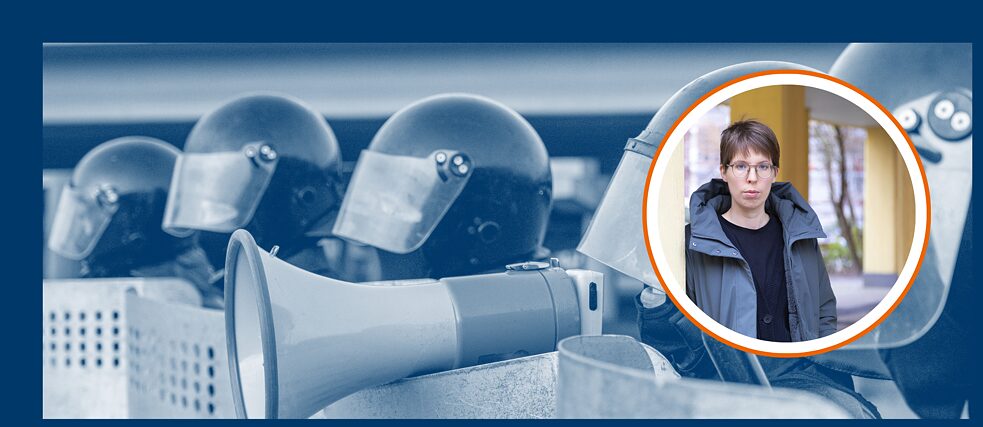
War rhetoric is everywhere - whether in the media, politics or everyday life. Linguistically, too, we are currently arming ourselves. Bettina Wilpert calls for a conscious and careful use of language.
Since the beginning of Russia’s full-scale invasion of Ukraine on February 24, 2022, war has become more present in the minds of Germans than in previous years. This is also reflected in language.
Defense Minister Boris Pistorius says that Germany must once again become “fit for war,” and there is much debate about military buildup, armament, or what in German is often referred to as Wiederaufrüstung (rearmament). But what exactly is meant by this term? Does it refer to the years following World War II or after German reunification? Strictly speaking, the term doesn’t quite apply to the Federal Republic of Germany. During the Cold War, after all, the Bundeswehr formed the largest Western European military force after the U.S. Army.
Watch Your Words
Even in matters that have nothing to do with war, martial rhetoric and war metaphors are widespread. The U.S. increase in tariffs on nearly every country in the world—especially China—is often described in the media as a “trade war” or “tariff war.” Yet even without using those specific terms, the rhetoric sounds similar. In Die Zeit, for example, one reads of an “attack on tariffs,” and Trump is described as being in a state of “attack frenzy.”You’d think language is the core craft of journalists. Yet here, terminology is often used rather loosely. After all, the Duden dictionary defines war as “a major military conflict lasting for an extended period.” Of course, war can be used metaphorically—but in this case, “trade dispute” or “trade conflict” would be more precise.
When Politics Becomes a Battlefield
The current government, too, is engaging in catastrophe rhetoric. There’s talk of “no alternatives” and the “last chance” before the “critical moment”—that is, before the fascists take power. Markus Söder even claimed the new government was “democracy’s last bullet.” Oof. That hits home. Or... hits.Clearly, only one man can help now—a man with “the constitution of a bear”: Friedrich Merz. “In the midst of the perfect political storm,” he “takes the helm,” “bringing with him what’s needed to survive in the ‘death zone.’” Berthold Kohler in the FAZ rolled out the heavy artillery in his May 6th commentary (pardon the metaphor). At the time, Kohler couldn’t have known that Merz wouldn’t be elected chancellor in the first round of voting that very day. Still, he was prescient: “for [Merz] will come under fire from all sides.” Whew. That lands. Or... hits its target.
The conservative press casts Merz as a strongman and pilot in control. Quite a contrast to the language once used to describe Angela Merkel. Early in her career, she was “Kohl’s girl,” later becoming the nation’s “Mutti” (Mom). A little less gender stereotyping would do the political landscape some good.
The Fighting Extends Into Everyday Life
Martial language isn’t limited to war-remote areas like politics and economics—it appears in everyday speech as well. As people get older and face the loss of friends and family members, one often hears the German phrase: „Die Einschläge kommen näher“ – literally, “the impacts (or strikes) are coming closer.” Other common expressions in everyday German include „an vorderster Front kämpfen“ (“to fight on the front lines”) or „jemanden im Stich lassen“ (“to leave someone in the lurch”). The latter comes from medieval combat: if a knight lay on the ground and no one helped him up, he was quite literally left to face the enemy’s thrust alone.The growing use of war rhetoric and metaphors in today’s discourse reflects an increasingly polarized society. Such terms should be chosen with care—they themselves contribute to the escalation of public debate. At the same time, there is genuine reason for concern in the current situation, where the U.S. no longer acts as Europe’s reliable ally as it once did.
When in doubt, stick to the terms: a bear is a bear, a conflict is a conflict, and a war is a war.
Our column “Word!” appears every two weeks. Itis dedicated to language – as a cultural and social phenomenon. How does language develop, what attitude do authors have towards “their” language, how does language shape a society? – Changing columnists – people with a professional or other connection to language – follow their personal topics for six consecutive issues.