Word! The Language Column
What remains of the dialect?
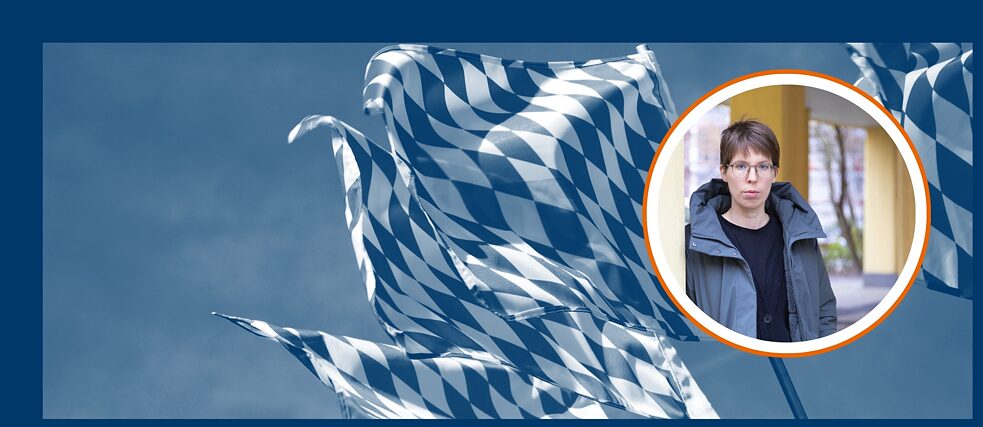
Bettina Wilpert grew up in Bavaria. But she was soon drawn northwards, to Berlin and Leipzig. She is hardly homesick for Bavaria. However, some unique Bavarian words and phrases still accompany her through everyday life.
In the Upper Bavarian province where I grew up, every village has a different name for the time. In Erlbach, for example, we said “quarter past eight”, whereas in Perach the same time was called “quarter nine”, and in Reischach it was called something else.
What Time Is It?
I moved to Berlin after leaving school. There I was usually looked at uncomprehendingly when I spoke of three quarters nine, i.e. 08:45. So I got into the habit of referring to this time as a quarter to nine. I then did my Master's degree in Leipzig. I was finally able to say three quarters to nine again. People from Leipzig and Saxony understood me, newcomers looked confused.After moving away from the Catholic countryside, I was proud that hardly anyone recognised my Bavarian origins. However, I still find it difficult to say the word “Brötchen” (bread roll) to this day. For me, this small pastry is still called “Semmel” in the southern German way. A light-coloured roll is one of my children's favourite foods, otherwise they are very “hoaklig”. In other words, they are fussy when it comes to food. I don't know an equivalent word for this in High German.
Occasionally we visit my mum in Bavaria. Then I quickly fall back into the dialect. It sounds very unfamiliar to my older daughter. She once said to me when I spoke Bavarian to her too: “Mum, please don't speak English to me.”
Only Available in Bavarian
I don't miss Bavaria, but I do miss the Bavarian language – because of very specific terms. One of my favourite Bavarian words is “tramhappad”, which means as much as sleep-drunk, still stuck in a dream – the “tram” – after getting up. Being sleepy is a temporary state. However, a person can stumble through life “tramhappad”.If you translate some Bavarian expressions literally, they turn out to be “false friends”. The words are very similar, but have different meanings in their respective languages. For example, as teenagers we used to go “furt” (to go away) on Friday evenings. But we didn't go out and leave our families, we went out to celebrate – “furtgeh”.
When my daughter turned two years old, I heard my parents say independently of each other: “De Zwoajährigen deaf ma nia ausgeloßn.” Literally translated, this means that you shouldn't let two-year-olds go out. True, young children really shouldn't go to parties. However, something else is meant: going out in this case means something like missing: There should always be enough two-year-olds. My parents meant that a two-year-old is at a very good age: the children are no longer babies, can walk and often speak, but have not yet fully reached the autonomy phase and the tantrums are limited.
Bavarian even has its own subjunctive. “I warad jetzt do” (I'd be there now) is said, for example, when you have turned up on time for an appointment but the other person is still waiting for you. Then you call him or her and announce: “I would be there now.” The Austrian cabaret artist Josef Hader made the Bavarian subjunctive famous in his programme Hader muss weg (Hader must go). He says to his sound man: “Sog ned i warad jetz da, wannst eh da bist.” (Don't say I'm here now when you're here anyway.)
I Prefer Standard German
For other expressions, I am glad that they are not used in the rest of Germany. Interestingly, they are often Bavarian greetings: instead of saying “Guten Tag” (Good day), people in Bavaria greet God – with the phrase “Grüß Gott”. I, for one, have no desire to greet him.As a schoolgirl, I had to take the school bus to the district town every morning. My male classmates usually greeted the bus driver Maddin (Martin) with either “Habedehr” (have the honour) or “Servus’”. Even back then, both sounded strangely outdated. I didn't want to do the sexist bus driver the honour. And “Servus” comes from Latin and means “slave”, as a form of greeting then “I serve you”. With language like that, it's no wonder that Bavaria still values the conservative.
That was my last column. On that note: “I warad jetzt weg” (I would be gone now).
Word! The Language Column
Our column “Word!” appears every two weeks. Itis dedicated to language – as a cultural and social phenomenon. How does language develop, what attitude do authors have towards “their” language, how does language shape a society? – Changing columnists – people with a professional or other connection to language – follow their personal topics for six consecutive issues.