Anne Weber
Epic Annette
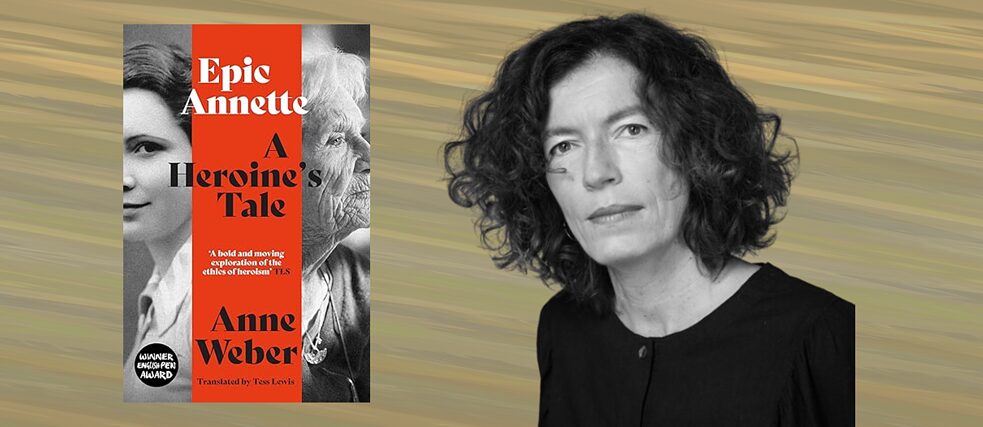
Often some of the most interesting characters in world history never receive the spotlight they deserve. Their legacies are buried under the weight of its heavy vestiges, often overlooked, unsung and forgotten. German-French writer Anne Weber rescued one such revolutionary nack into view and made her the central character of her German Book Prize-winning novel Epic Annette.
By Prathap Nair
Annette Beaumanoir, real-life heroine of Weber’s book, fought in the French resistance against Nazi occupation France and later took part in the struggle for Algerian independence. Part of a secretive resistance network, she sheltered fleeing Jewish families and rescued children from being deported to concentration camps. Once the war ended after the resistance won, Annette found her next calling – France’s colonial occupation of Algeria. Beaumanoir risked her life both times and was prosecuted for her role in the Algerian independence movement.
She joined forces with a French group aiding assistance to the Algerian resistance movement, Front de libération nationale, FLN. After being convicted for her role in the latter, she was sentenced to a ten-year imprisonment. Realising that her life in France as a free woman was over, she fled to Algeria. There she witnessed both the freedom struggle and the - fragile democracy that followed, which lasted only briefly before being toppled.
In Weber’s hands, a somewhat fictionalized account of Annette Beaumanoir extraordinarily eventful life transforms into an epic poem. She writes the novel in free verse, with Beaumanoir in the lead.
According to Weber, she made that decision because in the epic form there have been no women protagonists since time immemorial, and it has only ever eulogized men. “To tell it in free verse gave me the opportunity to appropriate this story not through fictionalising, but through rhythmising,” she says.
Even though the novel’s title is reminiscent of a larger-than-life character, Beaumanoir is an everyday woman in Weber’s telling. A driven, resolute, and tenacious woman who breaks through the cracks of authoritarianism with her kindred spirit and daring actions. In pared down prose, devoid of embellishments, Annette Beaumanoir’s story flows well-paced in the effortlessly fluid English translation of Tess Lewis.
In this interview, Weber tells us how Epic Annette came about.
Is it true that you met the real Annette Beaumanoir, the heroine of the novel, by accident? Could you tell us a little more about the roots of your extraordinary book?
Yes, that was a coincidence. I was invited to a small documentary film festival in the south of France to take part in a panel discussion. Afterwards, the screening, a very old, fragile woman stood up and said, among other things, that she herself had been in the Resistance. I was fascinated that - it was 2017, I think - you still could accidentally meet someone who had been in the Resistance. I also discovered that she had saved the lives of two Jewish children during the Occupation in Paris, when she was barely twenty years old. As a German, this fact touched me enormously, because it connected with a dark chapter of my country’s history.
At the beginning, I didn’t think of writing about her. But I went back to see her a few weeks later. That’s when she told me about an autobiography she had written in French, published by a small press. I bought it and found it fascinating, full of incredible details, though not very elegantly written. It seemed a pity that such a remarkable story had reached so few readers. I thought there might be another way of telling it, and maybe it was up to me to do it.
What is behind your decision to write it in free verse? (Even in translation, this feels like an excellent choice to tell the story of Annette and I want to know how you arrived at that choice)
I was very reluctant to turn this woman into a character in a conventional novel: to paint her story, invent details, create dialogues, put words in her mouth that she never said, as is usually done in novels. Why should I invent something? Her story was already adventurous enough.
Then it occurred to me that there is an ancient form in which the deeds of heroes - so far,
not heroines - are traditionally told, rather in which they are sung: the epic poem. I
based the story on this ancient form, and so it became a heroine’s epic. It’s not poetry, but a narrative with a stronger rhythm than a typical novel. Writing it in free verse gave me the opportunity to appropriate this story not by fictionalising, but by rhythmising.
Can you talk about how you approached balance, critical distance, in writing someone as epic as Annette? Did Annette give you a free rein or was she a constant presence in your writing process?
I was very lucky that Annette trusted me completely. I think that’s a rare attitude.
She chose my free will to write over control. I really appreciate that. Writing an epic, I didn’t have to be very objective. I maintained a certain distance, however with a benevolent approach.
Annette passed away in 2022. What was her reaction to your book? Did she read your French translation?
When I finished the French version of the manuscript, I gave it to her to read. She said:
“It’s fantastic! But it’s not me.” At first, I felt unsettled - she didn’t recognise herself, even though I hadn’t invented anything.
I drew a lot from her own book and our interviews. But after a while, I realized she didn’t see herself as a heroine, and I had turned her life into an epic. Telling someone else’s story is always an appropriation, an interpretation. She had the generosity to understand and accept this.
Later, when the book won the German Book Prize and was translated into many languages, she was incredulous, but I think she was happy. A month before she died, I told her that the book was going to be translated into Chinese. She laughed out loud, and so did I. Neither of us had expected such a success.
About the author
Born in Offenbach in 1964, Anne Weber has lived in Paris as a freelance author and translator since 1983. She has translated works from German into French (including those by Sibylle Lewitscharoff and Wilhelm Genazino) and from French into German (including works by Pierre Michon and Marguerite Duras). She writes her own books in both German and French. Her works have been honored with awards including the Heimito von Doderer Literature Prize, the 3sat Prize, the Kranichstein Literature Prize, the Johann Heinrich Voß Prize, and the Solothurn Literature Prize in 2024. In 2024, she received the Annette von Droste-Hülshoff Prize. For her book *Annette, an Epic of a Heroine*, Anne Weber was awarded the German Book Prize in 2020.

From the Translator’s Note by Tess Lewis, excerpted from Epic Annette:
“Telling Annette’s story in free verse let Weber exploit the tension between the sweeping - historical panorama of the epic and the unusual heroine in the ordinary, individual life of a woman from a humble background. (…) Each language has its particular rhythm and its rules governing word order, and my aim was always to maintain a rhythmic and syntactical flow in English that reads as naturally as both the French and the German versions do. In more than one passage, I took elements from each version and fused them into the English lines.”
