|
6:30 PM
Poetry, Ecology, Intimacy - A reading and conversation with Forrest Gander
State of Nature | Lecture
-
Library MMB, Mumbai

What many of us learned in school about lichen— that it’s an indicator species for pollution (litmus, in fact, is derived from lichen), and that it’s the synergistic alliance of a fungus and algae or cyanobacteria— is largely true, but simplified. If lichen ecology has more to do with collaboration than competition, it’s nevertheless true that collaboration is transformative. With lichen, which some scientists argue may be more related to animals than plants, the original organisms are changed utterly in their compact. They can’t return to what they were. And according to Anne Pringle, one of the leading contemporary mycologists (with whom I had the lucky opportunity to collaborate), it may be that lichen do not, given sufficient nutrients, age.
Anne and other contemporary biologists are saying that our sense of the inevitability of death may be determined by our mammalian orientation. Perhaps some forms of life have “theoretical immortality.” Lichen can reproduce asexually, and when they do, bits of both partners are dispersed together to establish in a new habitat. How long can the partners of a lineage continue to reproduce? No one knows. The thought of two things that merge, mutually altering each other, two things that, intermingled and interactive, become one thing that does not age, brings me to think of the nature of intimacy. Isn’t it often in our most intimate relations that we come to realize that our identity, all identity, is combinatory?
Forrest Gander, a writer and translator with degrees in geology and literature, was born in the Mojave Desert. Awarded the Pulitzer Prize, the Best Translated Book Award, and fellowships from the Guggenheim, Whiting and United States Artists foundations, Gander has most recently published Twice Alive: An Ecology of Intimacies(with an essay by N. Manu Chakravarthy). Gander, who taught at Harvard and Brown University, translates books by poets from Spain, Latin America, and Japan. He is married to the artist Ashwini Bhat.
Forrest Gander will deliver the lecture from Library MMB.
Video recording:
Anne and other contemporary biologists are saying that our sense of the inevitability of death may be determined by our mammalian orientation. Perhaps some forms of life have “theoretical immortality.” Lichen can reproduce asexually, and when they do, bits of both partners are dispersed together to establish in a new habitat. How long can the partners of a lineage continue to reproduce? No one knows. The thought of two things that merge, mutually altering each other, two things that, intermingled and interactive, become one thing that does not age, brings me to think of the nature of intimacy. Isn’t it often in our most intimate relations that we come to realize that our identity, all identity, is combinatory?
About the Speaker
Forrest Gander, a writer and translator with degrees in geology and literature, was born in the Mojave Desert. Awarded the Pulitzer Prize, the Best Translated Book Award, and fellowships from the Guggenheim, Whiting and United States Artists foundations, Gander has most recently published Twice Alive: An Ecology of Intimacies(with an essay by N. Manu Chakravarthy). Gander, who taught at Harvard and Brown University, translates books by poets from Spain, Latin America, and Japan. He is married to the artist Ashwini Bhat.
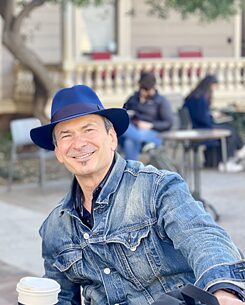
Forrest Gander will deliver the lecture from Library MMB.
Video recording:
Location
Library MMB
Dr Sir J J Modi Memorial Hall, Ground floor, K R Cama Oriental Institute Building
136 Bombay Samachar Marg, Opposite Lion Gate
Fort
Mumbai 400023
India
Dr Sir J J Modi Memorial Hall, Ground floor, K R Cama Oriental Institute Building
136 Bombay Samachar Marg, Opposite Lion Gate
Fort
Mumbai 400023
India
Location
Library MMB
Dr Sir J J Modi Memorial Hall, Ground floor, K R Cama Oriental Institute Building
136 Bombay Samachar Marg, Opposite Lion Gate
Fort
Mumbai 400023
India
Dr Sir J J Modi Memorial Hall, Ground floor, K R Cama Oriental Institute Building
136 Bombay Samachar Marg, Opposite Lion Gate
Fort
Mumbai 400023
India