|
4:30 PM
The Threepenny Opera by G.W.Pabst
Film screening|German Cinema in Focus
-
Goethe-Institut / Max Mueller Bhavan Bangalore, Bangalore
- Language German with English subtitles
- Price Free

We continue in 2024 with our film series German Cinema in Focus curated by Shivani and present to you The Threepenny Opera (1931), directed by G.W. Pabst. This is the last of four films in the sub-section Directors Special, spotlighting G.W. Pabst, one of the masters of early German Cinema.
The Threepenny Opera is an adaptation of a musical theatre of the same name from the Weimar era, created by German playwright Bertolt Brecht and composer Kurt Weill. Set in the destitute backstreets of Victorian London, the story revolves around the underworld kingpin Mackie Messer as he tries to win the affection of Polly Peachum eventually marrying her without the knowledge of her father ‘King of the Beggars’, while also evading pursuit by the authorities.
The film is a satire on capitalism, albeit toned down in comparison to the original play for the sake of marketability, however its core ideologies are very evident in the musical sequences. Similar to many of Pabst’s earlier well acclaimed productions, The Threepenny Opera is deeply infused with political undertones, resonating with the experiences and sentiments of the working class during the Weimar Germany era.
The Threepenny Opera
by Georg Wilhelm Pabst
1931 | b&w | 112 min.| German with English subtitles
Georg Wilhelm Pabst was an Austrian film director who went on to become a very influential German-Language filmmaker. His cinematic works are distinguished by their profound exploration of the human psyche and the depiction of individuals grappling with societal, cultural, and political challenges. His expertise in film editing is also noteworthy, with pioneering contributions such as continuity editing, the utilization of motivated point-of-view shots like the eyeline match, and the shot-reverse-shot technique for constructing dialogues. Furthermore, he enhanced the art of editing during sequences involving dynamic motion.
His films from the late 1920s and 1930s, contain a strong emphasis on the interrelationship between social conditions and the individual delving into how regular people grapple with the political turbulence, economic crises, and ethical decay that collectively contributed to the destabilization of the Weimar Republic. Some of his iconic films include Joyless Street (1925), Secrets of a Soul (1926), Pandora’s Box (1929), Diary of a Lost Girl (1929).
During the early 1930s, he transitioned into creating politically left-leaning films, including notable works like Westfront 1918 (1930), The Threepenny Opera (1931), and Comradeship (1931). However, this phase was short-lived because he was forced to cooperate with the Third Reich in producing propaganda films, which negatively impacted his career. Following the conclusion of the war, Pabst relocated to Vienna and directed films that strongly condemned anti-Semitism that helped restore his reputation. He died in 1967.
The Threepenny Opera is an adaptation of a musical theatre of the same name from the Weimar era, created by German playwright Bertolt Brecht and composer Kurt Weill. Set in the destitute backstreets of Victorian London, the story revolves around the underworld kingpin Mackie Messer as he tries to win the affection of Polly Peachum eventually marrying her without the knowledge of her father ‘King of the Beggars’, while also evading pursuit by the authorities.
The film is a satire on capitalism, albeit toned down in comparison to the original play for the sake of marketability, however its core ideologies are very evident in the musical sequences. Similar to many of Pabst’s earlier well acclaimed productions, The Threepenny Opera is deeply infused with political undertones, resonating with the experiences and sentiments of the working class during the Weimar Germany era.
The Threepenny Opera
by Georg Wilhelm Pabst
1931 | b&w | 112 min.| German with English subtitles
Georg Wilhelm Pabst was an Austrian film director who went on to become a very influential German-Language filmmaker. His cinematic works are distinguished by their profound exploration of the human psyche and the depiction of individuals grappling with societal, cultural, and political challenges. His expertise in film editing is also noteworthy, with pioneering contributions such as continuity editing, the utilization of motivated point-of-view shots like the eyeline match, and the shot-reverse-shot technique for constructing dialogues. Furthermore, he enhanced the art of editing during sequences involving dynamic motion.
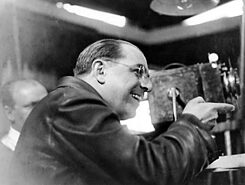
His films from the late 1920s and 1930s, contain a strong emphasis on the interrelationship between social conditions and the individual delving into how regular people grapple with the political turbulence, economic crises, and ethical decay that collectively contributed to the destabilization of the Weimar Republic. Some of his iconic films include Joyless Street (1925), Secrets of a Soul (1926), Pandora’s Box (1929), Diary of a Lost Girl (1929).
During the early 1930s, he transitioned into creating politically left-leaning films, including notable works like Westfront 1918 (1930), The Threepenny Opera (1931), and Comradeship (1931). However, this phase was short-lived because he was forced to cooperate with the Third Reich in producing propaganda films, which negatively impacted his career. Following the conclusion of the war, Pabst relocated to Vienna and directed films that strongly condemned anti-Semitism that helped restore his reputation. He died in 1967.
Location
Goethe-Institut / Max Mueller Bhavan Bangalore
716, CMH Road
Indiranagar 1st Stage
Bangalore 560 038
India
716, CMH Road
Indiranagar 1st Stage
Bangalore 560 038
India
Location
Goethe-Institut / Max Mueller Bhavan Bangalore
716, CMH Road
Indiranagar 1st Stage
Bangalore 560 038
India
716, CMH Road
Indiranagar 1st Stage
Bangalore 560 038
India