Interviews, Artikel und Reden Klaus-Dieter Lehmann
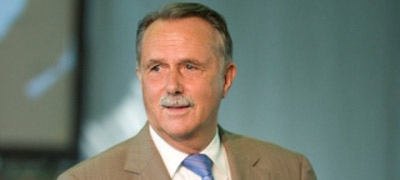
Klaus-Dieter Lehmann, president of the Goethe-Institut (Photo: Goethe-Institut)
21 April 2011
How should we deal with countries that disregard values like democracy, freedom of speech and pluralism? What can cultural dialogue bring about and where are its limits? These questions are currently controversial subjects of debate. Klaus-Dieter Lehmann explains his position in a conversation with Karin Fischer of Deutschlandfunk.
Klaus-Dieter Lehmann, the Chinese government not only affronted Germany with the arrest of Ai Weiwei, but also triggered a vehement cultural policy debate about the limits of cultural policy involvement in dealings with dictatorial regimes. Were the three directors of Germany’s largest and most powerful museums, Michael Eissenhauer, Martin Roth and Klaus Schrenk, too naïve when they planned their Enlightenment exhibition for China?
I do believe that they wanted to convey the impression that they are doing an art exhibition and also intended to restrict it to being an art exhibition. But if you put such an ambitious term as “Enlightenment” in the title, you must have the expectation even in China that goes along with the content. This means that a message was actually part of what was expected of this exhibition and it was not faced. During the first forum, I personally experienced what obliging set phrases and terms were used, like friendship and international understanding. And young Chinese were sitting there with great expectations who naturally wanted to hear a message, too.
Was it completely naïve to believe that they could just exhibit art in the centre of Beijing, on Tiananmen Square, which is symbolic when it comes to violence, in a representational building built for that express purpose and by a German architect? For my ears, it sounds so false, as if they had claimed in advance to actually want to have an effect – to want to carry out a sort of cultural dialogue about values.
You had to get that impression. The exhibition itself is not a bad exhibition. It is well curated, but it naturally has a composition that made the context necessary. In other words the pictures alone, the iconography alone, cannot convey themselves. A context has to be created and that’s why there was and is an event that Mercator is holding over the entire year in forums and salons. It is an integral element and without this mediation for the broader public, for the Chinese people this exhibition is more an example of exoticism than truly a thematically related exhibition sector.
We’ve also heard that this theoretical environment in particular seems managed. That no really critical questions were asked there either. And we learned that the conditions even at the press conference could be called nothing other than totalitarian. The ARD correspondent in Beijing was intimidated prior to the conference by the security police, the Chinese security police. The journalists who travelled along from Germany, travelling at the cost of BMW, were only given tourist visas. This means they were unable to work there with microphones and recorders. One has to say that was something like “embedded journalism.” Can they afford that, the German Foreign Office, which did contribute ten million euros?
It’s a lot of money and it really ought to achieve something. But the thing that matters to me is that the intimidation would not have even been possible if one of these three museum directors on the stage had taken a firm position. No one could have switched that microphone off. And I perceived the expectations, too. I was sitting among the young Chinese who also knew very well what is happening. And so it was irritating to feel as if no position was taken regarding the content, but instead only friendly slogans were being exchanged. It was in a newspaper, Lackner, I think it was, said that was actually more a functionary German spoken and not the German of museum people.
What is your standpoint concerning the demand that was made again this week that the exhibition should be pulled out?
I’m against it, I have to say that very frankly. I am a big advocate of possibilities of making a cultural appearance even in difficult countries. This applies to exhibitions, it also applies to other events. If they pull out now nothing is gained. I think that a year’s duration offers opportunities. They need to pay attention that all that has happened now is taken into consideration and that the organizers of the respective discussion forums are clever and ingenious enough to really keep the subject of the discussion in their own hands. If that doesn’t work then they really ought to disclose the means of censorship that the state is using. A state of this kind shies away from nothing more than when such practices are reported in public.
Now we’ve come to the topic that’s on everyone’s lips again, namely “change through rapprochement.” It’s a very, very old term. Dirk Sager from the German P.E.N. centre says we have two hopeless cases in the world: one is China, the other is Iran. And no one can really say we weren’t aware of it. The very same arguments were held before the Olympic Games in Beijing. Large numbers of regime opposers were arrested, after that nothing changed. We saw the uglier side of China again at the Frankfurt Book Fair where the official delegation refused to tolerate any meddling and any political insinuation. Then there was the Nobel Peace Prize for the writer Liu Xiabo, and then at the very latest perhaps a line should have been or could have been drawn.
I don’t like the term “change through rapprochement,” because ultimately culture is not the instrument in which change can be brought about through rapprochement. Culture is something independent and idiosyncratic. That is why for me, cultural dialogue always means showing one’s own profile, expressing one’s own position. I do not think that we want to get a multicultural process started with it. Instead it’s about getting to know different points of view and stimulating the imagination. To think about things. That’s actually the approach. All of my work as the president of the Goethe-Institut would be thwarted if I didn’t have hope. I have hope for China and also for Iran. It’s just that we create other formats; we don’t make the big grand entrances, but smaller forms. It’s the hard slog, but we are quite successful. The exhibitions that we have held in China, whether the “Kulturquartier 798” or others, were interesting things worth seeing, where we reached people. The entire Arab region is also characterized by very, very intense work in precisely these areas. We trained cultural stakeholders there. There, we were more enablers so that the talented people who had no opportunities in these countries could reveal their abilities, could gain instruments and skills. I see this as a very major, important approach: to solidify culture in countries, to create structures, offer possibilities for dialogue. That’s the main point and I have big hopes in that.
Well, I didn’t assume that you tell your staff members working in such difficult countries: We’re called Goethe; we’re the good guys. But maybe you could use a few examples to explain what at Goethe you’re up against, at the institutes. What difficulties do you have to face, what linguistic rules might need to be complied with, what ultimately works and what might not work.
First of all, as for the attitude at Goethe I would say that we don’t go out and close down at every first affront. That would be wrong. I’ll give you a few examples. In films, we often go to the limits of what censorship will allow. For instance The Lives of Others contains a number of innuendos that are not accepted in many countries. Then, we either include all of that in a film festival in order to neutralize it and so that it not recognized as such by the censors. Or we join forces with a country that is an ally of the critical country to defuse things and be able to work in this country. Another example: in many countries, corruption is a faux-pas word; it cannot even be touched upon. We did a series that concerned corruption but had another name, it was called Growth-impeding factors in emerging economies. It went great; we had a full house.
Where was this?
In the Arab region. I don’t want to name the country now because it’s still in a situation where we would put our own people at risk if I named it. But it illustrates very clearly that linguistic rules can be dealt with very creatively to create such possibilities. The second point is that we deliberately want to give the artists and the cultural professionals opportunities to really make their own possibilities public. In the past three years in Cairo, for example, we trained short filmmakers and documentary filmmakers. Many films that you saw on the Internet came from this school of the Goethe-Institut and in May we will hold a film festival in Berlin with the films that made history. That means we did not stipulate the content, but we made it possible that there are people who can handle the new instruments as video journalists, or as theatre makers, or publishers, and with that suddenly we have a structure in civil society with which we can work.
At the press conference for the Enlightenment exhibition in Beijing critical questions were booed, not by Chinese party members, but by people from the German business delegation. How important are economic relations that the Federal government has in other countries for your work? How much consideration do you have to take when it’s a matter of wording unpleasant truths and how bad is the feeling you have then as a cultural professional?
Well, I personally am very unhappy about this development, because the Goethe-Institut works with industry in very many countries, but with completely different constellations. We, as the Goethe-Institut, made sure that we input our qualities – intercultural competence – as our great strength and industry inputs their qualities. In other words, we don’t let ourselves be instrumentalized, but we do make use of an image of Germany as a whole. For three years we had a Year of Germany in China where we travelled through the big cities of the provinces and we had an audience of millions. And we did also receive relevant expectations formulated by the Chinese censors, which we were, however, able to negotiate so that they did not occur. Industry always stood by us in that. That was exactly this possibility that the assertiveness of industry and the assertiveness of culture as such was a great strength. That’s why I am so appalled about the unfortunate sentences that Martin Roth uttered about the dependence of culture on industry, because that would be the worst thing that could happen to us. Culture is still an independent realm and this independent realm has to be defended with all possible means. Otherwise we cannot employ culture to stimulate dialogues in difficult countries at all.
Culture is an independent realm. Many commentators pointed out that the artist Ai Weiwei embodies exactly these values, which the west exported to China with its Enlightenment show, albeit indirectly, namely the “emergence from self-incurred immaturity.” He’s considered a kind of Joseph Beuys of our times. He is very political. He investigated why so many children died in an earthquake: because the school buildings were badly constructed due to corruption and collapsed on top of them. He was brutally beaten for that. I have to ask you again, Klaus-Dieter Lehmann, what role should culture play? Isn’t it its job to be by all means oppositional and by no means affirmative? Even if the word oppositional is a little out of style, at least in our society.
Yes, I definitely believe that. I believe that culture and in particular the arts have the duty, the mandate, to call things by name in a time when they are not worded in this way in society or also where they are tabooed. Many social developments of recent decades lost their taboos through the arts. This applies to the culture of remembrance, where we in Germany really have much experience and also had to make good for a great deal. But it also applies to developments as those that Ai Weiwei really challenge in a way that I think is great. Like the example you cited with the earthquakes and the children. The number of earthquake victims was known, but what Ai Weiwei gave was to link the names of these children with this number. In other words, he gave the children faces and not just a disaster figure. The humaneness which art embodies in this way – that is such a decisive point. If you consider German artists, why did someone like Neo Rauch or like Baselitz become so interesting to the world? Because they dealt with regimes. Without the totalitarian regimes, Baselitz and Rauch would not have been marked in their artistic subject matter this way. So, in this respect, art is a very decisive field with a political force. Not in the meaning of party politics, but really from an individual form that makes up what Enlightenment also should be: individual responsibility – and the artist here is responsible for society and for social development.
That’s a very interesting thought, Mr. Lehmann, that the totalitarian regime, so to say, is what makes oppositional art possible in the first place. I’ve got a small detail to contribute to that from last week: China not only rejected the accusations and warnings of the west about this violation of human rights, but simply turned the tables and threw them back. The United States government, they said at the weekend, ought to mind its own business, society in the USA is marked by crime, poverty, racism and sexual discrimination, not to mention torturing enemies of the state. From the Chinese viewpoint you have to say that’s relatively plausible. Are we blind or is it enough to be the good guys by living in a democracy?
We’re not the good guys. In other words, in democracy we have our faults as well, and take a look at our Europe, whether it’s the debates about Berlusconi or other things that we face...
...Nationalism in Eastern Europe...
...Nationalism in Eastern Europe, the conflicts in southeastern Europe, etcetera and so forth. In other words, the good guys and the bad guys do not differ by living under certain forms of government, and we also know how weapons get to African states. All of these are things that show that we really ought to mind our own business. However, human rights violations are not negotiable and you cannot just eliminate or compensate injustice with injustice. That’s what it’s about when artists in these respective countries deal with different demands and also pressures, then we have to give them a great deal of credit for that.
But, for you and perhaps also because we are all so globally linked and on principle in the 21st century, boycott is not an option. It happened many times in the 20th century, for example at the Olympics.
Well, I would not accept a cultural boycott by any means, because I truly have a lot of confidence in culture. The things that politics with their formalized instruments or business with its distinct self-interests cannot achieve, art genuinely has possibilities for initiating processes that would otherwise not be possible, and art also always has the opportunity to point out alternatives. I know that cultural dialogue is no cure-all, but cultural dialogue can certainly help when it is done seriously and fairly and openly. Also with our own profiling, that such things can be really helpful and that’s what’s important to me and that is why I would always see a cultural boycott as a very difficult matter.
But, don’t you have to draw the line sometimes? Aren’t there these situations when your staff has to tell a government representative, “This far and no further or we won’t do this or that project, we can’t implement it like that”? Or is your work mainly made up of compromises?
No, not at all by compromises. I would very clearly deny that. These are simply versions that we have set ourselves within our own margins. For example we, as you well know, closed our reading room in North Korea. Why? We had a contract for many years that distinctly stated “No media selection by North Korea, but our own” and “Free entry for North Koreans.” Both were not observed, the consequence being that we closed in North Korea. The second: we held an exhibition in China called “Kunstquartier 798.” They wanted us to remove two works by Lewandowsky. It would have been an amputated exhibition, we negotiated a long time and then decided not to do the exhibition. In other words whenever we are restricted in our own free designing and choice of media, in what we can show on our own premises, or when visitors are chosen according to regime friendly and regime opponents, then that’s where we reach a limit of what is tolerable.
You spoke of intercultural competence earlier and that involves both sides. I’d like to broaden the focus a bit and ask you, do you sometimes detect that we in the west are too condescending, for example towards the values of others? What kind of a role does the neo-colonialism in our minds play, so to say, and the fact that we know we have the best constitution of all time and like to export this and the values of Enlightenment, freedom of speech, human rights, etc. that should belong to the whole world?
Well, I do think that in Europe and also in Germany there is still a distinctly Euro-centric way of thinking. That cannot be denied. On behalf of the Goethe-Institut, although I don’t want to talk about the good guys now, I would perhaps say that for us something was truly groundbreaking. There is a sentence worded, I think in 1970 by Ralf Dahrendorf, who said, “What we give is only worth as much as our willingness to take. Openness to others is therefore the principle of our foreign cultural policy.” That’s exactly what we want to be, a learning community. And this equality and these dialogues are actually practiced by the Goethe-Instituts. I would also like to hope that much of the work done outside, also in the nuances we spoke of in our interview, would become better known in Germany, so that some of this arrogance or ignorance is lessened.
Again briefly back to the general global situation: You operate a network of Goethe-Instituts and therefore also are on site in those countries, in which the power structures are now crumbling. And it causes some pain, also for us intellectuals, that no one could foresee these developments in North Africa. Are we too saturated and also too busy with our own problems, with the exception of the disaster in Japan, to declare our solidarity with the fate of people in other parts of the world?
We are very self-involved and I believe it confuses us that we hear shocking news daily from around the world. This leads to withdrawal. But, it is quite astonishing that Germany’s intellectuals do not take far more distinct positions, for especially what’s said about Maghreb and the Middle East…that’s a development that’s so new for us and surprisingly good! That these are not ideologies emerging, that no Islamism is emerging, but young, cultural intellectuals…that is a wonderful possibility to really seek out opportunities together. Because it is clear they do not want to see themselves as a lost generation and want to seek opportunities. So this means that what we’re seeing here is first of all individualism that certainly also corresponds to our way of thinking. The Goethe-Institut has received many letters from the region recently – when you see these letters and see how strongly these people perceive culture as a factor that made this development possible in the first place, then you think, my God, why aren’t the cultural workers more aggressive in this area? It helps these people immensely and I think that even in such hard times we can ponder theatre, film, all these wonderful things, because culture can also be a weapon.
In other words, Klaus-Dieter Lehmann, you have the feeling that you as the Goethe-Institut helped this process along?
Yes, we make that claim, even if we only had a sideline possibility. But we really had this community around our institutes. The institute in Cairo is only fifty metres from Tahrir Square. Yes, we certainly helped it along by promoting civil societal structures. The Goethe-Institut has become more political and I believe rightly so.
This interview is a transcript of the conversation between Karin Fischer and Klaus-Dieter Lehmann for Deutschlandfunk on 17 April 2011. The interview in its entirety is available as an audio stream on the Deutschlandfunk website.
The relationship between culture and conflict is the subject of the book just published by Steidl-Verlag, Konfliktkulturen, edited by Hans-Georg Knopp and Ronald Grätz, the secretary-generals of the Goethe-Institut and the Institut für Auslandsbeziehungen.