Wolfgang Spahn is an Austrian-German visual artist based in Berlin. His work includes interactive installations, miniature slide paintings and performances of light & sound. His art explores the field of analogue and digital media and focuses on both their contradiction and their correlation. That's why he is also specialised in re-appropriated and re-purposed electronic technologies.
Wolfgang Spahn Spahn's immersive audio-visual performances merge the technically distinct production of images and sounds. In this respect, the data stream of a digital projector becomes audible whereas the sound created by electromagnetic fields of coils and motors is be visualised. Spahn teaches at the Professional Association of Visual Artists in Berlin (BBK-Berlin) and is Associate Lecturer at the University of Paderborn, Department of Media Studies as well as at the University of Oldenburg, Department of Art and Visual Culture.
Spahn has presented his work at national and international exhibitions (Selection):
2000 Biennial of Young Art in Genoa, Italy; 2003 The Kosovo Art Gallery in Pristina, Kosovo; 2005 Biennial in Prague, Czech Republic; 2010 Biennial Of Miniature Art in Serbia; 2010 Media-Scape in Zagreb, Croatia; Musrara Mix 2015, Jerusalem, Israel; Bodenlos – Vilem Flusser und die Künste 2015/16, Akademie der Künste, Berlin.
He was also exhibiting at international Festivals of Media Art (Selection): 2008 and 2009 Internationales Klangkunstfest in Berlin, Germany; 2009 The Art of the Overhead in Malmö, Sweden; PIXEL09 and 15 in Bergen, Norway; Transmediale 2012 and 2014, Berlin, Germany.
Final Report
Overview
The Indian Sonic Research Organisation gave me an opportunity to work as bangaloREsident in Art and Science Lab Bangalore of Srishti University from 8th of April to 16th May 2016. During this period I mainly concentrated on three projects which I partly developed and presented with some scientists and artists from Bangalore. These projects were: a modular synthesizer, an analogue Computer (Strange Attractors) anda music-performance, which a.o. would be based on the technologies mentioned above.
Yashas Shetty (Artists and Head of the Art and Science Lab), Shreyasi Kar (Assistant at the Art and Science Lab) and Dr. David Farris (Indian Institute of Science, Bangalore) were important partners. A big advantage was co-operation from the bangaloREsidentsPaul Affeld and Tobias Daemgen.
In addition to this my stay in Bangalore inspired me to do a photo-project that I developed after coming back to Berlin and will be presenting next year.
The projects in detail:
1. Modular Synthesizer
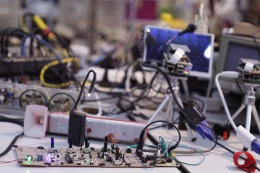
My original idea was to develop an instrument which can produce analogue sounds and additionally can also be used in the class (useful for students and post-graduates). Hence Yashas Shetty and Shreyasi Kar introduced me first of all to the legendary SP Road, a shopping street in Bangalore. Here literally each and every latest electric part is available. But there is a problem – you have to try hard to look for them in the shops and shelves. It would have been very difficult initially to develop the project without the expert guidance. Thanks to the moderate prices it was possible to make the synthesizer cost efficient. This was a crucial factor, because one of my objectives was to enable Indian students reproduction of my model.
‘Strange Attractors’ are entities belonging to the ‘Chaos Theory’. The graphic presentation of these systems is often so fascinating that it remains to be the focus of artistic discussions. The most known example of Strange Attractor is the ‘Lorenz Attractor’. Edward N. Lorenz, the famous American meteorologist described it in 1963 as an ideal-typical model for weather pattern (atmospheric convection). The characteristic of the Chaos Theory is that even the smallest change in the initial value leads to a totally different chaotic behaviour. This allows for infinite variations of similar (but not identical) structures in the artistic presentation.
Wolfgang Spahn The objective of my project was to make an analogue computer that can simulate Strange Attractors. I wanted this simulation to take place in an acoustical manner and not in the graphic form. I often discussed the technical terms with the mathematician Dr. David Ferris, who frequently visited the Art and Science Lab as a guest. These discussions were of immense importance for the understanding of basic principles in mathematics. I was able to launch the first module of the analogue computer already in Bangalore and show the Lorenz Equation. It was an important part of my solo performance at the final presentation ‘On the Rooftop’ for the bangaloREsidency.
3. Music and Performance
The music performances were an outcome of the intensive artistic cooperation with Yashas Shetty and in this respect one of the unexpected, wonderful surprises during my stay in Bangalore. In several Jam-sessions we used our respective artistic concepts of sound / noise and light to fathom the threshold of listening experience and conventional perception of humans.
I was very happy that I could present my solo-piece ‘Entropie’ several times for example at Srishti Old Campus Gallery, Venkatappa Art Gallery (Art Marathon) and ‘On the Rooftop’.
This piece merges analogue and digital techonolgy. Based on the parameters coincidence, chaos and order ‘Entropie’ generates simultaneously structured noise as well as abstract light patterns.
4. Fotography
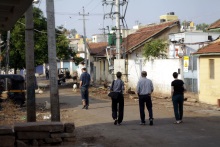
The idea to do a project that focuses on the contrast between the historical city and the new technology initiated during a trip to Mysore, organized by the Goethe-Institut Bangalore. The first digital photos of the happenings on the streets were taken while walking through the ‘old village’ in the early mornings. These pictures are to be seen analogue as a contrast with the coloured transparencies. These colour transparencies provide the basis for the ‘Art of Painting on Transparencies’, which is inspired by the ‘Miniature Painting’ by Mysore School. The Goethe-Institut arranged for an excursion to the Mysore School and I was lucky to see the private collection and even take photos. Thanks to this excursion I could work in detail on the mythological motives used there.
Vote of Thanks
I thank the Art and Science Lab, Bangalore for inviting me, supporting me in every aspect and making my stay comfortable and pleasant. My special thanks go to Yashas Shetty and Shreyasi Kar. I also wish to thank the Goethe-Institut Bangalore for financing my stay and organising everything extremely well. Many thanks especially to Christoph Bertrams and Maureen Gonsalves who introduced me and the other bangaloREsidents to the cultural scene in Bangalore and gave us various opportunities to showcase our art in different fields.
Additionally I also wish to express my gratitude to Dr. David Ferris for inspiring discussions and the scientific know-how. I was happy that he visited me in Berlin.
To all other bangaloREsidents – thanks a lot for an inspiring time together.